
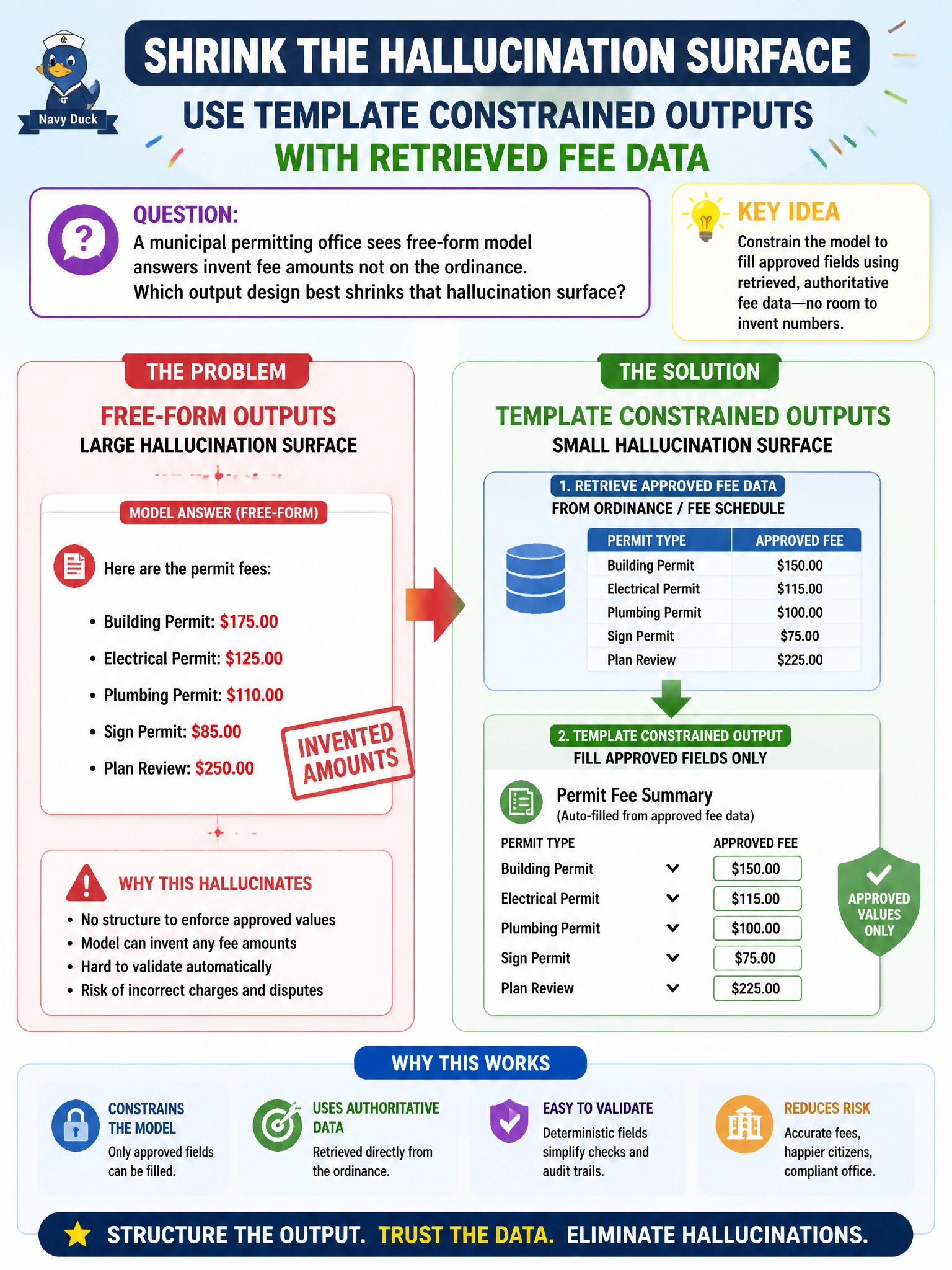
A municipal permitting office sees free-form model answers invent fee amounts not on the ordinance. Which output design best shrinks that hallucination surface?
Select an answer to reveal the explanation.
Short Explanation
Free-form answers are an open highway for made-up fees. Templated fields—“fee code,” “amount from schedule,” “source citation”—force the model into a narrow lane fed by retrieved ordinance data.
Full Explanation
Free-form narrative answers give a permitting model a wide surface to invent fee amounts that are not in the ordinance. Output design that templates constrained fields—fee code, amount drawn from retrieved schedule rows, effective date, unit basis, and source citation—forces the model to fill approved slots from retrieved fee data instead of composing plausible-sounding dollar figures. Structure plus grounding shrinks the hallucination surface for municipal fee guidance while keeping answers consistent for counter staff and residents who compare quotes.
Encouraging long essays with no fixed fields maximizes invention and makes automated checks nearly impossible. Allowing any plausible fee abandons legal accuracy and can create unequal treatment across applicants. Removing dollar signs so staff cannot notice wrong amounts deliberately impairs human review; obscuring currency is not a mitigation and conflicts with transparent civic fee communication.
Exam caveat: templates reduce free-form error but still fail if retrieval returns the wrong schedule row, if the ordinance changed and the index is stale, or if staff skip a quick visual check against the posted schedule. Constrained JSON or form fields are a control layer, not a replacement for the official fee table.
Operational check: query a known permit type, confirm the templated amount matches the ordinance line item exactly including units, then attempt a prompt that asks for a "discounted" or "friendlier" fee—the constrained output should refuse or clearly mark non-schedule amounts rather than invent them, and the citation field should point at the retrieved schedule entry.