
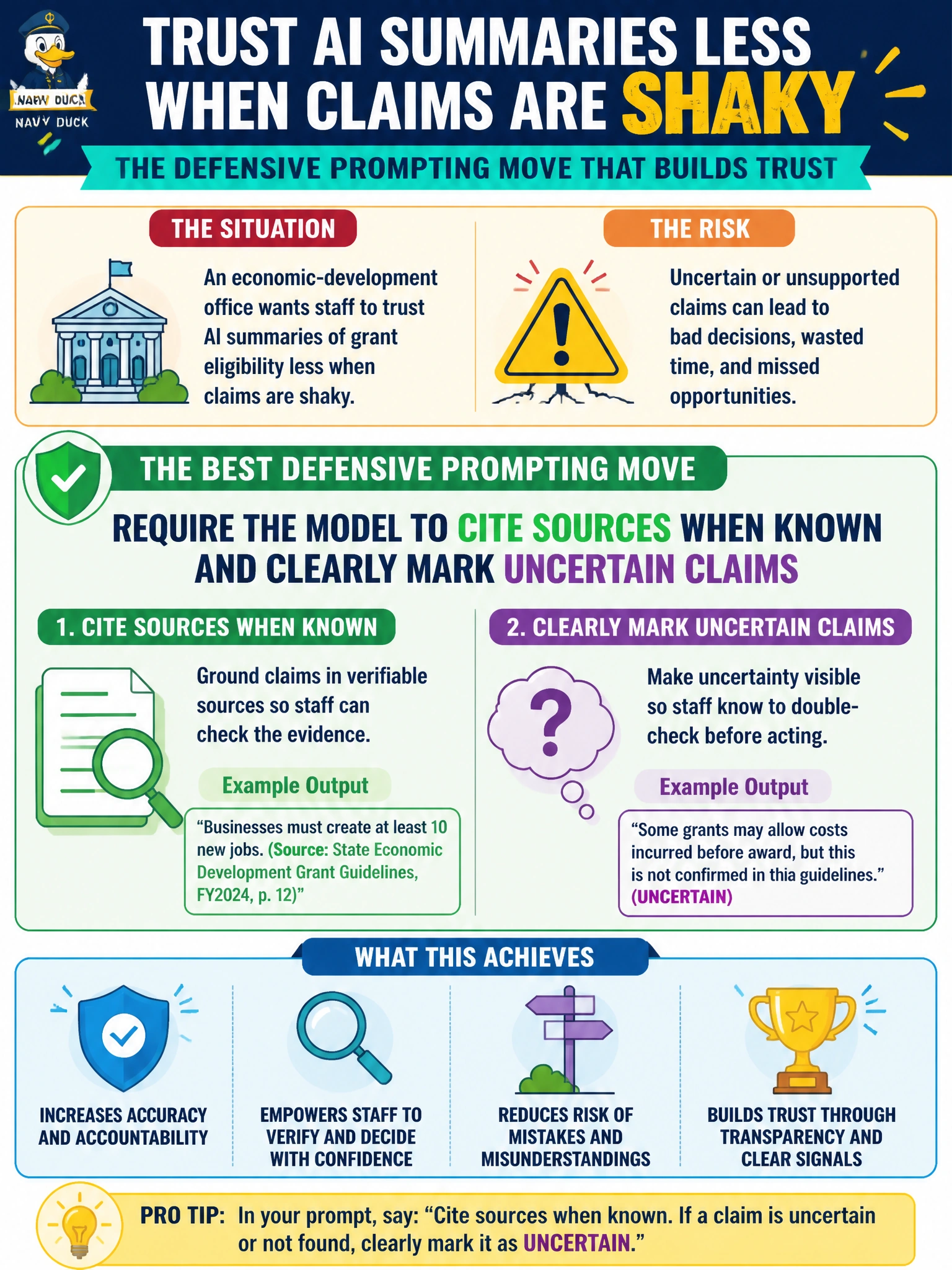
An economic-development office wants staff to trust AI summaries of grant eligibility less when claims are shaky. Which defensive prompting move best supports that?
Select an answer to reveal the explanation.
Short Explanation
Uncertainty labels are like sticky notes on a draft memo: “verified from the NOFO” versus “not sure—check with grants.” Asking the model to cite what it has and flag what it doesn’t keeps economic-development staff from treating guesses as gospel.
Full Explanation
Economic-development staff using AI to summarize grant eligibility need calibrated trust, not false certainty. Defensive prompting that requires citing sources when known and clearly marking uncertain claims turns the model into a transparent draft assistant: verified statements point to the NOFO, FAQ, or eligibility checklist, while gaps are labeled so a human grants officer can verify before advising a business. That practice does not make the model infallible, but it surfaces shaky claims instead of packaging them as settled municipal guidance.
Instructing the model never to mention uncertainty hides risk and encourages overconfident eligibility answers. Rewarding invented citation URLs creates fabricated authority—worse than an honest "unknown." Hiding confidence language so residents cannot question answers undermines accountability and due diligence in public-facing grant counseling.
Exam caveat: citation-and-uncertainty prompting is a disclosure control, not proof that cited text is correctly interpreted; staff must still open the source. Operational check: feed a deliberately incomplete grant excerpt, confirm the assistant flags missing criteria instead of inventing them, and that any citations resolve to real documents in the office’s approved corpus.