
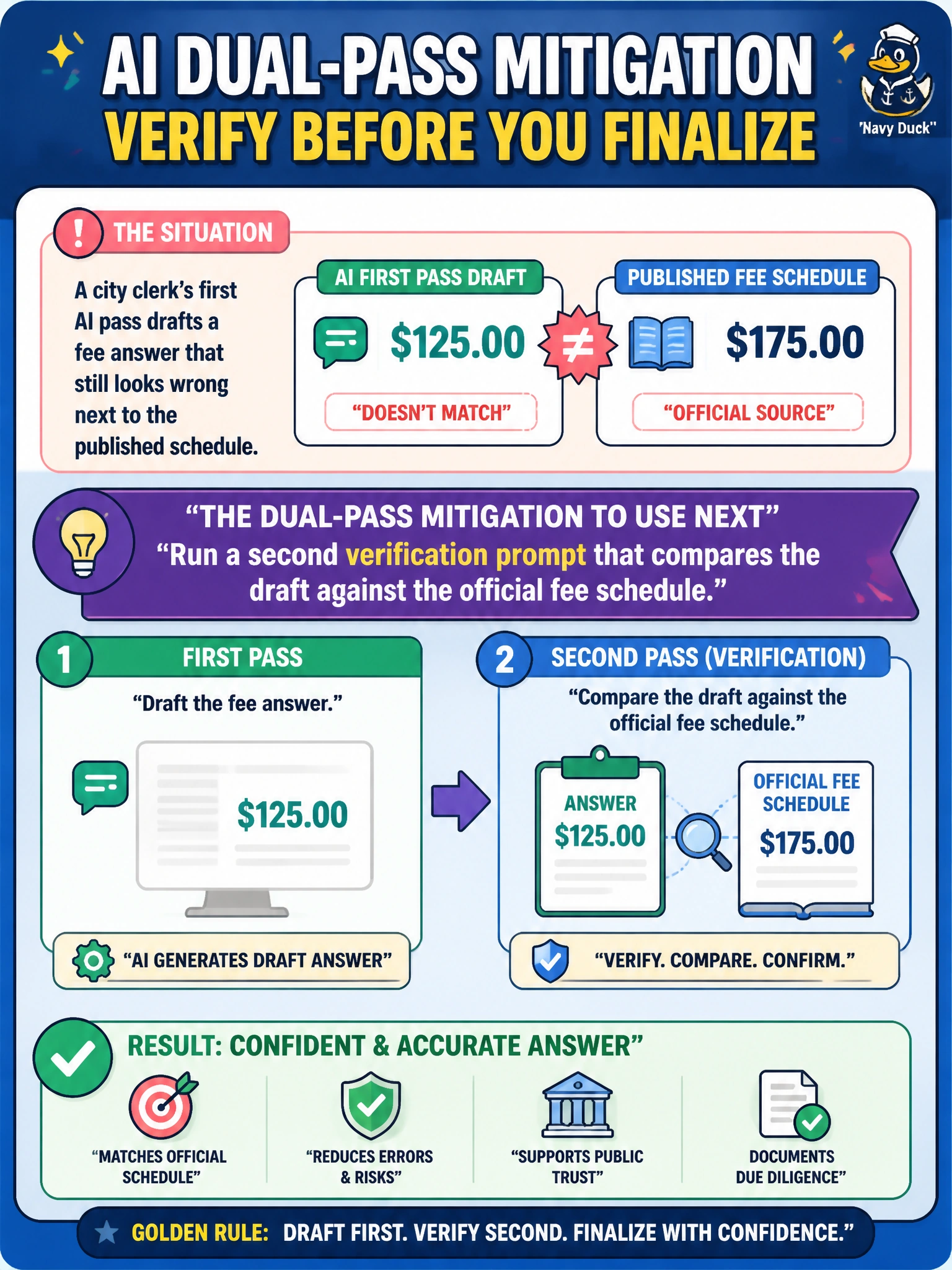
A city clerk’s first AI pass drafts a fee answer that still looks wrong next to the published schedule. What dual-pass mitigation should the clerk use next?
Select an answer to reveal the explanation.
Short Explanation
Treat the first answer like a rough clerk draft, then run a second pass that says “check this against the posted fee schedule.” That dual-pass habit catches invented fees before they leave the counter.
Full Explanation
When a city clerk’s first AI draft of a fee answer disagrees with the published schedule, the mitigation is process, not hope. Dual-pass or verification prompting runs a second step that explicitly compares the draft against the official fee schedule (or ordinance table) and requires correction or refusal where they diverge. The first pass may be useful for tone and structure; the second pass is the accuracy gate before anything leaves the counter. Treating verification as a standard clerk workflow reduces invented fees that create liability and resident distrust.
Publishing the first draft without checking the schedule skips the control entirely. Deleting the fee schedule removes ground truth so contradictions cannot be detected—an anti-pattern. Asking the model to invent a friendlier fee prioritizes popularity over legal rates and invites unequal or unlawful charging.
Exam caveat: a second prompt only helps if the authoritative schedule is actually provided or retrieved; verifying against memory still hallucinates. Operational check: plant a wrong fee in a draft, run the verification pass with the real schedule attached, and confirm the assistant corrects to the published amount and cites the schedule line before the answer is released.