
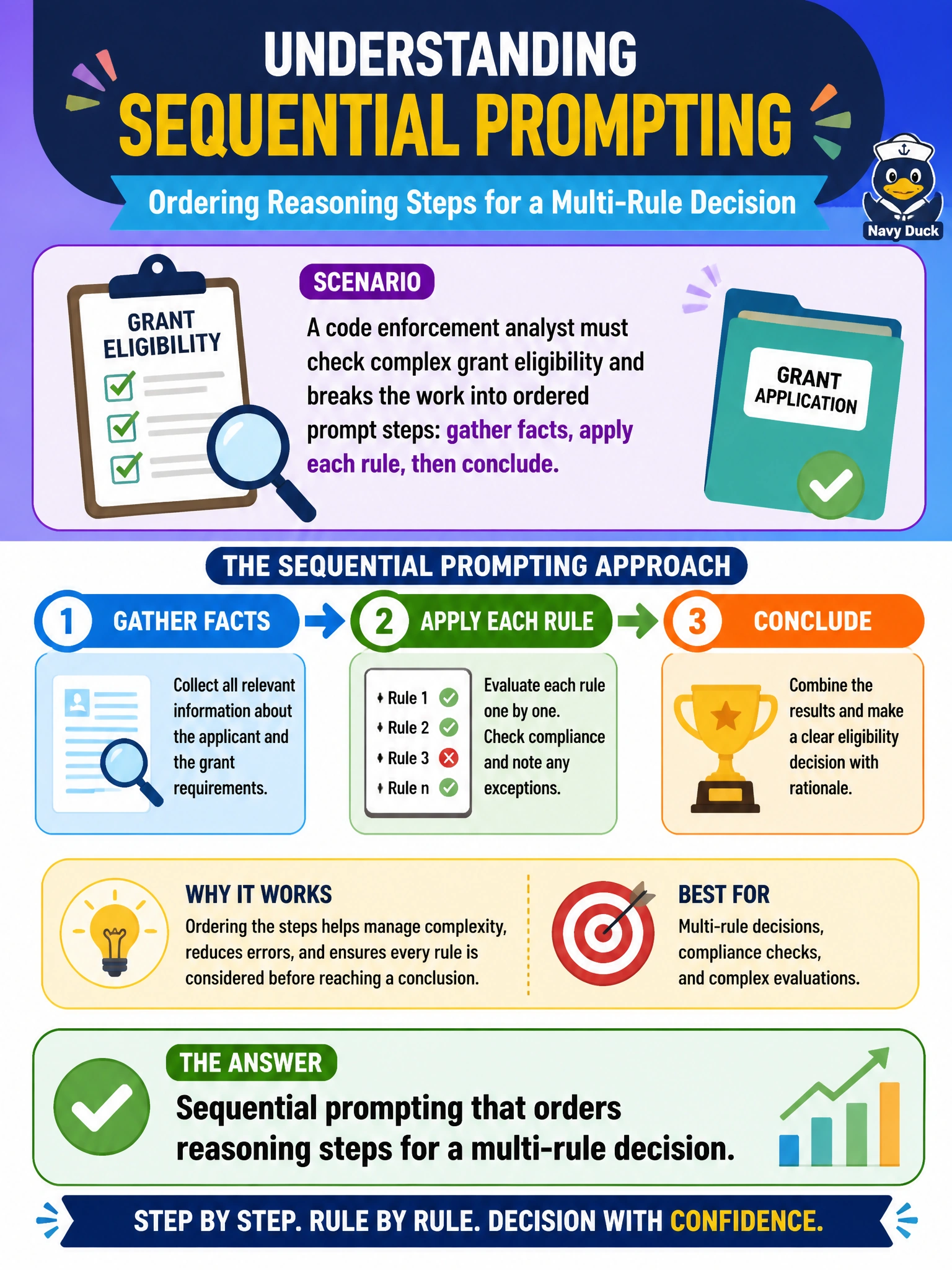
A code enforcement analyst must check complex grant eligibility and breaks the work into ordered prompt steps: gather facts, apply each rule, then conclude. Which prompting approach is this?
Select an answer to reveal the explanation.
Short Explanation
You can treat eligibility like a checklist: gather the facts, apply each rule, then make the call. Sequential prompting keeps that reasoning on track. A jailbreak that skips rules, shuffled rules, or an unrelated image-captioning task would take you away from the eligibility decision.
Full Explanation
Sequential prompting for a multi-rule decision orders the reasoning so facts are gathered, each rule is applied, and a conclusion follows in a controlled sequence. When you check complex grant eligibility, this structure helps because eligibility can depend on several requirements: skipping a residency or income rule can change the outcome. Staging the steps in prompts makes intermediate conclusions visible and auditable for municipal grant work. A single adversarial jailbreak that skips eligibility rules fails by concept: it attempts to evade controls rather than apply the rules legitimately. Randomly shuffling rule order on every run undermines consistency and can change outcomes when rules interact; novelty is not a sound goal for a civic decision. Replacing the rules with an unrelated image-captioning task changes the problem entirely and abandons eligibility logic. Exam caveat: Sequential prompting improves process discipline but cannot supply missing facts. If required documents are absent, the process should request the data or abstain rather than assume eligibility. Practical check: Encode the grant checklist as ordered prompt stages, record the fact bundle and each rule’s pass/fail result, and require a reviewer to confirm every rule citation before issuing the eligibility letter.