
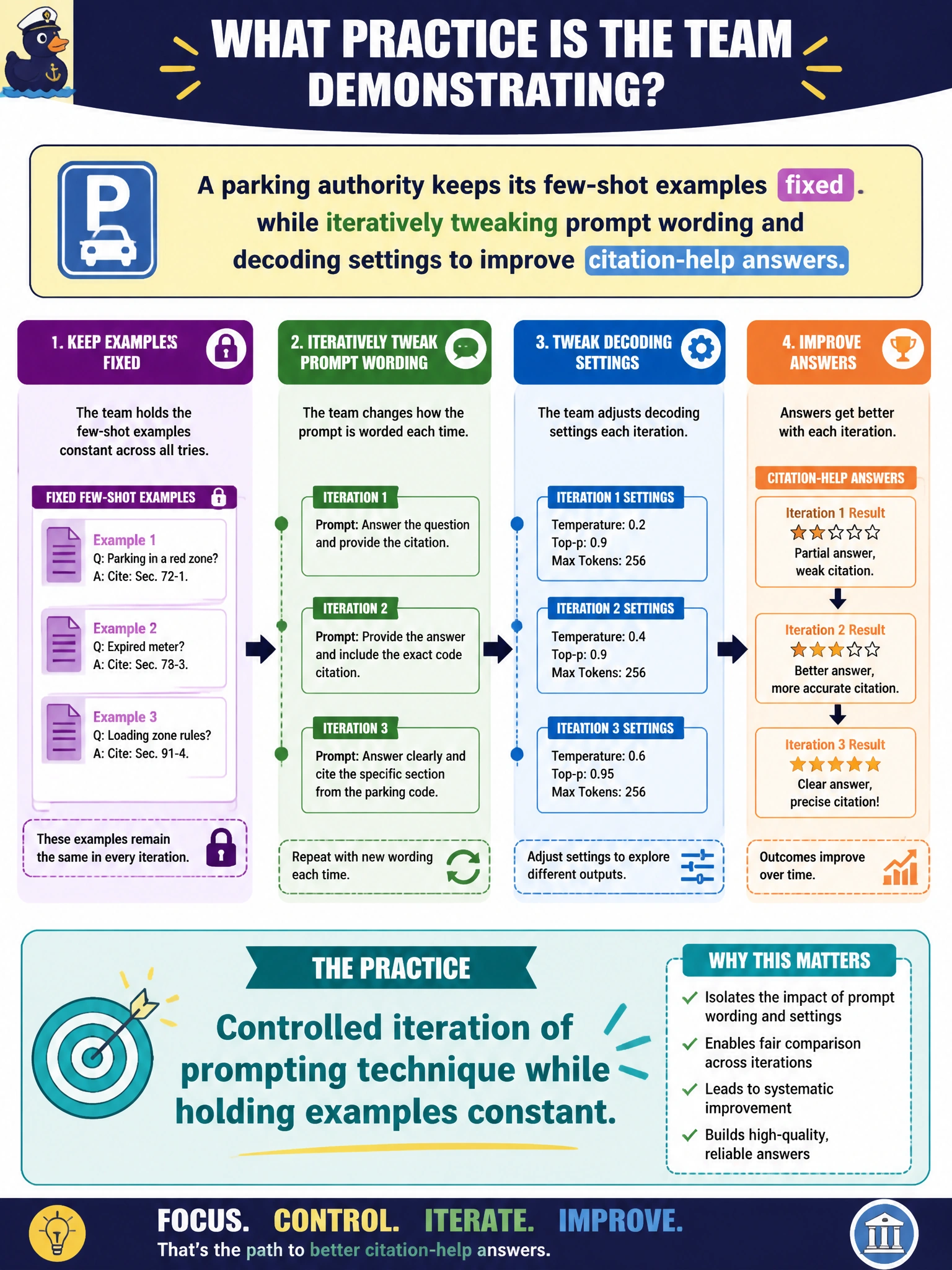
A parking authority keeps its few-shot examples fixed while iteratively tweaking prompt wording and decoding settings to improve citation-help answers. What practice is the team demonstrating?
Select an answer to reveal the explanation.
Short Explanation
Change one dial at a time: keep the good examples glued down, then nudge wording or settings and see what moves. That is controlled iteration, not rebuilding GIS or pasting secrets into the chat.
Full Explanation
Controlled prompt iteration isolates variables: keep few-shot exemplars fixed while adjusting instruction wording or decoding settings so performance changes can be attributed. A parking authority improving citation-help answers demonstrates sound municipal AI operations when it freezes the example set and iteratively tweaks prompt text and decoding parameters. That discipline prevents “everything changed” experiments that cannot be reproduced or audited.
Retraining the city’s entire GIS stack after every chat turn fails by concept: GIS retraining is unrelated to prompt-technique iteration for a citation assistant and is operationally absurd as a per-turn response. Deleting exemplars whenever an answer looks slightly better removes the control variable and can erase the very anchors that stabilize answers. Publishing raw API keys in the prompt for faster iteration is a security failure, not an experimentation method, and exposes municipal credentials.
Exam caveat: Holding exemplars constant is good experimental hygiene, but you must still re-test after model version changes because the same prompt can behave differently on a new model. Decoding tweaks (temperature, top-p) affect variability; lower creativity settings often suit deterministic civic FAQs. Do not confuse prompt iteration with model fine-tuning or infrastructure rebuilds.
Operational check: Version the prompt template, freeze the exemplar block, change one instruction or decoding knob per trial, score a fixed citation-help test set, and promote only the variant that improves metrics without regressions.