
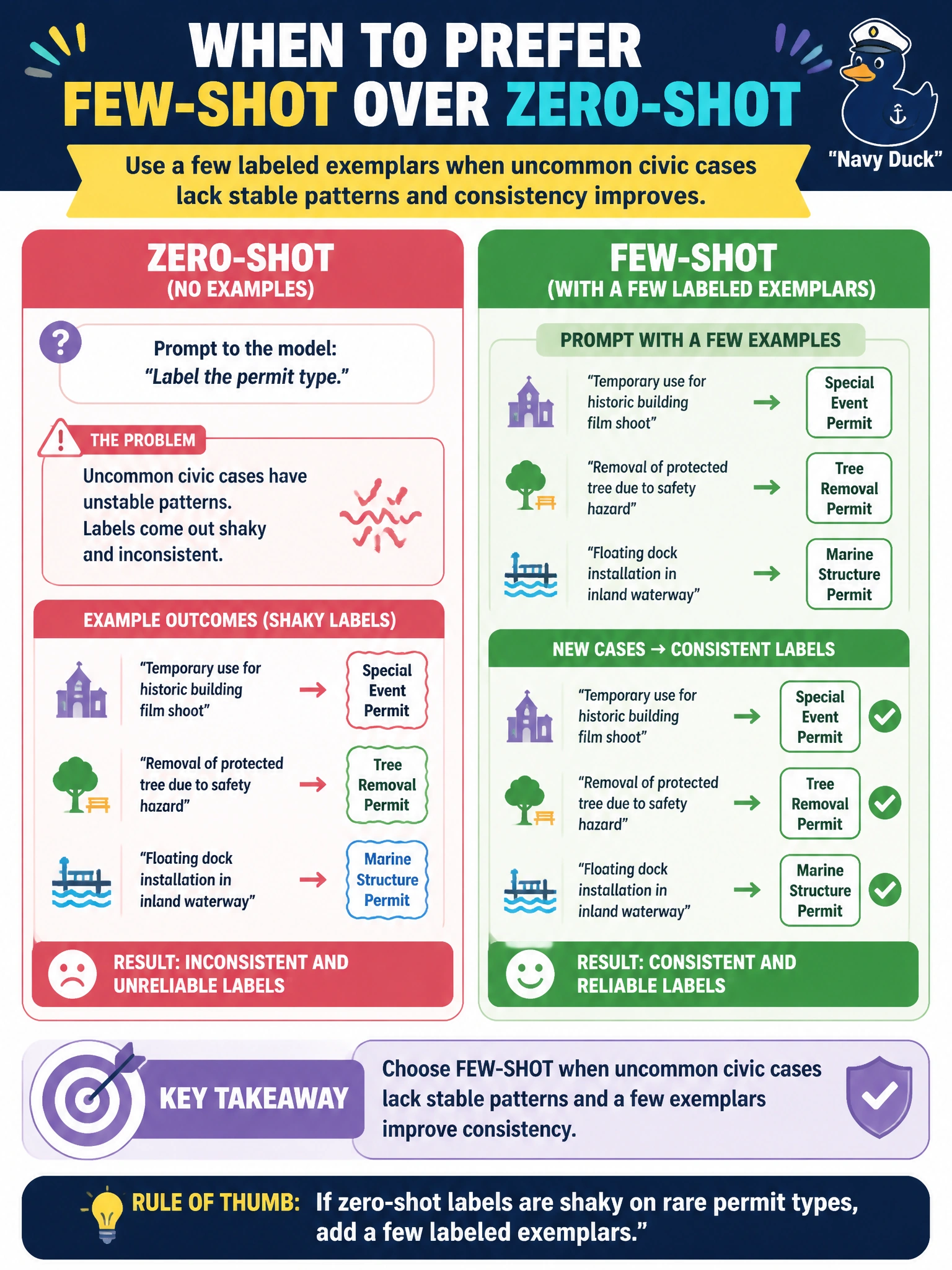
A community development agency sees shaky labels on rare permit types when it asks with no examples, then improves after adding a few labeled exemplars. When should the team prefer few-shot over zero-shot?
Select an answer to reveal the explanation.
Short Explanation
Rare permit types are like uncommon stamps—without a few clear samples, the sorter guesses. A handful of labeled exemplars usually beats a cold zero-shot ask. Calculators, wiping the knowledge base, or ditching policy are not the cue.
Full Explanation
Few-shot prompting is preferable to zero-shot when the task distribution is sparse or idiosyncratic and a few labeled exemplars convey the desired decision boundary. Rare permit types at a community development agency often lack stable patterns in pretraining data, so zero-shot labels wobble; adding a handful of correct exemplars usually stabilizes categorization. Prefer few-shot when examples measurably improve consistency on uncommon civic cases—not as a universal default for every trivial task.
Preferring few-shot whenever the task is pure arithmetic with a calculator already available fails by concept: arithmetic should use tools or deterministic calculators, not example-driven language imitation. Preferring few-shot only after permanently deleting the municipal knowledge base fails because destroying authoritative corpora removes grounding and is unrelated to the zero-shot versus few-shot decision. Preferring few-shot only when the model must ignore every policy constraint fails because examples never authorize discarding safety or legal policy.
Exam caveat: Few-shot helps consistency but can encode bias if exemplars are skewed toward one neighborhood or applicant type. Exemplars also consume context window, so keep them short and representative. On the exam, map “rare or unstable categories improve with examples” to few-shot, and do not confuse that choice with deleting RAG corpora or disabling policy.
Operational check: Hold out a set of uncommon permit labels, compare zero-shot versus three-to-five-shot accuracy on the same cases, keep the exemplar set that lifts consistency, and re-validate after any policy change to permit codes.