
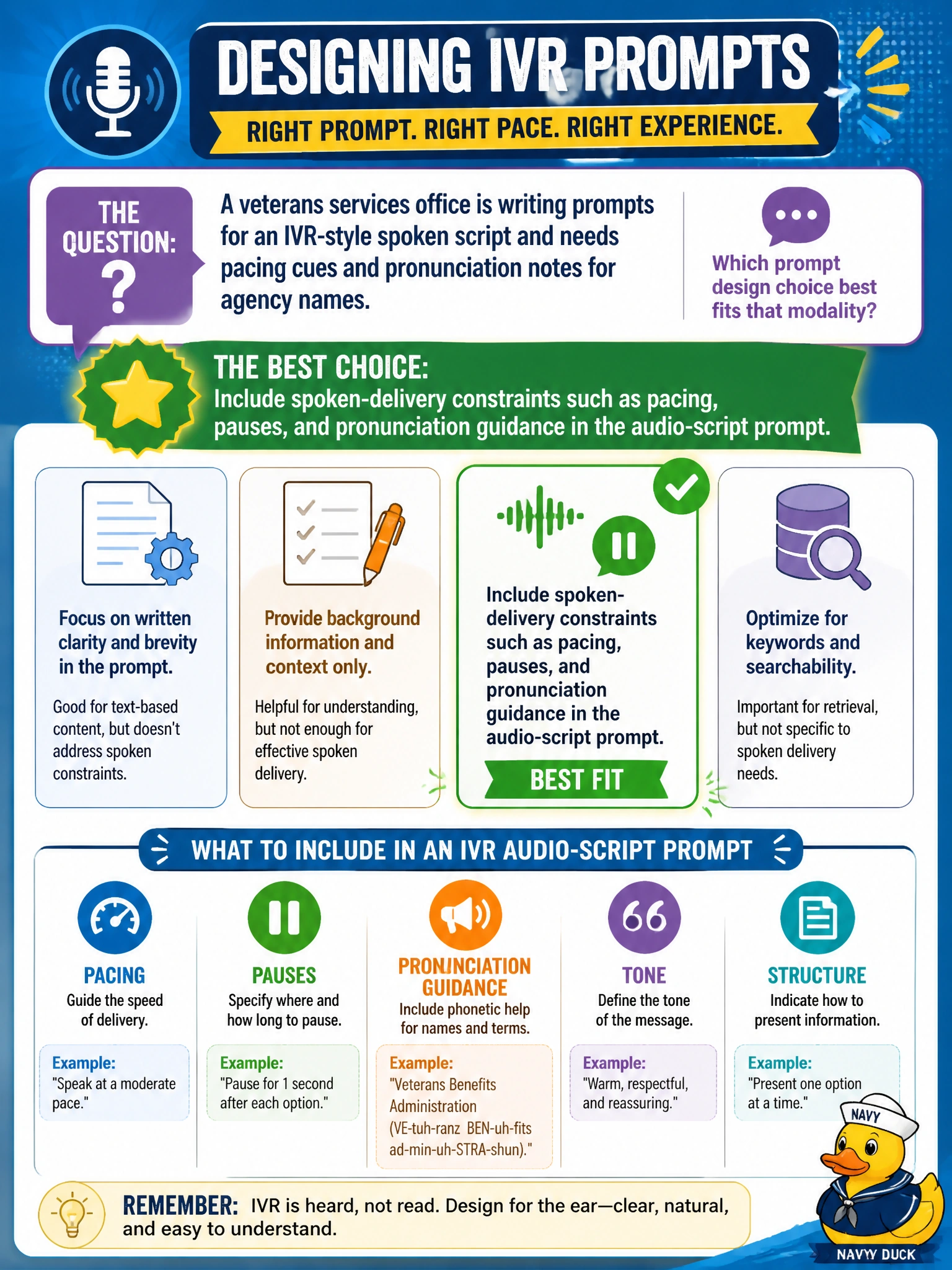
A veterans services office is writing prompts for an IVR-style spoken script and needs pacing cues and pronunciation notes for agency names. Which prompt design choice best fits that modality?
Select an answer to reveal the explanation.
Short Explanation
Spoken IVR is theater for the ear: mark the pace, the pauses, and how to say the hard agency names. Baking those delivery notes into the script prompt matches the audio modality. Picture prompts and database schemas will not coach the voice.
Full Explanation
Audio and spoken-script prompts succeed when they encode modality-specific delivery constraints. For an IVR-style veterans services script, including pacing, pauses, and pronunciation guidance for agency names directly shapes how TTS or live agents render the message for callers. Spoken delivery notes are part of the creative brief for audio, just as style and framing are part of an image brief for posters.
Using only a silent image-generation prompt with no speech instructions fails by concept: it targets a different modality and provides none of the spoken-delivery structure the IVR task needs. Asking for a vector database schema instead of spoken wording fails because infrastructure or retrieval schema design is unrelated to writing a clear audio script. Disabling all punctuation so the speech engine guesses every pause worsens prosody control; punctuation and explicit pause markers are tools for pacing, not obstacles.
Exam caveat: Pronunciation hints improve clarity but do not replace testing on the actual TTS engine or IVR platform, and accessibility requirements (speech rate options, language choice) still apply. Do not assume one prompt works identically across vendors’ speech systems. Distinguish modality-aware prompting from RAG schema design and from image-only prompts on related exam items.
Operational check: Generate the IVR script with explicit pause and pronunciation notes for agency names, render it through the office’s TTS, and verify callers can distinguish agency names at normal and slowed playback before promoting the script to production.