
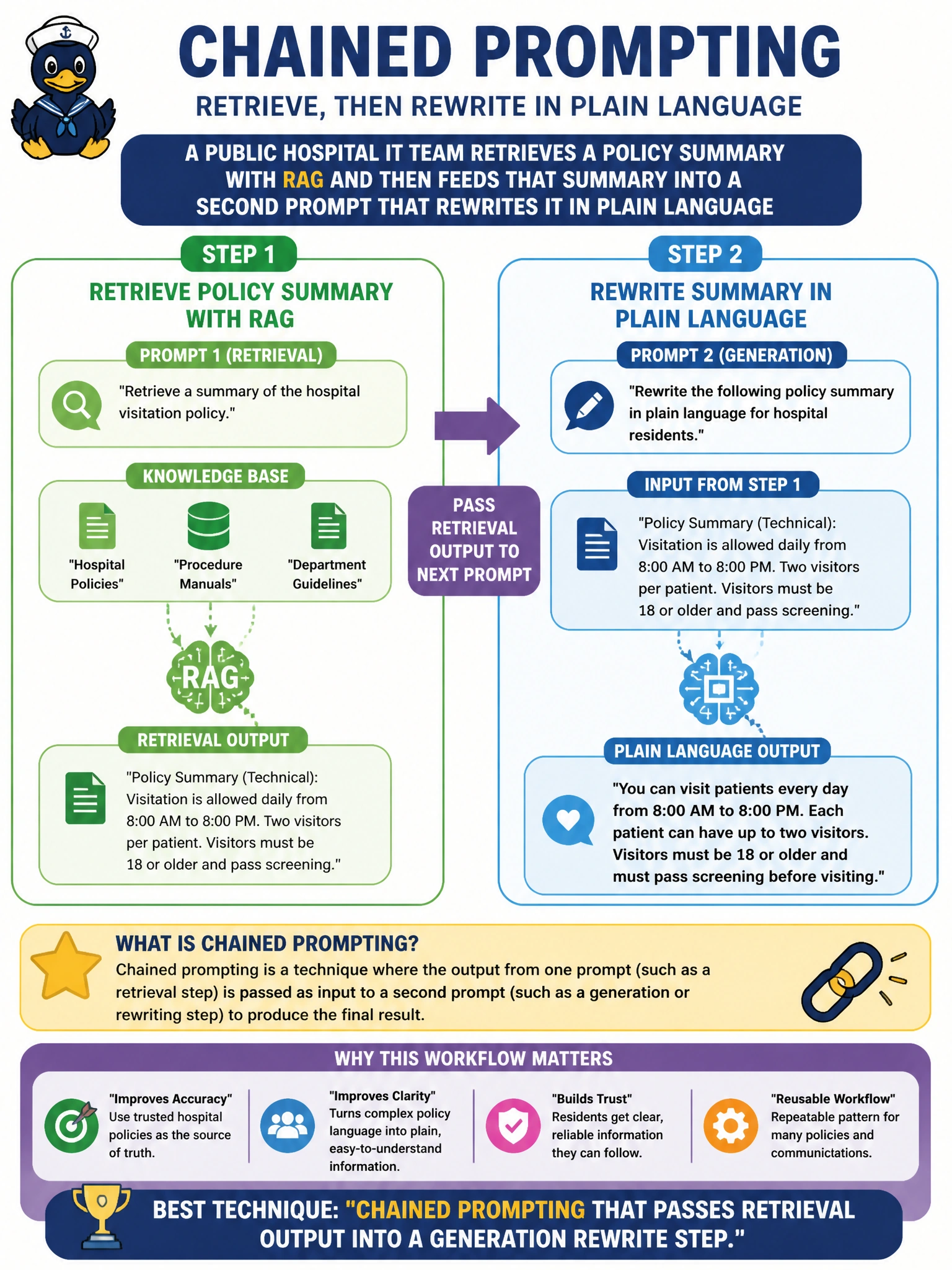
A public hospital IT team retrieves a policy summary with RAG and then feeds that summary into a second prompt that rewrites it in plain language for residents. Which technique best describes this workflow?
Select an answer to reveal the explanation.
Short Explanation
First pull the grounded summary, then hand that baton to a rewrite prompt for residents—like summarizing a memo before translating it into plain talk. That handoff is chained prompting. Skipping retrieval, clustering, or training a diffusion model on photos is a different task.
Full Explanation
Chained prompting sequences distinct stages so that an intermediate output becomes the input to the next prompt. Retrieving a policy summary with RAG and feeding it into a second prompt to rewrite it in plain language for residents is exactly this handoff: grounding first, then generation for readability. Public hospital IT teams can use this pattern to keep clinical or administrative policy faithful while producing resident-friendly wording. Training a diffusion model on discharge photos is an image-model training task, not a prompt-chain workflow for policy text. Removing retrieval and asking the rewrite model to rely on pretrained knowledge discards grounding and risks hallucinated hospital rules that residents may rely on. Merging both steps into an unsupervised clustering job is also a mismatch: clustering groups data without labels; it does not perform a retrieve-then-rewrite sequence. Exam caveat: chaining does not eliminate risk if the RAG summary is wrong or incomplete, because errors can propagate into the rewrite. Evaluate retrieval faithfulness and rewrite fidelity separately, and apply hospital privacy controls to PHI or restricted policy text throughout the chain. In practice, log the summary and rewrite as separate artifacts, check that every substantive claim in the resident text appears in the summary, and withhold publication if the rewrite adds policy numbers or eligibility rules absent upstream.