
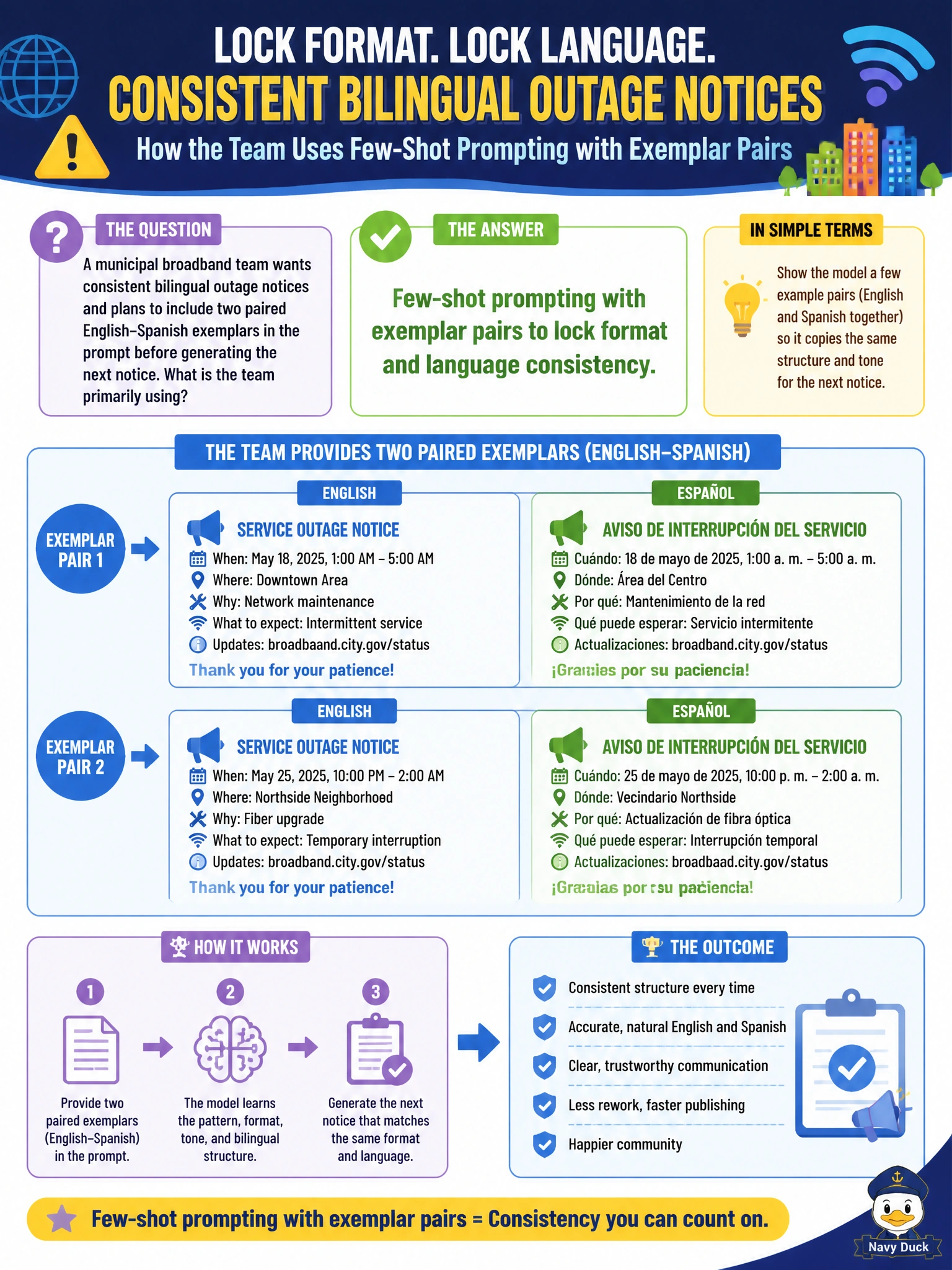
A municipal broadband team wants consistent bilingual outage notices and plans to include two paired English–Spanish exemplars in the prompt before generating the next notice. What is the team primarily using?
Select an answer to reveal the explanation.
Short Explanation
You’re showing the model two bilingual notice pairs so it can follow their shared layout and language pattern. That’s few-shot prompting; searching splice diagrams, increasing randomness, or removing examples won’t provide the same consistency.
Full Explanation
Few-shot prompting provides worked examples in the prompt so the model can mirror the desired structure and language pattern. By including two paired English–Spanish outage notices before generating the next notice, the broadband team demonstrates its preferred layout and how the two language versions align. This is useful for recurring resident communications, where inconsistent formatting or translation alignment can confuse readers. Searching fiber splice diagrams only may provide technical information, but it does not show the model how to format paired bilingual notices. Raising temperature encourages more variation, so notices are more likely to depart from a consistent layout. Removing all examples leaves the model without the demonstrated pattern, making format and language consistency less dependable. Exam caveat: examples guide the output but do not guarantee accuracy, so the bilingual pairs should be approved and correct. Practical check: place two approved pairs in the prompt, generate a new notice, and compare its layout and English–Spanish field alignment with those examples before publishing.