
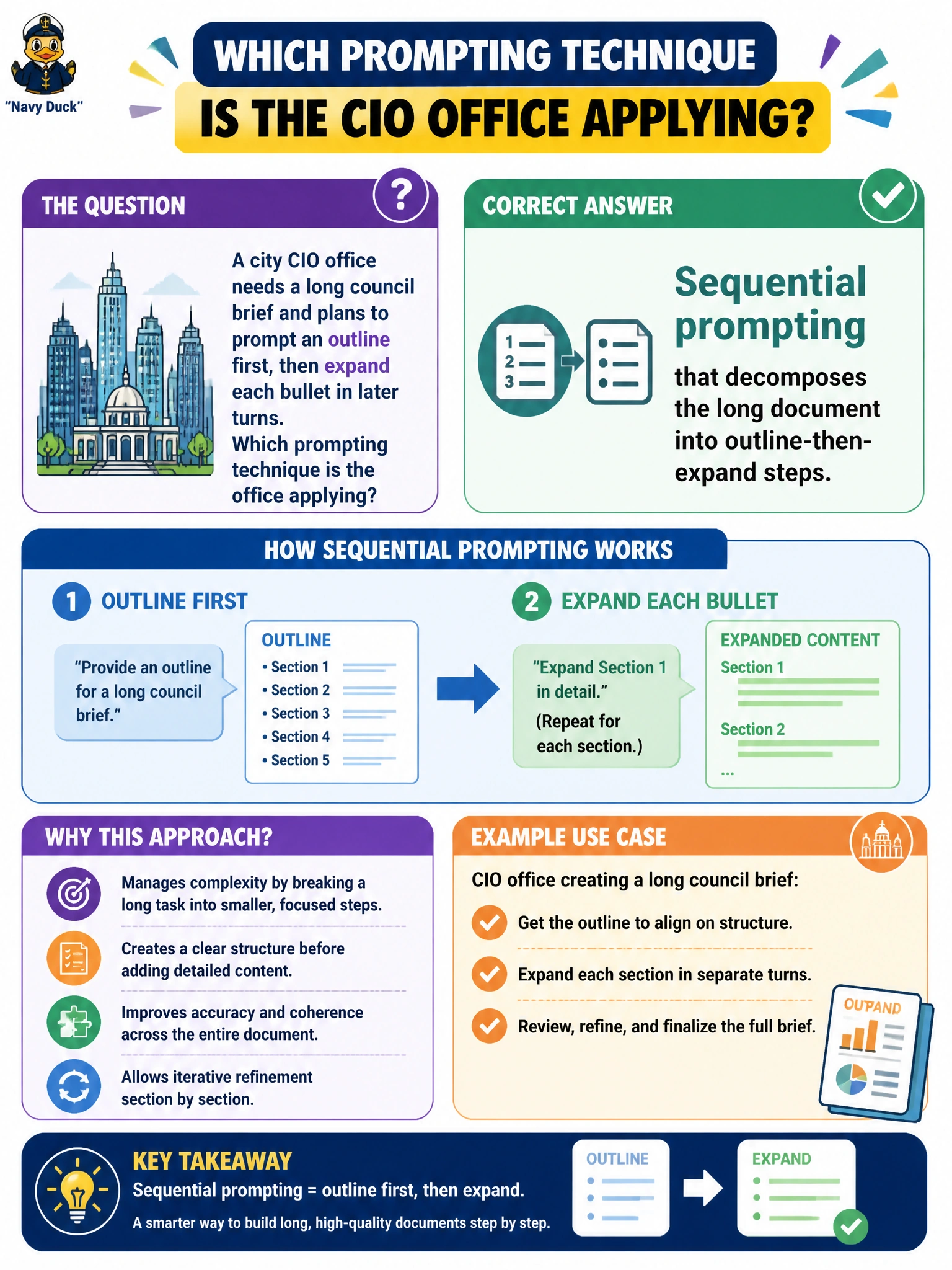
A city CIO office needs a long council brief and plans to prompt an outline first, then expand each bullet in later turns. Which prompting technique is the office applying?
Select an answer to reveal the explanation.
Short Explanation
You’re planning a long civic brief in manageable stages: outline first, then expand each bullet. That’s sequential prompting—a helpful way to build structure before drafting the details.
Full Explanation
Sequential prompting breaks a large generation task into ordered stages, with each turn building on an intermediate result. Here, you first prompt for an outline and then expand each bullet in later turns. That outline-then-expand workflow lets you review the structure before developing each section and gives you more control than requesting the entire long brief at once. Zero-shot translation of the brief into another language without an outline changes the language, not the drafting workflow, so it does not decompose the document into stages. A single-shot request for the complete council brief asks for everything in one turn rather than building from an outline; that can make a lengthy draft harder to control and review. Fine-tuning a new municipal foundation model is a model-training decision, not a prompting technique for drafting this brief. Exam caveat: Sequential prompting is a workflow, not a guarantee of legal, policy, or factual accuracy; an outline can still contain mistaken assumptions. Practical check: Save and review the outline, expand one section per turn while preserving its headings, then compare the final draft with the outline for missing or invented sections.