
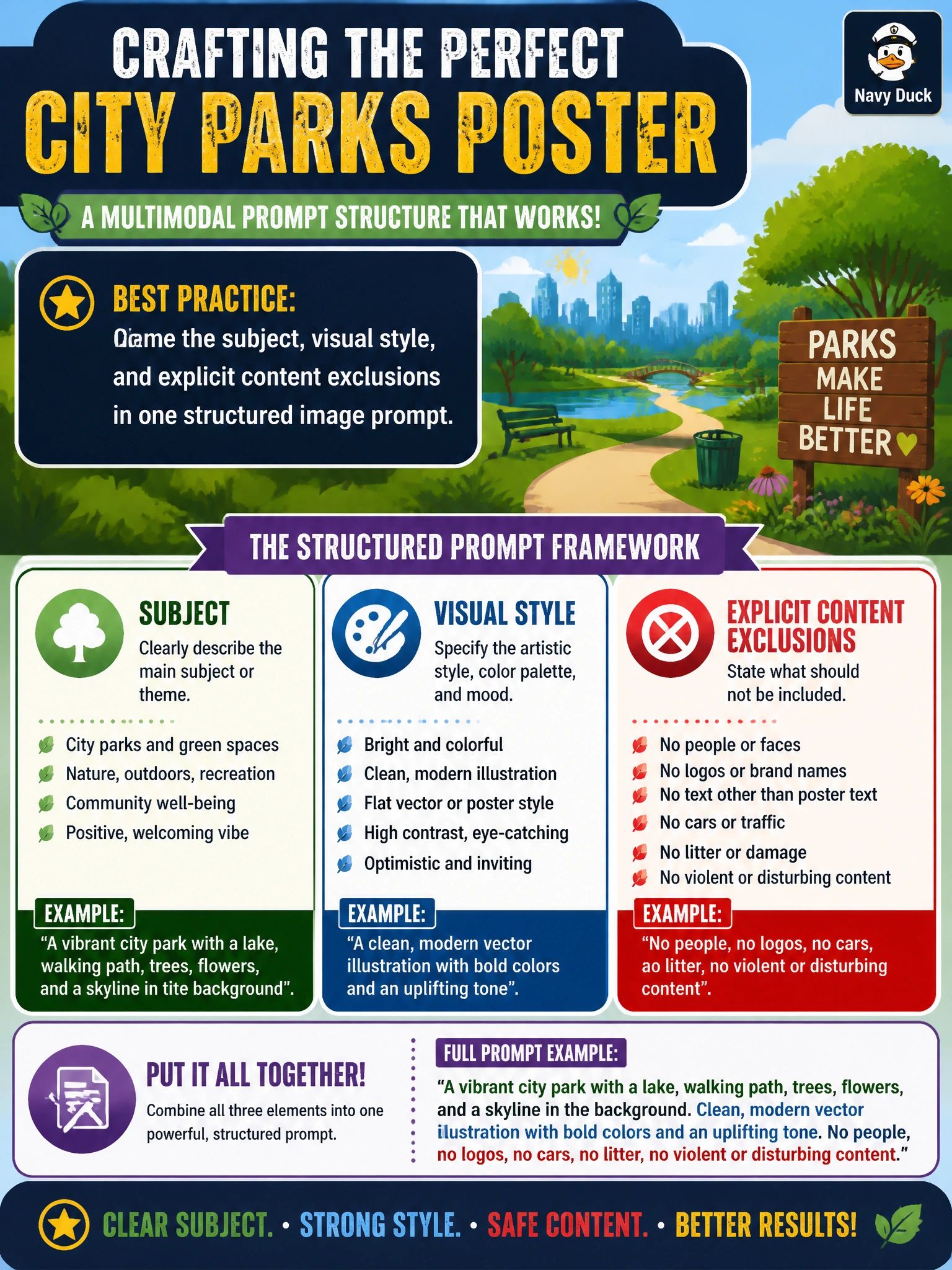
A planning commission staff member is drafting a generative-image prompt for a city parks poster and wants subject, style, and banned content spelled out up front. Which prompt structure best supports that multimodal request?
Select an answer to reveal the explanation.
Short Explanation
Think of the image prompt like a film shot list: say what is in the frame, how it should look, and what must never appear. Spelling subject, style, and bans up front keeps a parks poster on-brief. Dumping an ordinance or asking about GPUs does not steer the picture.
Full Explanation
Structured generative-image prompts for municipal communications work because they make the visual contract explicit: name the subject (what must appear), the style (brand look, lighting, medium), and content exclusions (what must never appear). That single structured brief is how planning-commission staff keep a city parks poster aligned with approved messaging and safety rules when the model can otherwise invent overlays, people, logos, or unsafe imagery. Multimodal image generation follows the prompt; vague prompts produce uncontrolled composition.
Sending only a park name fails by concept because it delegates style, typography, and banned imagery to model defaults, which is the opposite of a controlled civic creative brief. Pasting an entire zoning ordinance without visual instructions fails because legal text is not a shot list—it floods the context with non-visual constraints and still leaves subject, style, and negatives unspecified. Asking for GPU cluster sizing fails because infrastructure capacity planning is an operations topic, not a creative or multimodal prompt structure for poster art.
Exam caveat: Structured prompts reduce risk but do not replace brand review, accessibility checks on text in images, or policy bans on depicting real minors or sensitive facilities. Negative instructions help, yet models can still miss exclusions, so human approval before public posting remains required. Do not confuse image-prompt structure with retrieval, fine-tuning, or cluster sizing questions that appear elsewhere on the exam.
Operational check: Before generating the parks poster, require a prompt checklist that lists subject, style tokens, and an explicit exclusions block; generate a sample; verify banned elements are absent and brand colors/fonts match the city’s style guide; archive the approved prompt with the asset for reproducibility.