
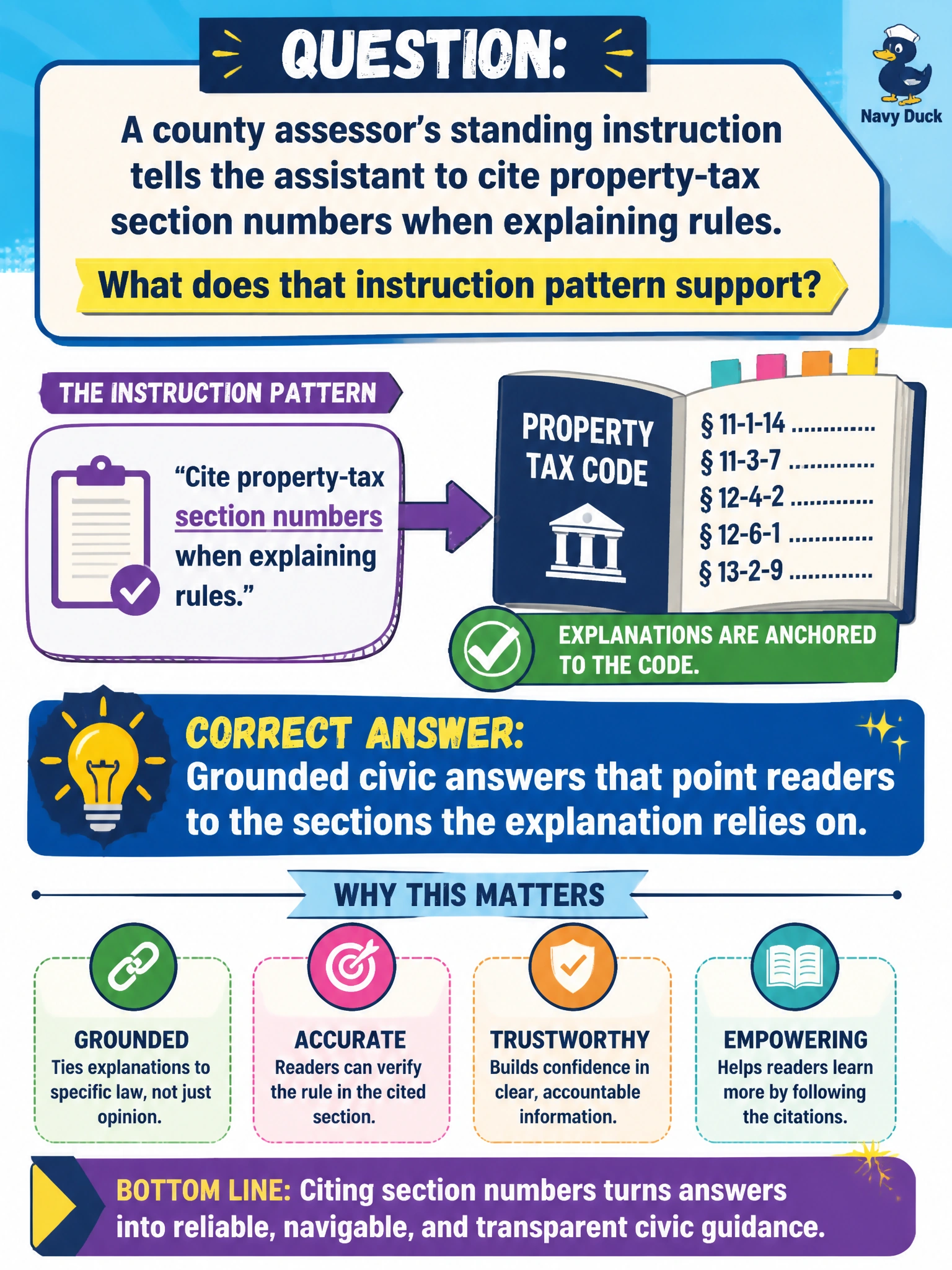
A county assessor’s standing instruction tells the assistant to cite property-tax section numbers when explaining rules. What does that instruction pattern support?
Select an answer to reveal the explanation.
Short Explanation
“Cite the section” is the assessor’s way of saying show your work. Residents get the rule and the pointer, not a floating claim with no ordinance trail.
Full Explanation
A county assessor’s standing instruction to cite property-tax section numbers supports grounded civic answers that point readers to the sections the explanation relies on. Citations turn claims into verifiable guidance: residents, agents, and appeals boards can open the referenced rule instead of trusting a floating paragraph. That pattern strengthens transparency for valuation, exemption, and payment-rule explanations that routinely draw challenges.
Hiding sources so residents cannot verify how valuations are calculated is the opposite of assessor accountability. Automatically deleting the tax code from the RAG corpus after each citation would destroy the knowledge base and break the next question. Replacing numeric section references with invented informal nicknames removes the precise pointers statutes, ordinances, and appeal processes need.
Exam caveat: citation instructions should bind to retrieved or provided section text. Ordering “cite sections” without retrieval or an attached excerpt can produce fabricated section numbers that look official. Pair the instruction with RAG over the adopted code, and prefer citations drawn from chunk metadata rather than free recall.
Operational check: ask a typical exemption or millage question, confirm the reply includes real section numbers present in the corpus, spot-open those sections, and ensure the explanation’s substance matches the cited rule before publishing the assistant to the public counter.