
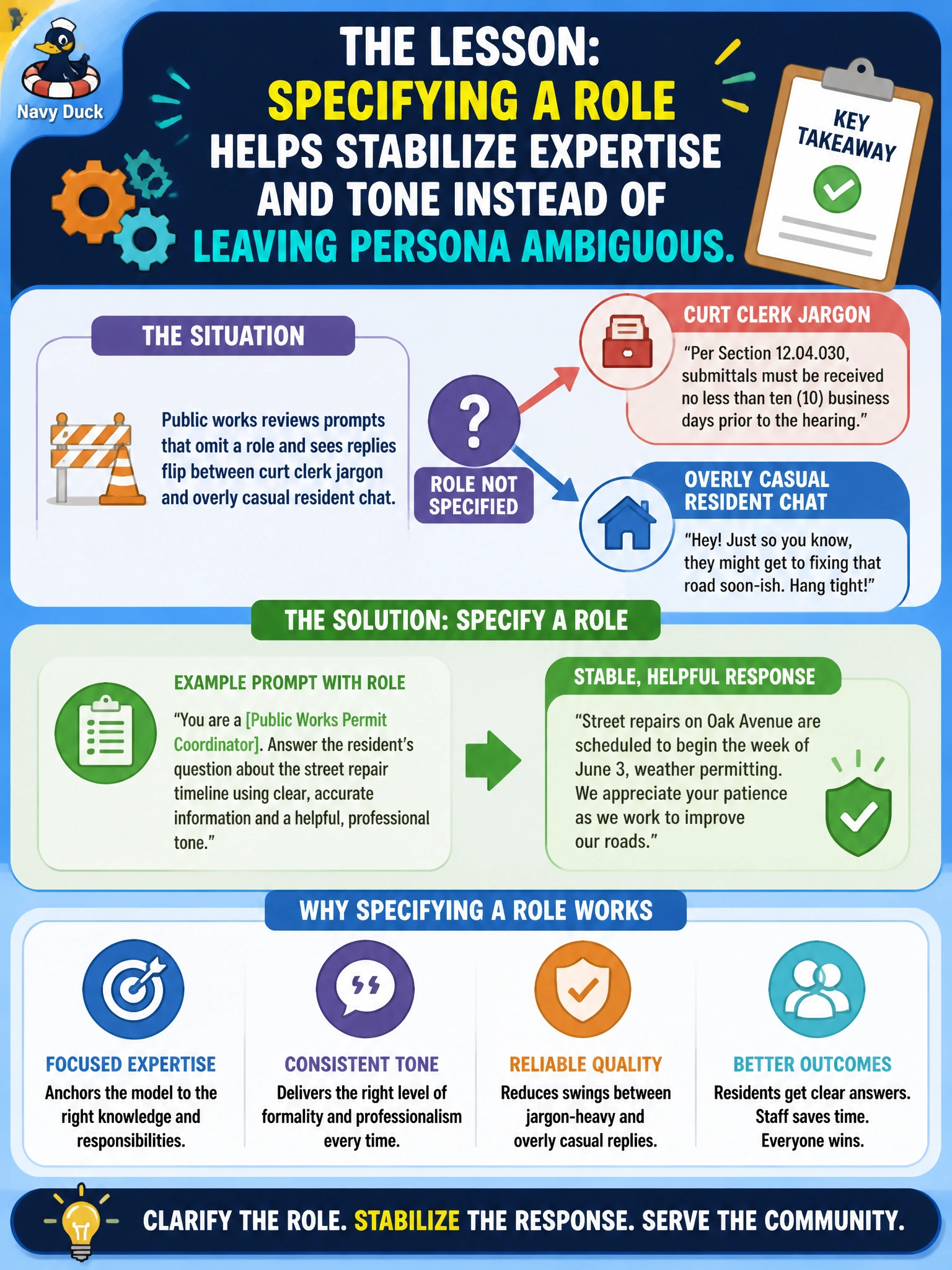
Public works reviews prompts that omit a role and sees replies flip between curt clerk jargon and overly casual resident chat. What lesson should they take?
Select an answer to reveal the explanation.
Short Explanation
No role is like no name tag—sometimes you get the front-counter clerk, sometimes a buddy on the porch. Put the role in the prompt and the voice settles down.
Full Explanation
When prompts omit a role, public-works replies can flip between curt clerk jargon and overly casual resident chat because the persona is underspecified. Specifying a role helps stabilize expertise and tone—for example, “you are a courteous public-works customer-service specialist”—so voice and focus stop wandering sentence to sentence. Role clarity is a basic prompt-engineering control for consistent municipal communication across shifts and ticket types.
Treating role omission as ideal because models should randomly pick a persona is the defect agencies are trying to eliminate. Tone inconsistency does not prove that output-format JSON constraints must be removed; format and role solve different problems and often coexist. Inconsistent tone also does not mean the vector database must be wiped; retrieval hygiene is unrelated to persona ambiguity in the prompt text.
Exam caveat: role stabilizes tone but does not supply facts. Keep roles paired with clear instructions, safety constraints, and grounded policy or work-order context so consistency does not become consistently wrong content. Roles also should match channel—counter chat versus formal written notice.
Operational check: generate several complaint acknowledgments without a role and with a defined public-works role; compare tone variance and professionalism, then lock the clearer role into the shared template used by the bureau.