
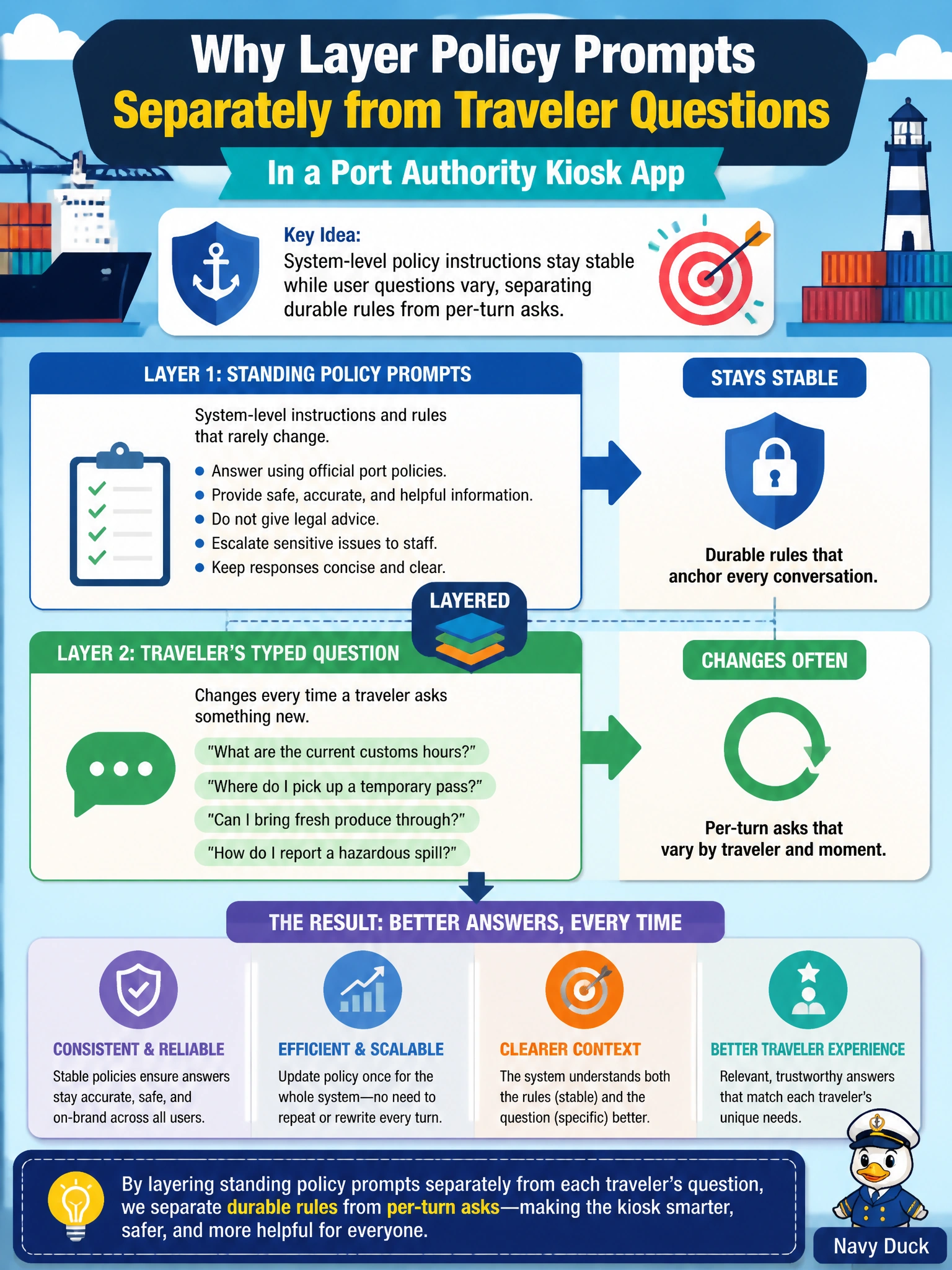
A port authority kiosk app keeps standing policy prompts separate from each traveler’s typed question. Why is that layering useful?
Select an answer to reveal the explanation.
Short Explanation
Think house rules on the wall versus whatever a traveler just typed. System policy stays put; user questions come and go. That layering keeps the kiosk from “forgetting” safety every turn.
Full Explanation
Keeping standing policy prompts separate from each traveler’s typed question is useful because system-level instructions stay stable while user questions vary. Durable rules—safety, scope, citation, tone—persist across kiosk sessions; per-turn asks change with each traveler. That layering prevents the port authority kiosk from “forgetting” policy every time someone types a new itinerary question.
User questions must not overwrite system policy each turn; if they do, safety rules evaporate under prompt injection or casual wording. System prompts are not “only valid as images inside a diffusion training set”—they are text instructions to the generative model. Claiming kiosk hardware ignores instruction text is false; the application stack still sends layered prompts to the model.
Exam caveat: separation helps, but applications must protect system layers from injection (e.g., traveler text trying to “ignore previous instructions”). Layering is necessary architecture, not automatic immunity.
Operational check: send a traveler question that attempts to override policy, confirm system rules still hold (no payment collection, plain language, etc.), and verify normal questions still get helpful answers under the standing policy.