
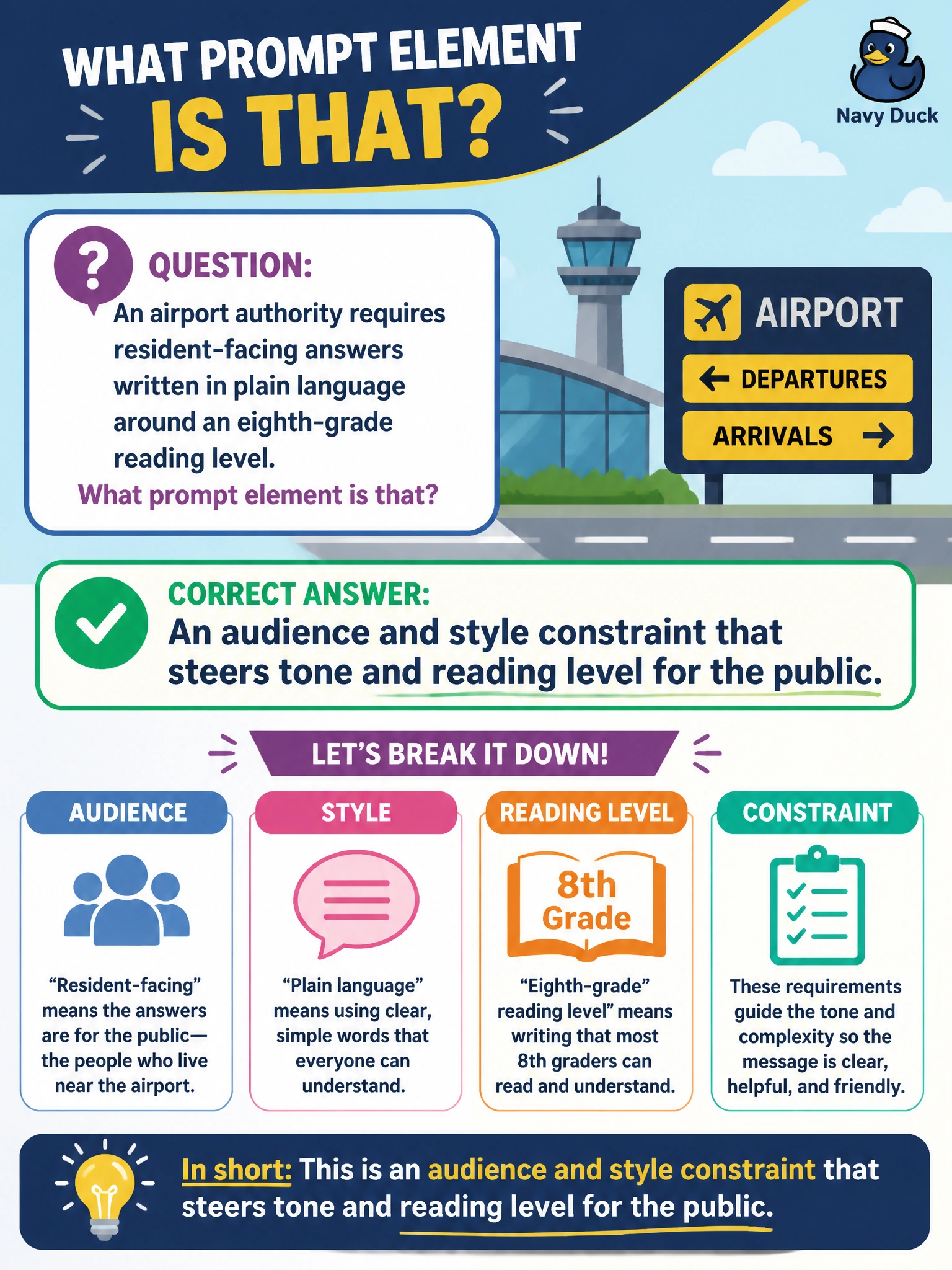
An airport authority requires resident-facing answers written in plain language around an eighth-grade reading level. What prompt element is that?
Select an answer to reveal the explanation.
Short Explanation
Residents shouldn’t need a law degree to read a parking notice. Style constraints—plain language, grade-level targets—tell the model who it’s talking to. Same facts, clearer voice.
Full Explanation
Requiring resident-facing answers at about an eighth-grade plain-language level is an audience and style constraint. It steers tone, vocabulary, and sentence complexity for the public without changing the underlying airport facts. Port and airport authorities use style constraints so parking, security, and terminal notices remain understandable to travelers who are not aviation lawyers.
A vector top-k setting that truncates every answer to eight tokens is a retrieval/length hack, not reading-level style control, and would mangle meaning. A model-hub license field does not automatically translate everything into legal French. A fine-tuning objective that maximizes jargon density targets the opposite audience—airside staff jargon—not public plain language.
Exam caveat: style constraints improve clarity but must not simplify away mandatory legal meanings. For regulated notices, plain language plus links to full policy text is safer than oversimplifying obligations away.
Operational check: generate a sample parking or security notice with the grade-level constraint, run a readability check, have a non-specialist staffer paraphrase it, and confirm critical rules (times, prohibited items, fee amounts) remain accurate.