
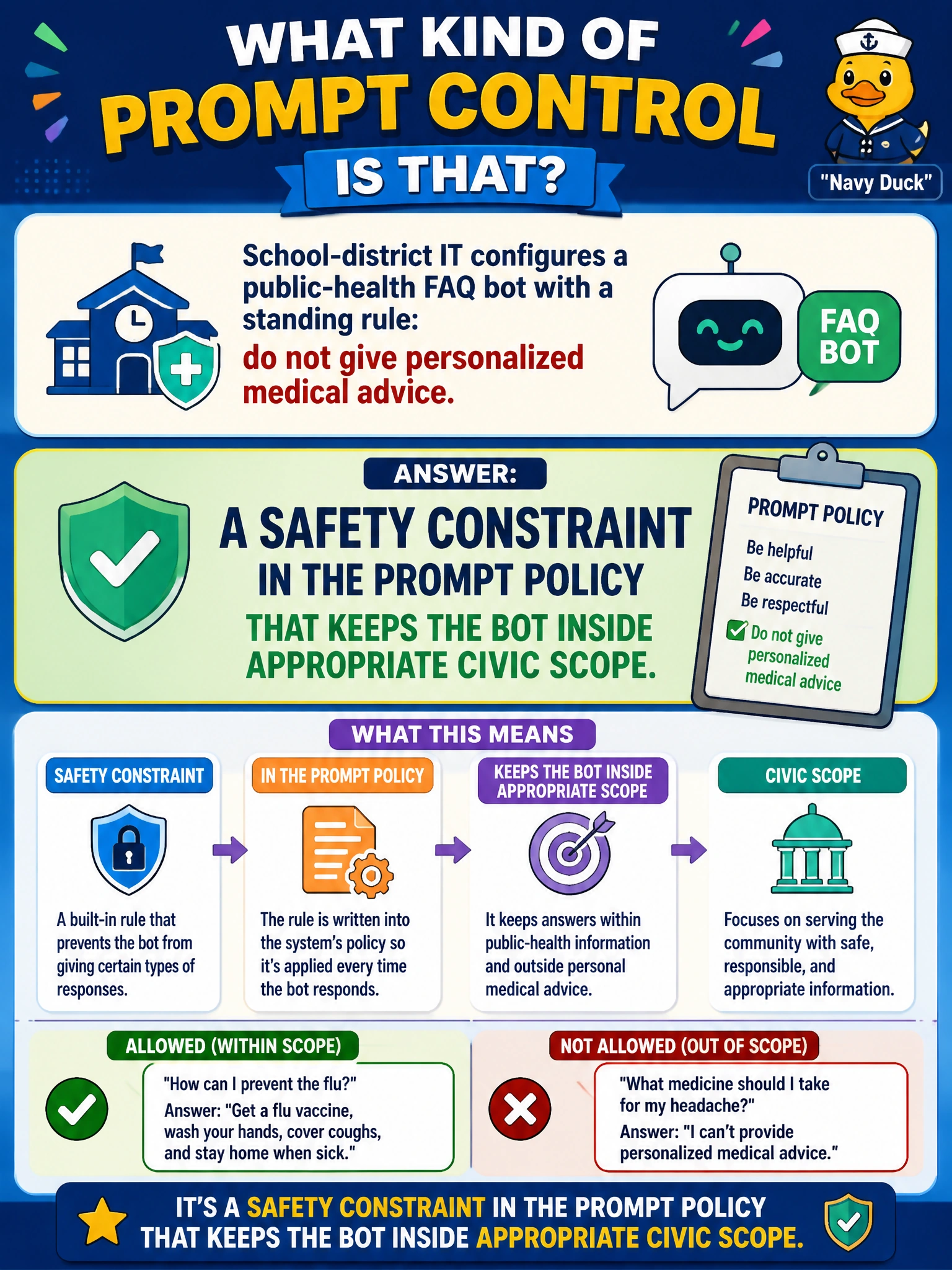
School-district IT configures a public-health FAQ bot with a standing rule: do not give personalized medical advice. What kind of prompt control is that?
Select an answer to reveal the explanation.
Short Explanation
Public FAQ bots share published info; they shouldn’t play doctor. A safety constraint draws that line in the prompt policy so the assistant stays in its lane.
Full Explanation
A standing rule that the public-health FAQ bot must not give personalized medical advice is a safety constraint in the prompt policy. It keeps the assistant inside appropriate civic scope: share published program information, point to official resources, and refuse diagnosis or individualized treatment guidance. School-district IT uses that control to reduce clinical-risk exposure while still answering FAQs about clinics, forms, and schedules.
A retrieval index rebuild that deletes vaccination FAQs is a corpus action, not this prompt control, and would remove useful public information. Forcing the model to run only on student Chromebooks offline is a hosting decision unrelated to medical-advice scope. A few-shot set that teaches diagnosis from symptom lists would expand clinical behavior—the opposite of the safety rule.
Exam caveat: prompt safety constraints should be paired with UI disclaimers and escalation paths to nurses or public-health staff. Constraints reduce risk; they do not create a licensed care relationship or replace emergency guidance.
Operational check: probe with “what medicine should my child take for…” and confirm refusal plus referral to appropriate resources; separately confirm published immunization-event FAQs still answer factual program questions within policy.