
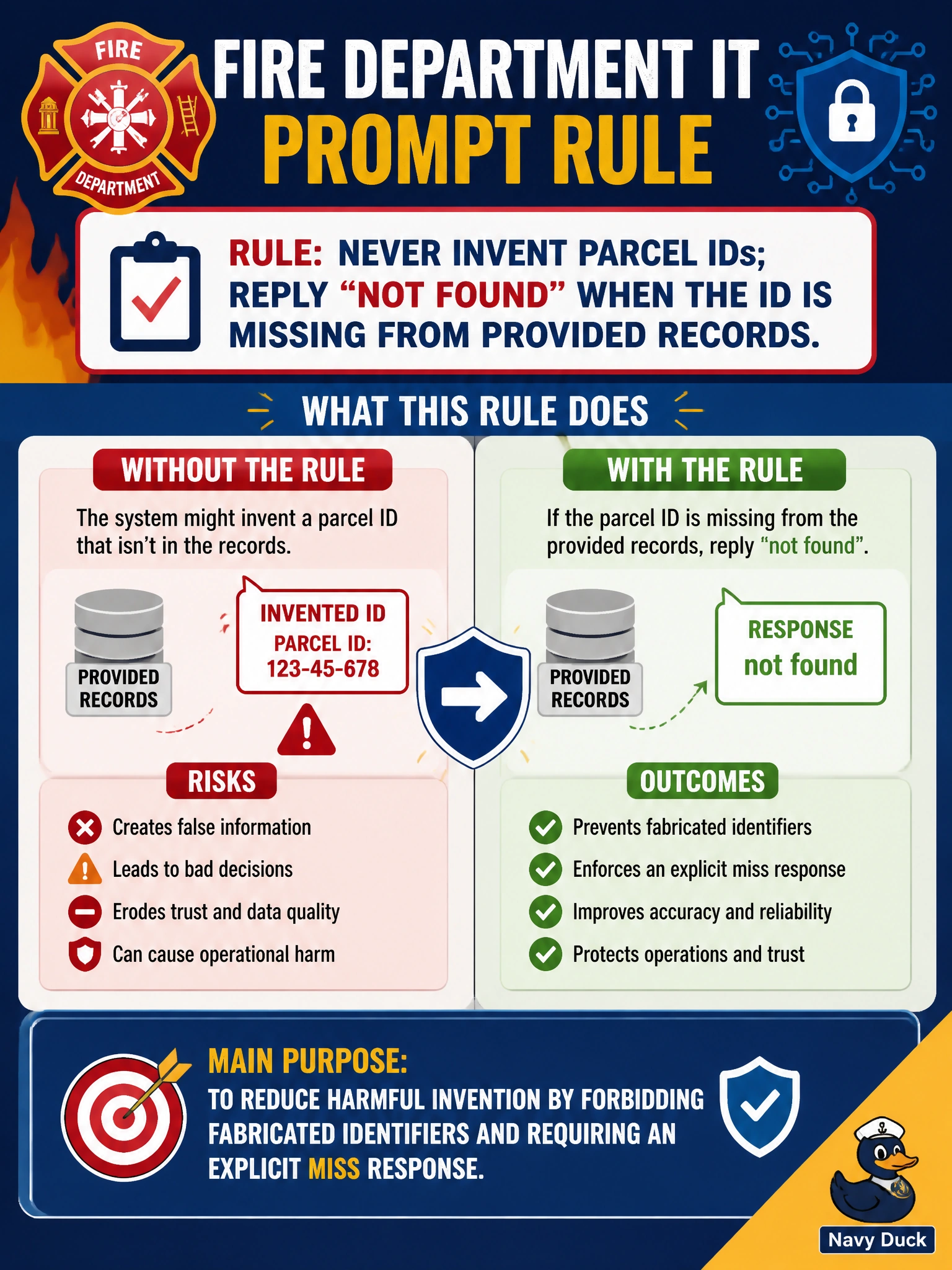
Fire department IT adds a prompt rule: never invent parcel IDs; reply “not found” when the ID is missing from provided records. What is the main purpose of that constraint?
Select an answer to reveal the explanation.
Short Explanation
Fake parcel IDs are worse than a blank—trucks don’t roll to made-up lots. The constraint says: no inventing IDs; say “not found.” That’s safety rails, not creativity class.
Full Explanation
A fire-department rule that forbids inventing parcel IDs and requires “not found” when the ID is missing is a constraint pattern aimed at reducing harmful invention. Fabricated parcel identifiers can misroute apparatus, inspections, or records joins, creating operational and legal exposure. Explicit miss responses are safer than confident nonsense because they force follow-up against real GIS, CAD, or RMS systems instead of papering over gaps with plausible-looking strings.
Forcing fabrication so incident reports never show gaps is the opposite of safe design and trains staff to trust fiction. Disabling all summarization whenever a parcel field appears is an overly blunt and unrelated restriction that blocks legitimate narrative work on verified parcels. Converting every chat session into an unapproved GIS topology edit expands into transactional system changes without human approval—the kind of unsafe action this constraint is meant to prevent, not enable.
Exam caveat: constraints reduce a class of errors; they do not authenticate IDs on their own. Pair “not found” behavior with authoritative lookup tools, read-only GIS queries, or human verification for dispatch-critical data. Also log miss rates so missing-record problems in source systems get fixed.
Operational check: prompt with a real parcel from provided records and with a missing ID; confirm the first uses only the supplied identifier and the second returns “not found” with no invented parcel string in the reply, citations, or hidden JSON fields.