
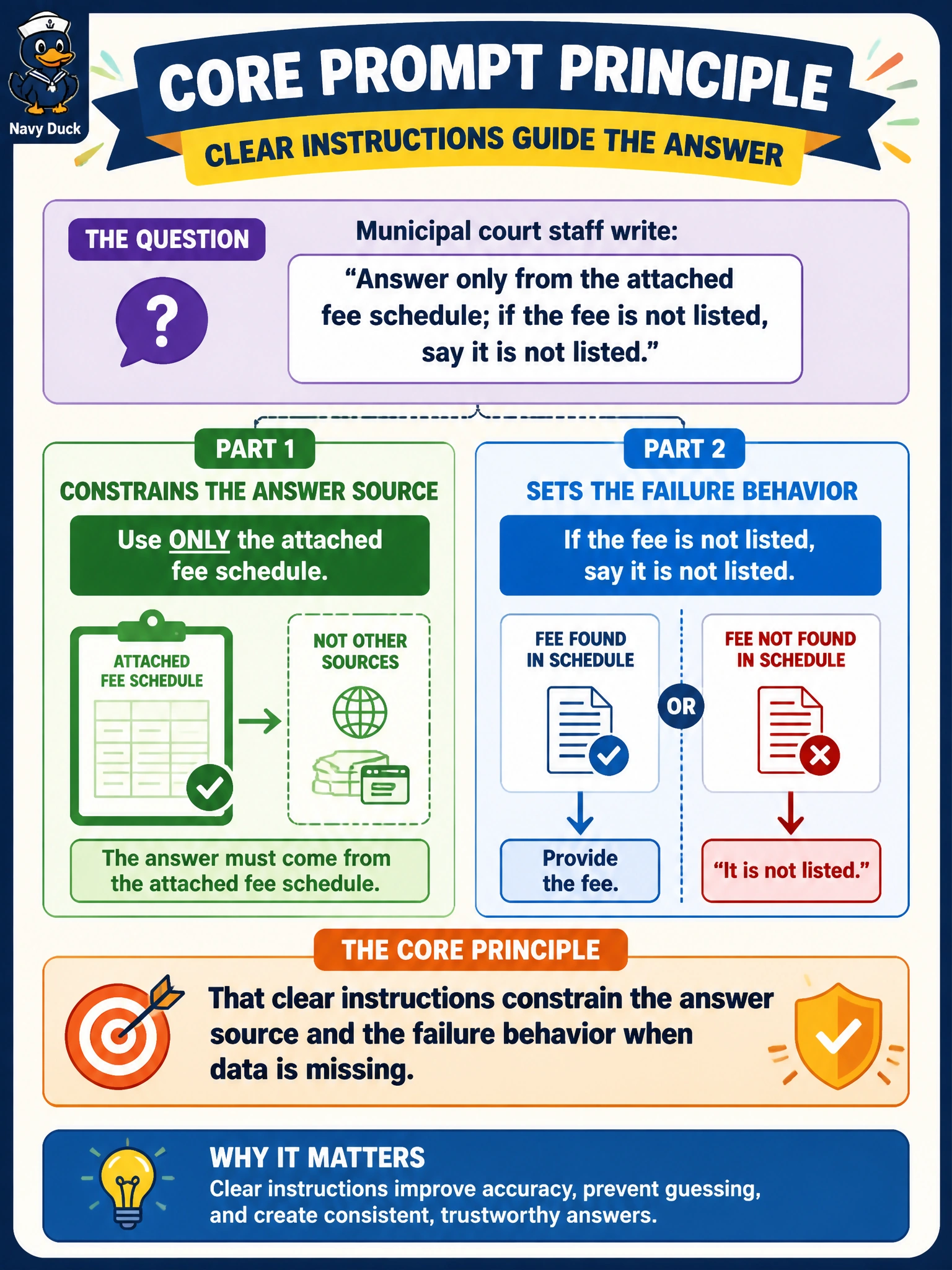
Municipal court staff write: “Answer only from the attached fee schedule; if the fee is not listed, say it is not listed.” What core prompt principle does this illustrate?
Select an answer to reveal the explanation.
Short Explanation
Spell out the job: use this schedule, and if it’s not there, say so. Clear instructions beat hoping the model guesses court policy. Ambiguity is how creative surcharge fan fiction starts.
Full Explanation
Writing “Answer only from the attached fee schedule; if the fee is not listed, say it is not listed” illustrates clear instructions that constrain both the answer source and the failure behavior when data is missing. Municipal court fee questions are high-stakes: invented surcharges create liability and erode trust. Explicit source limits plus an explicit miss response are foundational prompt principles alongside roles and constraints.
Attached documents are not ignored pending fine-tuning on courtroom audio; instruction-following models can use provided context when told to. Omitting instructions so the model invents creative surcharges is the failure mode courts must avoid. Role labels alone do not replace task instructions—roles set persona; instructions set what to do and what to do when the schedule is silent.
Exam caveat: “answer only from the attachment” still requires the attachment to be present in context and readable. If the schedule is missing from the prompt, the model cannot comply—pair this instruction with reliable document injection.
Operational check: ask for a fee that is on the schedule and one that is not; confirm the first cites the schedule amount and the second returns the prescribed “not listed” behavior with no invented surcharge.