
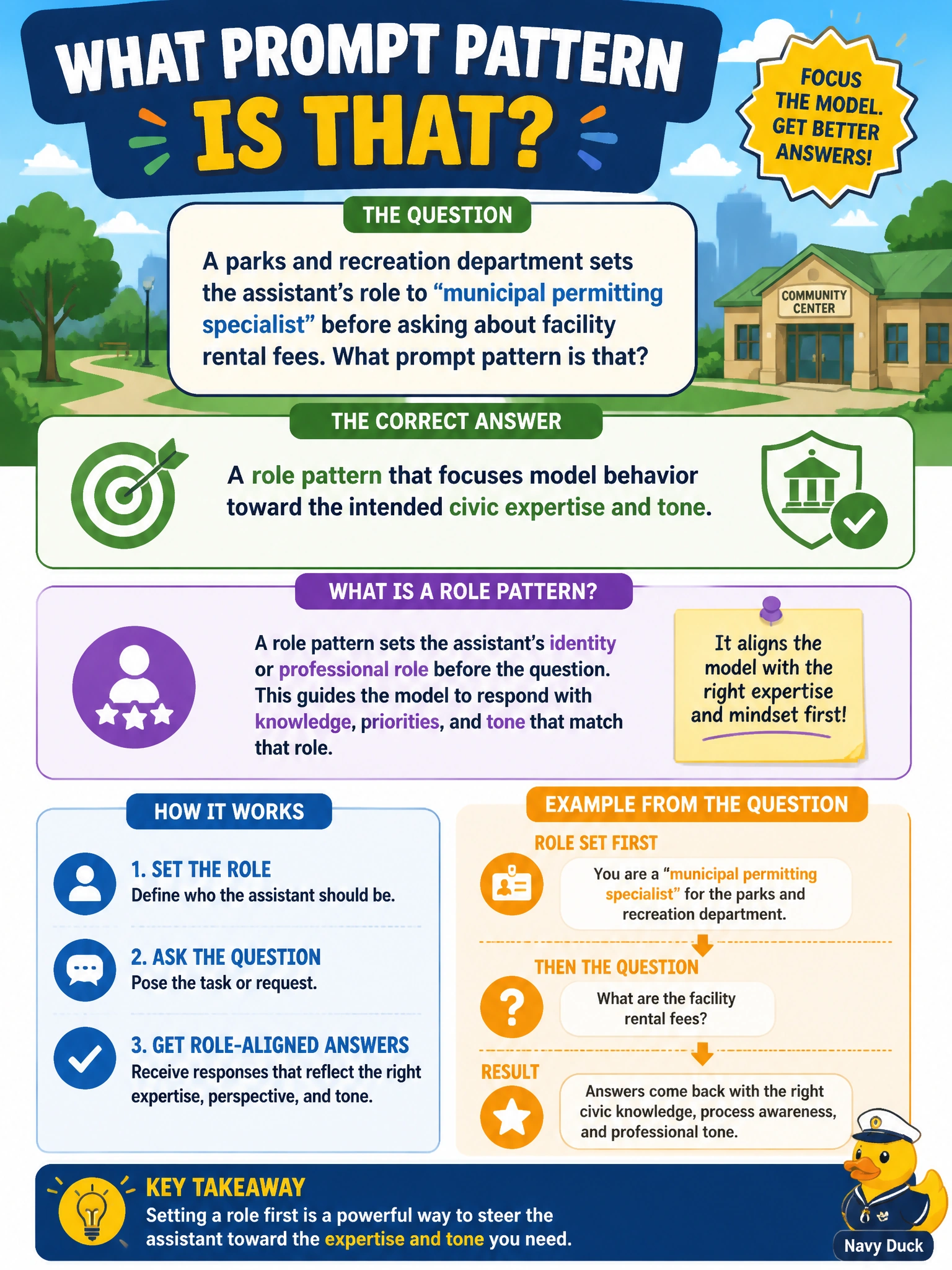
A parks and recreation department sets the assistant’s role to “municipal permitting specialist” before asking about facility rental fees. What prompt pattern is that?
Select an answer to reveal the explanation.
Short Explanation
Telling the model “you’re the permitting specialist” is like putting the right clerk at the window. Role prompts steer tone and focus before the fee question even lands. It’s framing, not a sneaky fine-tune.
Full Explanation
Setting the assistant’s role to “municipal permitting specialist” before asking about facility rental fees is a role prompt pattern. Roles focus behavior toward intended expertise, vocabulary, and tone so the model answers more like a permitting clerk than a generic chatbot. In parks and recreation fee Q&A, that framing biases toward relevant policy and fee-table reasoning without changing model weights.
A modality switch that converts the fee table into an image first is unrelated to role prompting and usually harms text accuracy. Increasing top-k is a retrieval parameter, not a role pattern. Fine-tuning that rewrites base weights for every fee change is a training operation, not a prompt-time role assignment—and is the wrong tool for routine fee questions when documents and roles suffice.
Exam caveat: a role alone does not guarantee correct fees. Roles work best with clear instructions, constraints (don’t invent fees), and grounded context from schedules. Role without sources still hallucinates numbers.
Operational check: compare answers with and without the permitting-specialist role on the same fee question; confirm tone and focus improve, then still verify numeric fees against the published rental schedule before public release.