
A public library system needs staff search that finds both paraphrase matches and exact code section numbers in municipal references. Which retrieval approach should they evaluate?
Select an answer to reveal the explanation.
Short Explanation
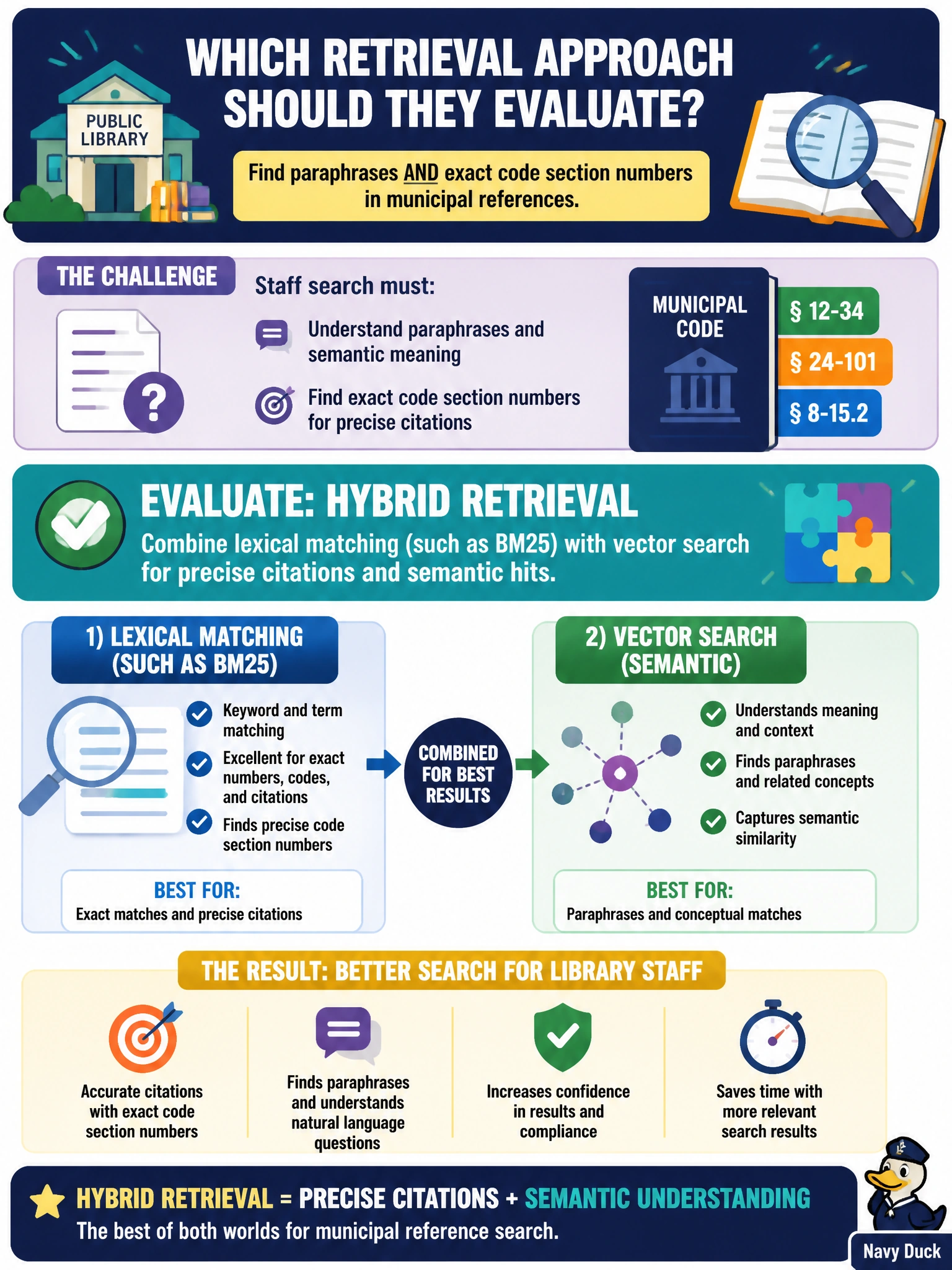
Section “12.04.110” wants a sharp keyword eye; “that noise ordinance” wants a semantic one. Hybrid search—BM25 plus vectors—covers both. Pure memory without retrieval is how made-up cites get born.
Full Explanation
Municipal reference work mixes exact identifiers (“12.04.110”) with paraphrase questions (“that noise ordinance about late parties”). Hybrid retrieval combines lexical matching such as BM25—which excels at precise tokens and section numbers—with vector search—which catches semantic and synonym hits. A public library staff search that must serve both citation lookup and natural-language phrasing should evaluate hybrid retrieval because neither signal alone covers the full query mix.
Vector-only search that disables embeddings whenever digits appear throws away semantic help on mixed queries and is an odd special case; digits often mark the exact cite you still want lexical help for, not a reason to cripple search. Keyword-only search that rejects any paraphrase not copied letter-for-letter fails real staff language. A generative model with no retrieval will fabricate section numbers with false confidence—unacceptable for municipal citations.
Exam caveat: hybrid systems need sensible fusion (score normalization, weighted combination, or reciprocal rank fusion) and still depend on a clean corpus. Hybrid is an approach to evaluate, not a guarantee without tuning.
Operational check: build a dual test set—queries with exact section numbers and queries that only paraphrase titles—measure recall for both under keyword-only, vector-only, and hybrid, and adopt the configuration that recovers precise cites and semantic matches for library staff.