
A housing authority designs RAG for voucher policy Q&A and must pick models from a hub. Which pattern correctly separates responsibilities?
Select an answer to reveal the explanation.
Short Explanation
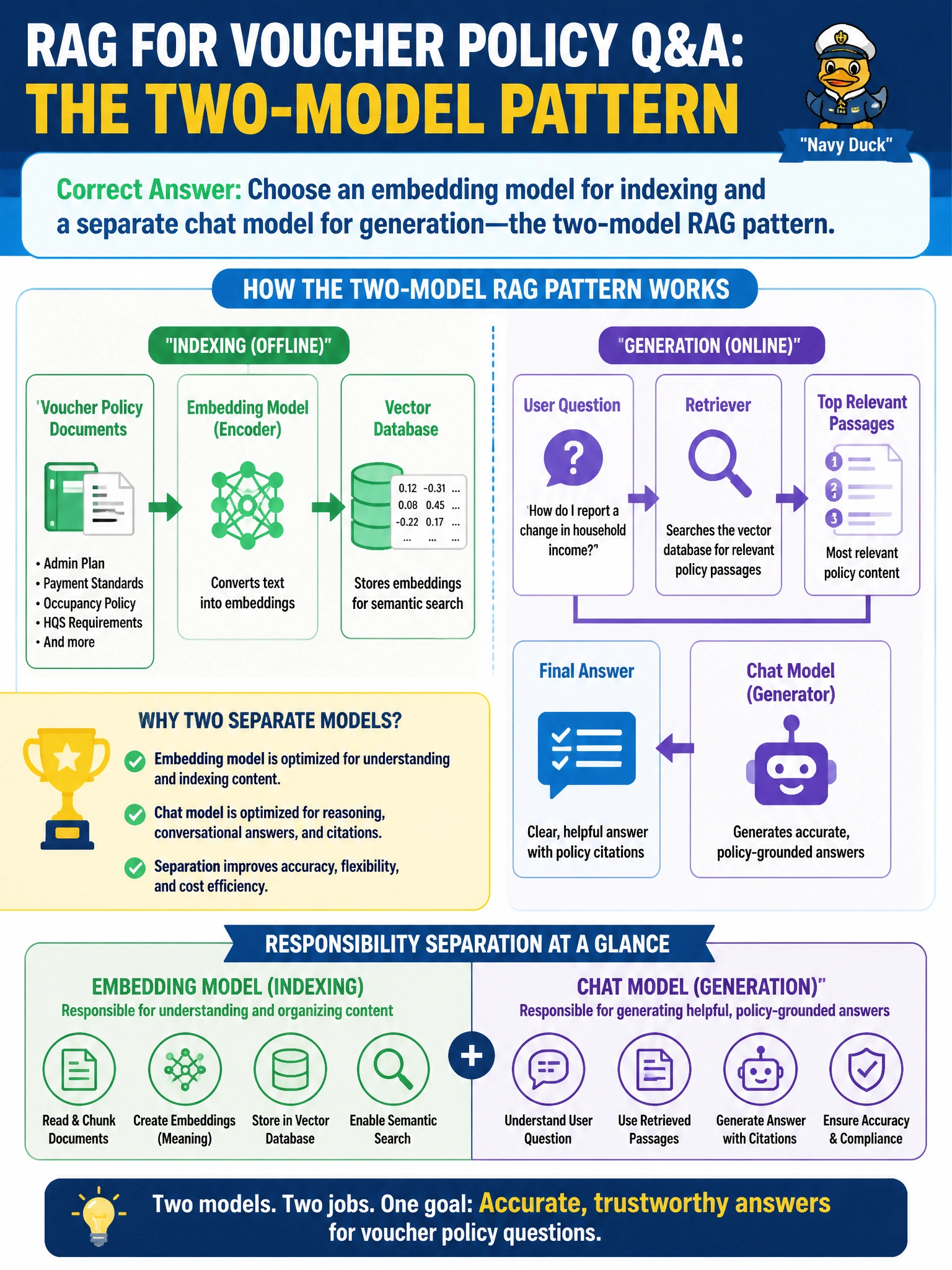
RAG usually wears two hats: one model turns policy text into searchable vectors, another writes the answer. Pick a solid embedder for the index and a chat model for the reply—don’t make a paint program do both jobs.
Full Explanation
Standard RAG separates two jobs: an embedding model turns voucher-policy text into vectors for indexing and search, and a chat (generative) model writes the resident-facing answer from retrieved passages. Choosing those models independently from a hub—picking a strong embedder for the index and a suitable chat model for generation—is the two-model RAG pattern housing authorities should follow. Each model is optimized for its task; hub cards that list embedding quality versus chat quality should drive that split.
Using one diffusion model to embed PDFs and answer only as images misunderstands both embedding and text Q&A; diffusion is for image generation. Skipping embeddings and fine-tuning a single chat model on every scanned lease reintroduces brittle weight updates and loses scalable retrieval over a growing policy set. Forcing the chat model to be the only embedder even when a stronger embedding model is listed on the hub sacrifices retrieval quality for convenience.
Exam caveat: some platforms offer combined stacks, but conceptually you still have an embedding function and a generation function. “Two-model pattern” means separate responsibilities, whether packaged as one product or two downloads.
Operational check: verify the index was built with the chosen embedding model’s dimensionality, pair it with a chat model that accepts retrieved context, and run voucher-policy questions confirming answers cite indexed sections rather than unsupported lease folklore.