
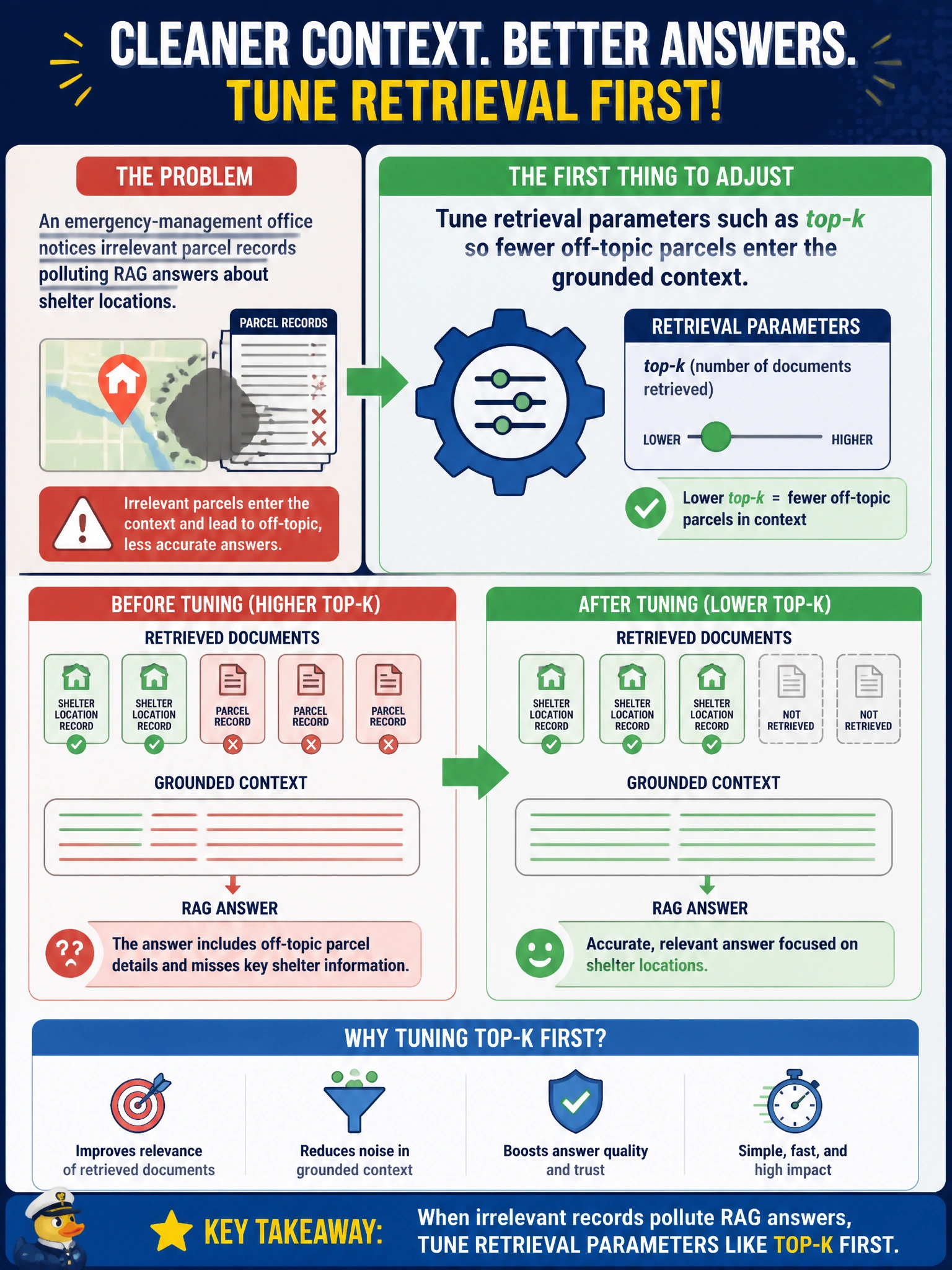
An emergency-management office notices irrelevant parcel records polluting RAG answers about shelter locations. What should practitioners adjust first?
Select an answer to reveal the explanation.
Short Explanation
Too many random parcels in the prompt is like dumping the whole map drawer on the desk. Tighten how many neighbors retrieval pulls—top-k and friends—so shelter facts aren’t crowded out by noise.
Full Explanation
When irrelevant parcel records pollute shelter-location answers, the immediate lever is retrieval quality control. Tuning parameters such as top-k reduces how many neighbors enter the grounded context, so off-topic parcels are less likely to crowd out shelter facts. Emergency-management RAG fails practically when the prompt is stuffed with loosely related property noise; tightening retrieval is the first-line fix before redesigning the whole stack.
Increasing top-k dramatically worsens pollution by packing even more parcels into the prompt. Removing shelter documents and relying on pretraining for addresses is dangerous in disasters—addresses must come from curated shelter lists, not memorized guesses. Switching exclusively to a diffusion model is modality mismatch; image generators do not solve textual shelter Q&A and do not “ignore” the need for correct retrieved facts.
Exam caveat: top-k is one knob among several—score thresholds, metadata filters (document type = shelter), and corpus hygiene (keep parcel GIS out of the shelter collection) often matter as much. Start with retrieval tuning and filtering when symptoms are irrelevant neighbors.
Operational check: reproduce a shelter query, inspect the retrieved set, lower top-k or add a shelter-only filter until parcels drop out, then confirm the answer lists only approved shelter sites from the emergency plan.