
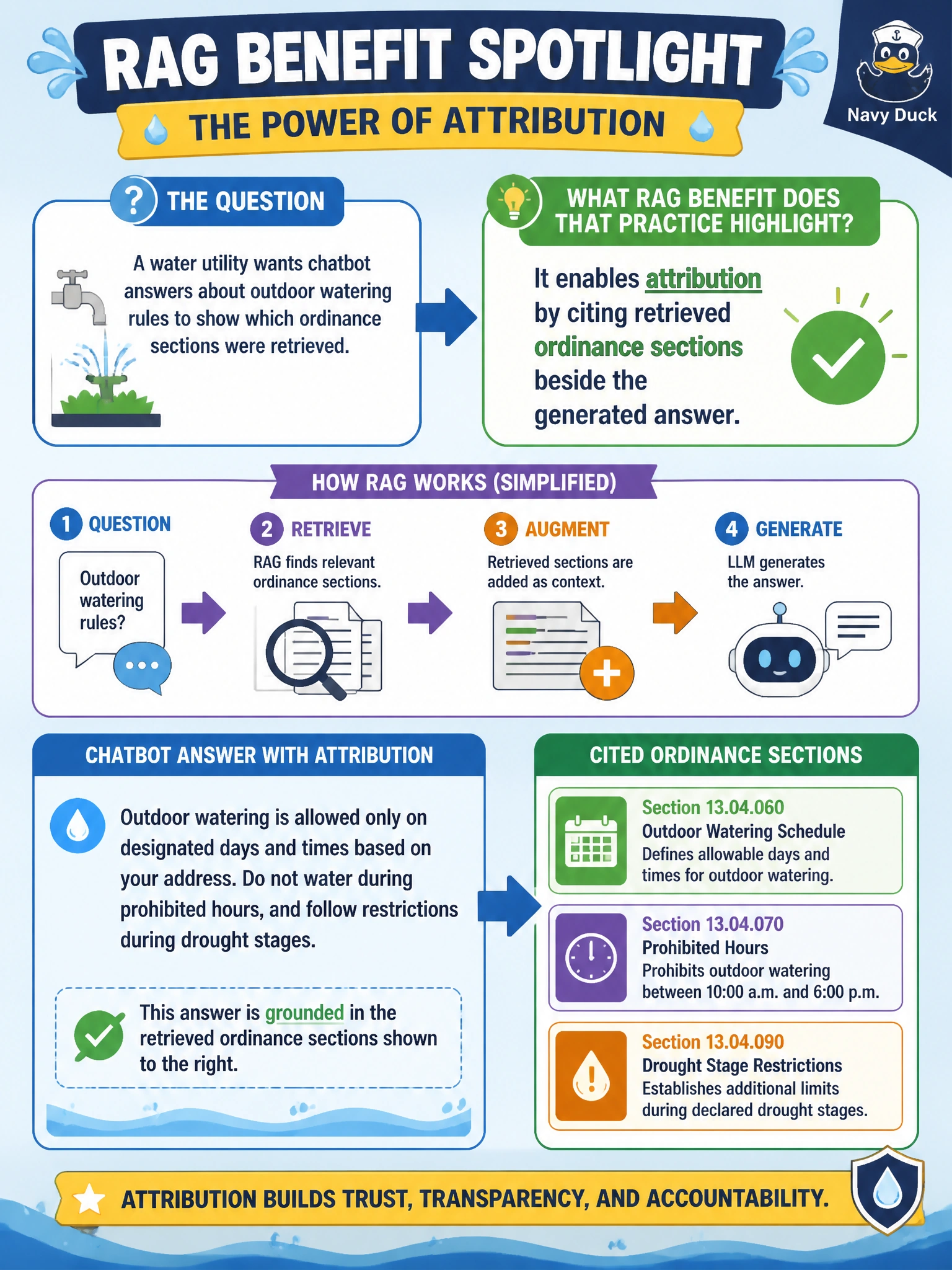
A water utility wants chatbot answers about outdoor watering rules to show which ordinance sections were retrieved. What RAG benefit does that practice highlight?
Select an answer to reveal the explanation.
Short Explanation
Showing the ordinance section next to the answer is like a clerk pointing at the page they used. Residents and auditors can see the grounding, not just a confident paragraph with no trail.
Full Explanation
Showing which ordinance sections were retrieved beside outdoor-watering answers highlights attribution—the ability to point residents and auditors at the civic sources that grounded the reply. In RAG, citations make generation inspectable: the water utility can demonstrate that a restriction came from a retrieved section rather than from an untraceable model guess. That transparency is a primary governance benefit of retrieval-augmented assistants in regulated municipal domains.
Attribution does not prove embeddings permanently delete the need for human review of policy changes; humans still adopt ordinances and validate high-impact messaging. Citations do not eliminate the need for a context window—retrieved text still must fit in the prompt for the model to use it. Turning the assistant into a billing system that posts payments is unrelated to citation practice and would expand scope into transactional risk.
Exam caveat: displaying a section number is only trustworthy if retrieval actually returned that section and the UI does not fabricate citations. Always bind displayed cites to retrieved chunk metadata.
Operational check: for a sample watering-rules question, confirm the UI lists the same section IDs present in the retrieved chunks, open those ordinance links, and verify the generated summary does not contradict the cited text before publishing the feature to ratepayers.