
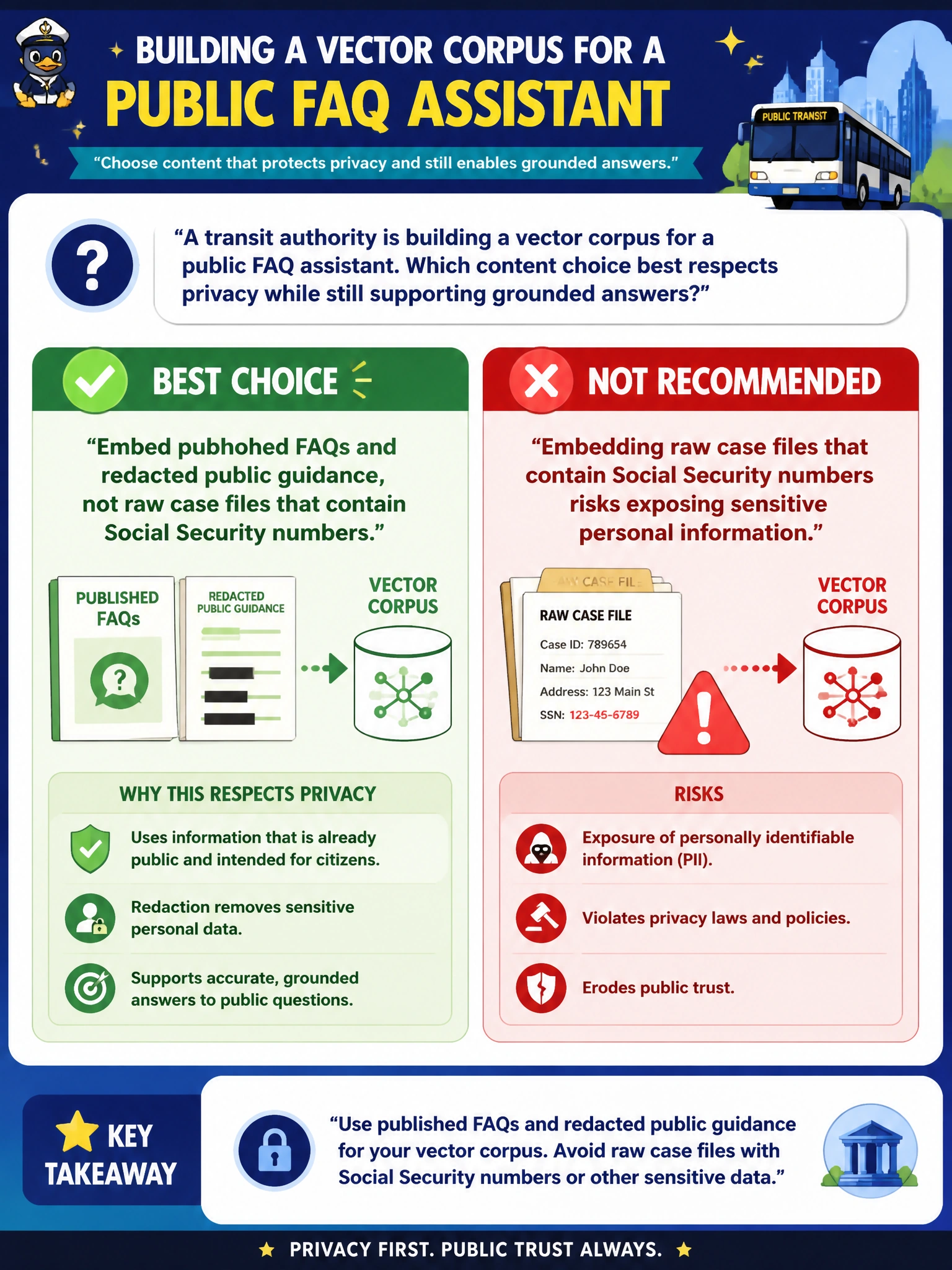
A transit authority is building a vector corpus for a public FAQ assistant. Which content choice best respects privacy while still supporting grounded answers?
Select an answer to reveal the explanation.
Short Explanation
Public FAQ bots should drink from the public fountain, not the locked HR cabinet. Published FAQs belong in the vectors; raw files with SSNs do not. Keep sensitive case junk out of the search pile.
Full Explanation
A transit authority’s public FAQ assistant should ground answers in material that is appropriate to expose through retrieval. Embedding published FAQs and redacted public guidance supports grounded replies while respecting privacy: Social Security numbers and other sensitive case data never enter the vector index that serves trip-planning or fare questions. Least-privilege corpus design is a core municipal RAG control—public bots drink from public (or carefully redacted) wells.
Embedding complete unredacted customer case files invites leakage of account details into prompts and logs whenever retrieval fires; that is a privacy incident waiting to happen, not “better grounding.” Storing driver payroll and badge photos in the same public-answer index mixes HR-sensitive content with rider FAQs and expands blast radius. Indexing CCTV clips with rider faces as the primary source for fare questions is irrelevant to fare policy and introduces biometric and surveillance privacy risks.
Exam caveat: “published FAQs” still need review for oversharing (account numbers pasted into a FAQ draft, etc.). Redaction standards and access-separated indexes for internal casework versus public Q&A remain necessary.
Operational check: inventory candidate corpus sources, block any document class containing SSNs or raw case PII from the public index, run a retrieval spot-check that fare and schedule answers cite only approved FAQ/guidance pages, and document the exclusion list for audit.