
A 311 resident-services desk needs answers that track frequent policy library updates. Leaders reject fine-tuning the base model for each change. Which approach best fits?
Select an answer to reveal the explanation.
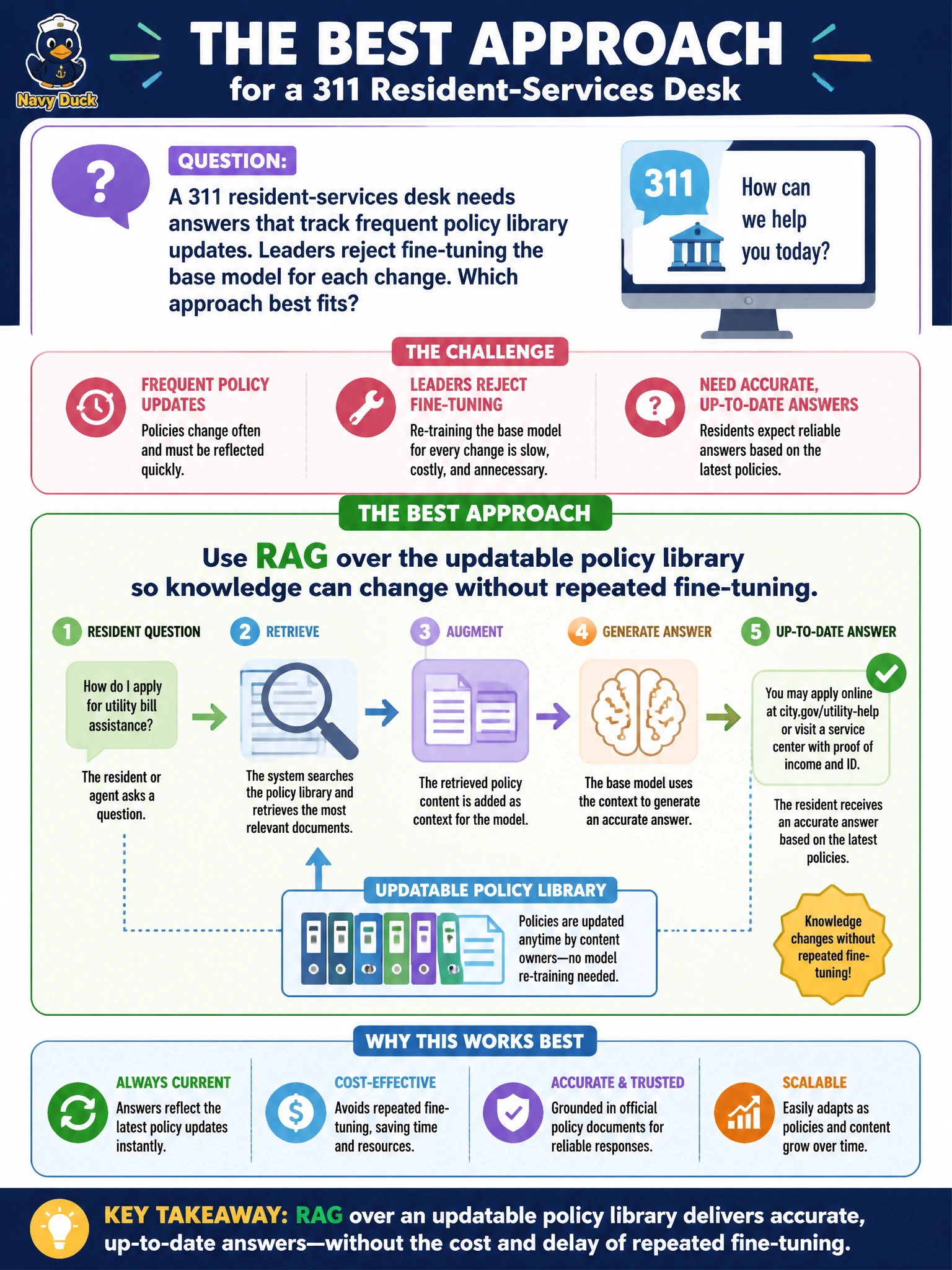
Short Explanation
Policies move; weights don’t like weekly rewrites. Point the bot at a living policy library with RAG and you update the binder, not the whole brain. That is why 311 skipped fine-tune-for-every-memo.
Full Explanation
A 311 resident-services desk lives on policies that change: fee memos, diversion scripts, holiday schedules, and eligibility rules. Fine-tuning the base model for each change is slow, expensive, and hard to audit. RAG over an updatable policy library fits because knowledge lives in documents you can revise and re-index without rewriting model weights. The assistant retrieves the current policy text and generates resident-facing language from that grounding, which is exactly what leaders want when they reject per-change fine-tuning.
Baking every revision into weights weekly recreates the rejected fine-tune treadmill and still lags between training runs. Asking the model to memorize scripts from a single training run and ignore the library abandons the living source of truth. Replacing the policy library with a rules engine that cannot draft resident-facing language may encode logic but fails the need for natural explanations 311 agents and residents expect; it is a different product, not a better fit for conversational policy answers.
Exam caveat: RAG is not maintenance-free. Someone must publish accurate policies, control who can update the corpus, and monitor retrieval quality. Choosing RAG over fine-tuning solves agility; it does not remove governance.
Operational check: pick a recent policy memo, update only the library/index (not weights), ask the desk bot the affected question, and verify the answer reflects the new memo with a citation—proving knowledge changed without a fine-tune cycle.