
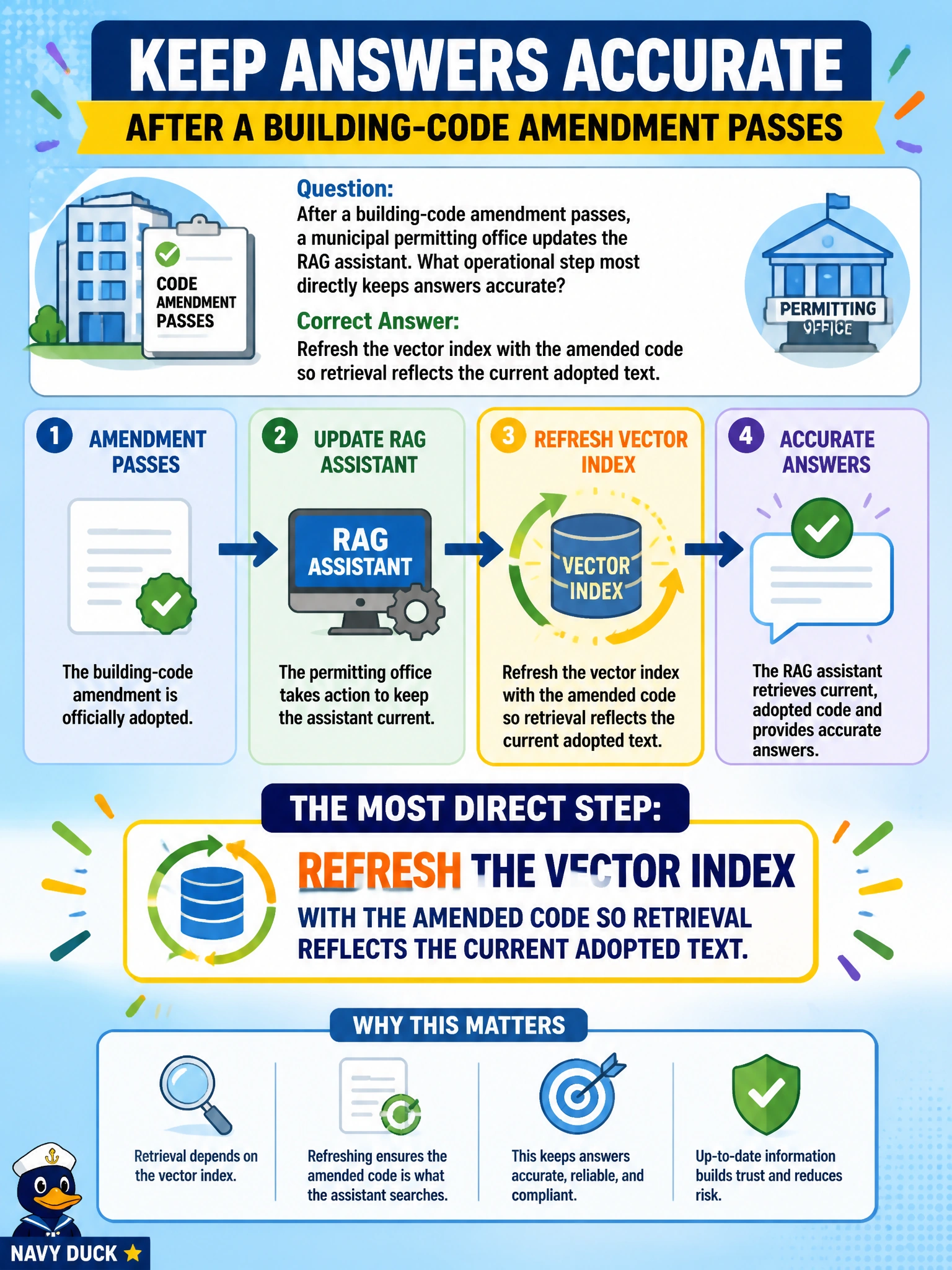
After a building-code amendment passes, a municipal permitting office updates the RAG assistant. What operational step most directly keeps answers accurate?
Select an answer to reveal the explanation.
Short Explanation
When council amends the code, you need the assistant’s index to reflect the new authoritative text. Refresh the vector index so retrieval uses the adopted language, not superseded passages.
Full Explanation
When a building-code amendment passes, the authoritative text changes. If the municipal permitting RAG assistant still retrieves the prior index, it can confidently cite superseded requirements. Refreshing the vector index with the amended code most directly keeps answers accurate because retrieval then reflects the current adopted language. Re-ingest, re-chunk, and re-embed the text, then replace or version old passages so grounded generation tracks what council adopted. Lowering the chat model’s temperature does not delete older code from the vector store: temperature affects sampling randomness, not index contents. Disabling retrieval until every resident re-files open permits is operationally extreme and unrelated to accuracy; existing applications may follow transition rules, but the knowledge base must still show the new text. Retraining a diffusion model on blueprint images addresses image generation, not textual code questions, and cannot regenerate fee or code tables as a substitute for documents. Exam caveat: a refresh should deprecate or version obsolete chunks. Appending the amendment while leaving contradictory old sections equally retrievable can produce mixed guidance, so use clear effective dates and remove or down-rank superseded text. Practical check: verify the new section is searchable, ask a question whose answer changed under the amendment, and confirm the cited language and effective date match the clerk’s official posting rather than the prior text.