
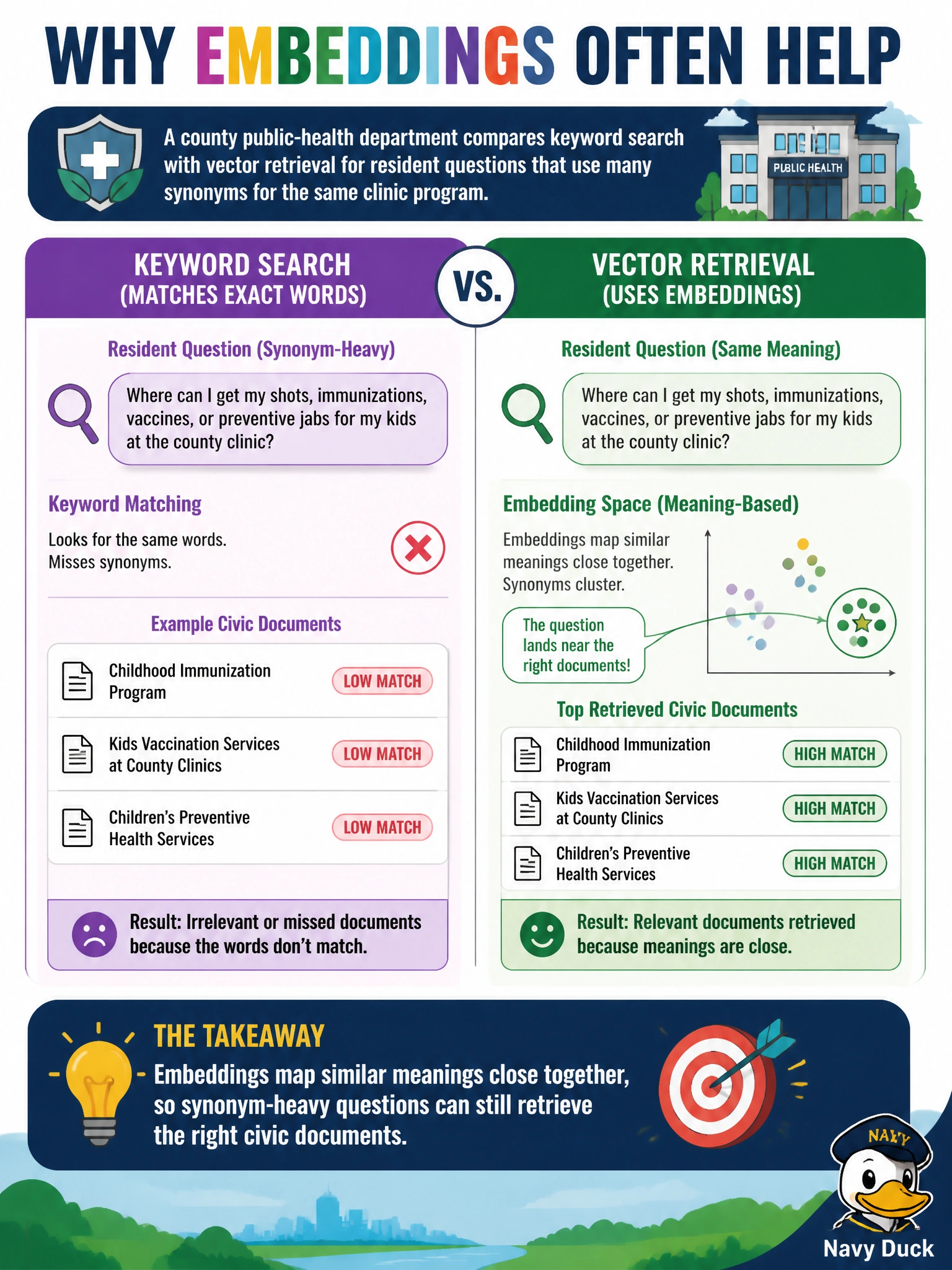
A county public-health department compares keyword search with vector retrieval for resident questions that use many synonyms for the same clinic program. Why do embeddings often help?
Select an answer to reveal the explanation.
Short Explanation
Residents say “flu shot clinic” while the PDF says “immunization event”—same idea, different words. Embeddings park those phrasings near each other so search still finds the right flyer. Plain keyword match can miss that handshake.
Full Explanation
Public-health residents rarely type the exact title of a clinic program. They say “flu shot,” “vaccine day,” or “shot clinic” while the published flyer says “immunization event.” Embeddings place semantically similar phrases near each other in vector space, so synonym-heavy questions can still retrieve the right civic documents even when lexical overlap is weak. That semantic bridge is why vector retrieval often helps a county public-health desk compared with pure keyword search over the same library.
Embeddings do not replace published clinic policy or prove the model already knows every local schedule; schedules change and must remain in curated sources. The idea that keyword search always beats vectors for everyday language is backwards for synonym cases—keywords miss when vocabulary differs. Vector retrieval does not require the resident to type an exact health-code section number; requiring exact identifiers is closer to lexical lookup and defeats the synonym advantage embeddings provide.
Exam caveat: embeddings can over-retrieve loosely related public-health material (another vaccine program, a different clinic). Hybrid search, filters by program or date, and human-reviewed FAQs still matter. Synonym power is not a license to skip curation or citation.
Operational check: build a synonym test set from real 311/public-health phrasings, compare keyword-only versus embedding (or hybrid) recall for the same flyer, and confirm the assistant cites the correct clinic program page before go-live.