
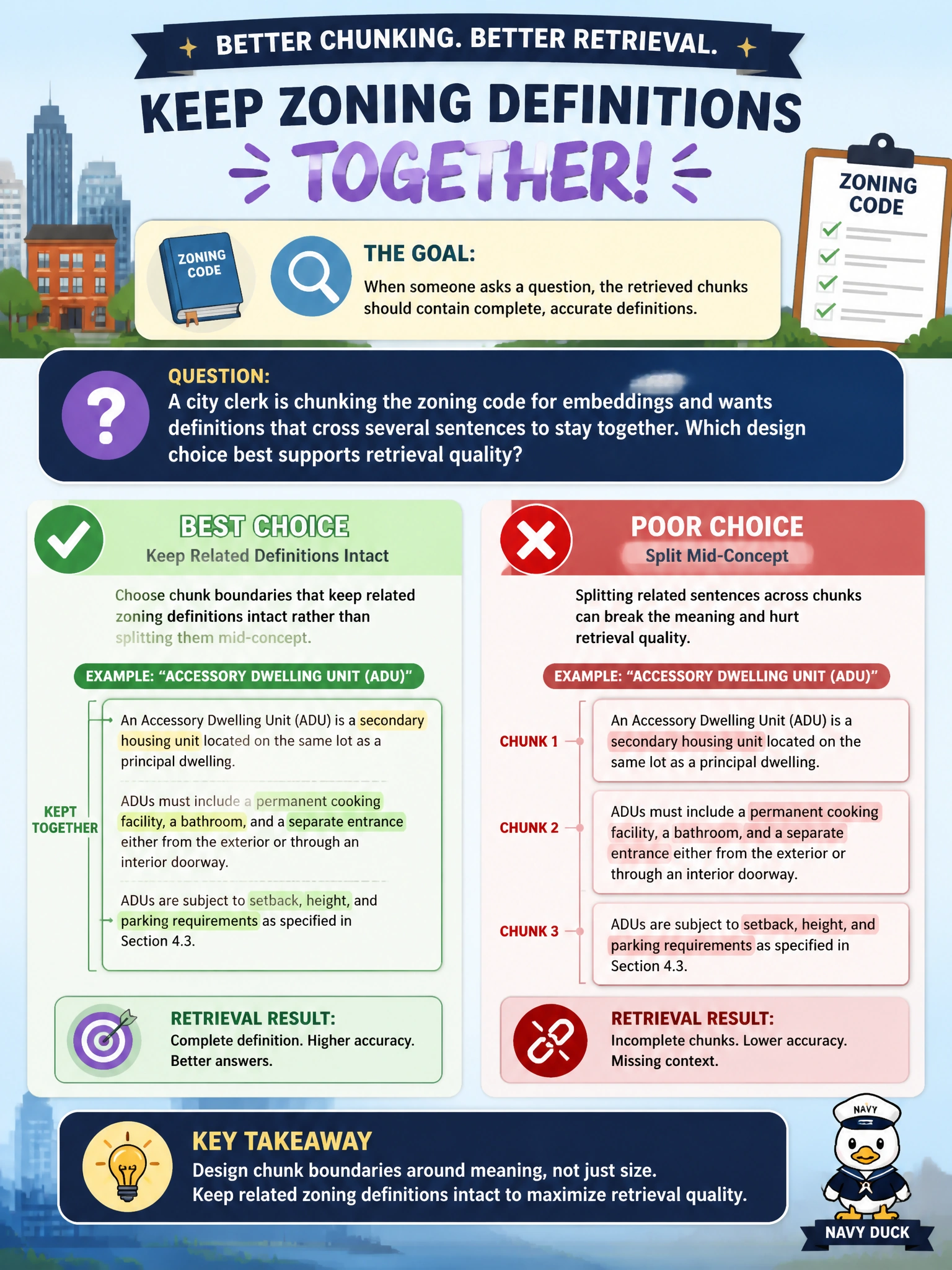
A city clerk is chunking the zoning code for embeddings and wants definitions that cross several sentences to stay together. Which design choice best supports retrieval quality?
Select an answer to reveal the explanation.
Short Explanation
Think of chunking like adding tabs to a binder: if you split a zoning definition mid-thought, retrieval may return only half of it. Keep related sentences together so you get a coherent piece the model can use.
Full Explanation
Embedding quality for municipal codes depends on the chunks you index. A zoning definition that spans several sentences may link purpose, applicability, and exceptions as one concept. Keeping those related sentences intact preserves semantic coherence, so retrieval can return a usable definition rather than a severed half-thought and the generator can answer residents and planners more accurately. A fixed one-sentence limit can split a continuing definition and leave retrieval with incomplete meaning. Disabling embeddings and relying on the chat model’s training memory abandons grounding; zoning language is local and frequently amended, so model recall may be invented or outdated. Storing the entire multi-hundred-page code as one vector creates an oversized blob that wastes context and makes precise retrieval difficult. Exam caveat: keeping related text together does not mean making chunks arbitrarily huge. Long chunks can dilute similarity scores and crowd the context window, so paragraph- or section-aware splits with modest overlap can preserve definitions without swallowing entire titles. Practical check: inspect a multi-sentence definition in the chunker output to confirm it remains intact, then run paraphrase queries for that term and verify the retrieved passages include the complete definition staff would provide to a counter customer.