
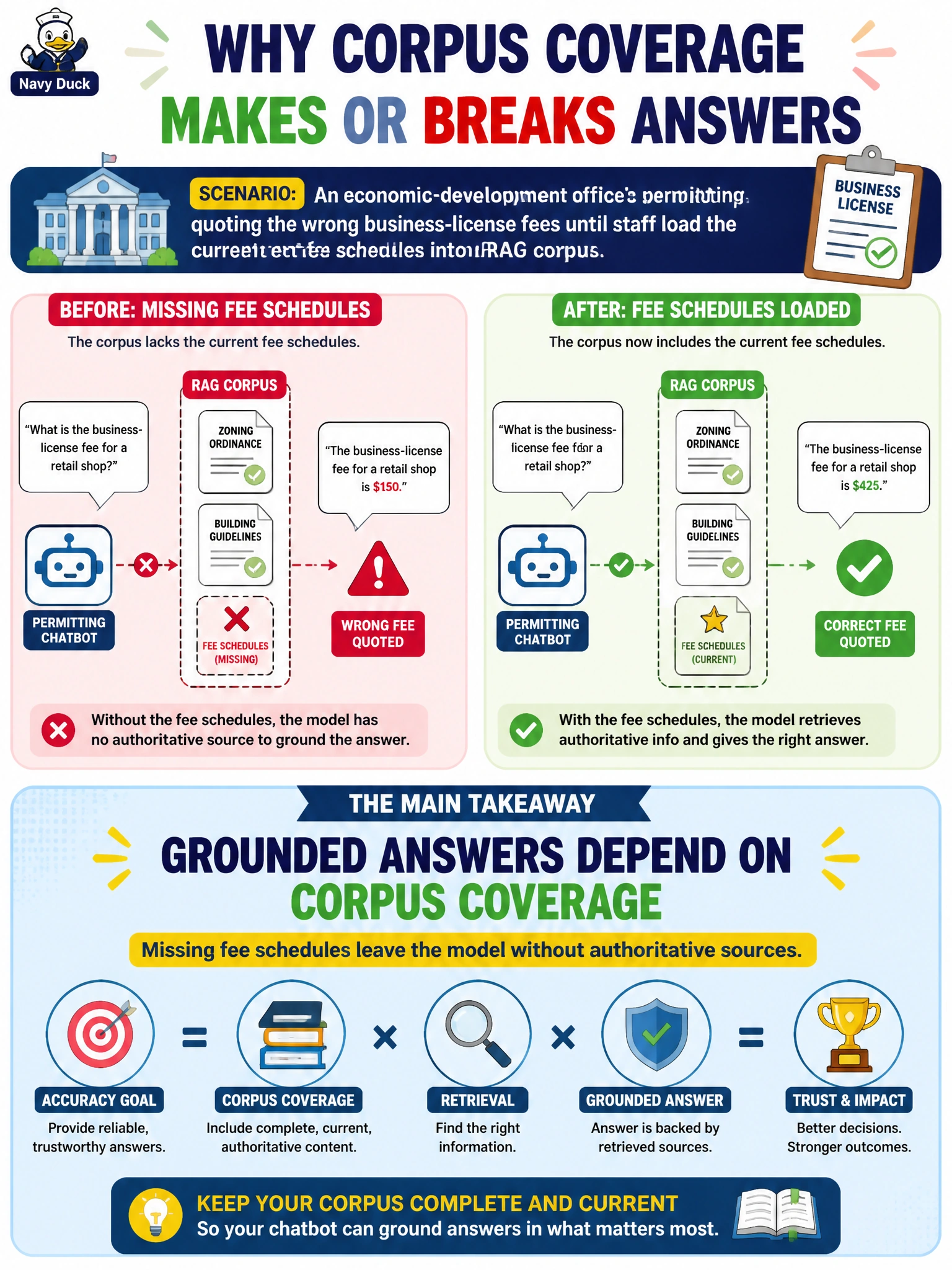
An economic-development office’s permitting chatbot keeps quoting the wrong business-license fees until staff load the current fee schedules into the RAG corpus. What does that outcome mainly show?
Select an answer to reveal the explanation.
Short Explanation
Think of RAG like a reference shelf behind the counter. If the fee binder isn’t on the shelf, the clerk invents from memory—and that’s how wrong license fees sneak out. Stuffing the current schedules into the corpus is what finally gave the model something true to lean on.
Full Explanation
In retrieval-augmented generation (RAG), the chat model does not magically know every municipal fee table. It answers from whatever authoritative text the retrieval layer can find in the corpus and place into context. When the economic-development permitting chatbot quoted wrong business-license fees, the root cause was coverage: the current fee schedules were not in the indexed store, so retrieval could not surface the numbers staff intended to ground on. Loading those schedules into the RAG corpus fixed the failure mode because grounded answers depend on having the right sources available before generation. That outcome is the core lesson for civic AI operators—corpus completeness for high-stakes numeric policy is not optional.
Replacing the embedding model with a larger chat model does not repair missing documents. A bigger generator still invents or approximates fees when no schedule is retrieved; model size is not a substitute for authoritative evidence. Claiming RAG systems ignore documents and only reuse cached resident chats misstates how RAG works: retrieval is designed to fetch corpus passages, and chat history alone is not a substitute for adopted fee schedules. Mandating overnight fine-tuning on every ordinance rewrite confuses parametric learning with knowledge refresh. Fine-tuning is slow, costly, and unnecessary when the operational fix is to index the new schedule and re-retrieve it.
Exam caveat: wrong answers in a RAG bot can also come from stale versions, bad chunking, or weak ranking even when some fee text exists—so coverage is necessary but not always sufficient. Still, this stem highlights the coverage gap that disappeared once schedules were loaded.
Operational check: after publishing new license fees, confirm the PDF or structured schedule is ingested, chunked, embedded, and searchable; spot-ask the bot for two representative license types and verify cited amounts match the council-adopted table before reopening the public assistant.