
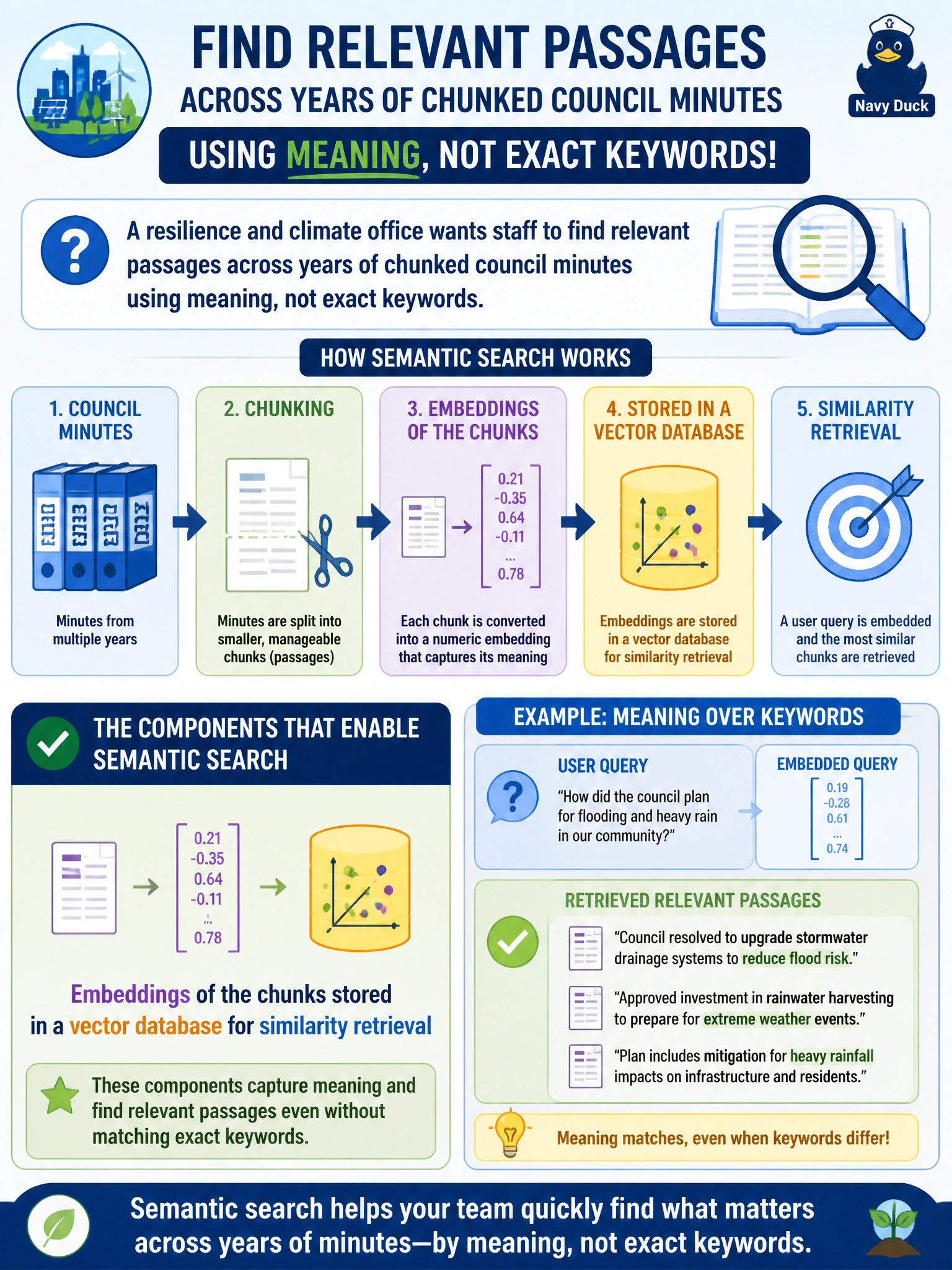
A resilience and climate office wants staff to find relevant passages across years of chunked council minutes using meaning, not exact keywords. Which components enable that semantic search?
Select an answer to reveal the explanation.
Short Explanation
Embeddings turn each chunk of minutes into a meaning-coordinate, and the vector database is the map. Search finds nearby meanings even when the wording differs—perfect for climate staff hunting themes across years.
Full Explanation
Resilience and climate staff searching years of chunked council minutes by meaning need semantic retrieval, not brittle keyword identity. Embeddings of the chunks stored in a vector database enable similarity retrieval: queries and passages map into a shared vector space so related discussions match even when wording differs. That embedding-plus-vector-DB pairing is the core retrieval layer behind many civic RAG systems for thematic search across minutes.
A fax gateway that reprints minutes onto thermal paper is a legacy transport/print path and does not compute semantic similarity. A rules engine that only matches identical five-word phrases is exact lexical matching and fails when climate topics are phrased differently across years. A diffusion model that redraws each minute page as clip art changes modality to images and does not provide meaning-based passage retrieval over the text corpus.
Exam caveat: semantic search still needs sensible chunking, metadata filters (date, committee), and human review before operational decisions; similarity is not guaranteed legal or scientific correctness. Operational check: embed the minutes corpus, run climate-theme queries with known relevant passages, measure recall of those passages versus keyword-only search, and tune chunk size and top-k for staff workflows.