
A city CISO team must analyze lengthy vendor RFPs with a generative assistant. Which hub metadata should they prioritize when shortlisting models?
Select an answer to reveal the explanation.
Short Explanation
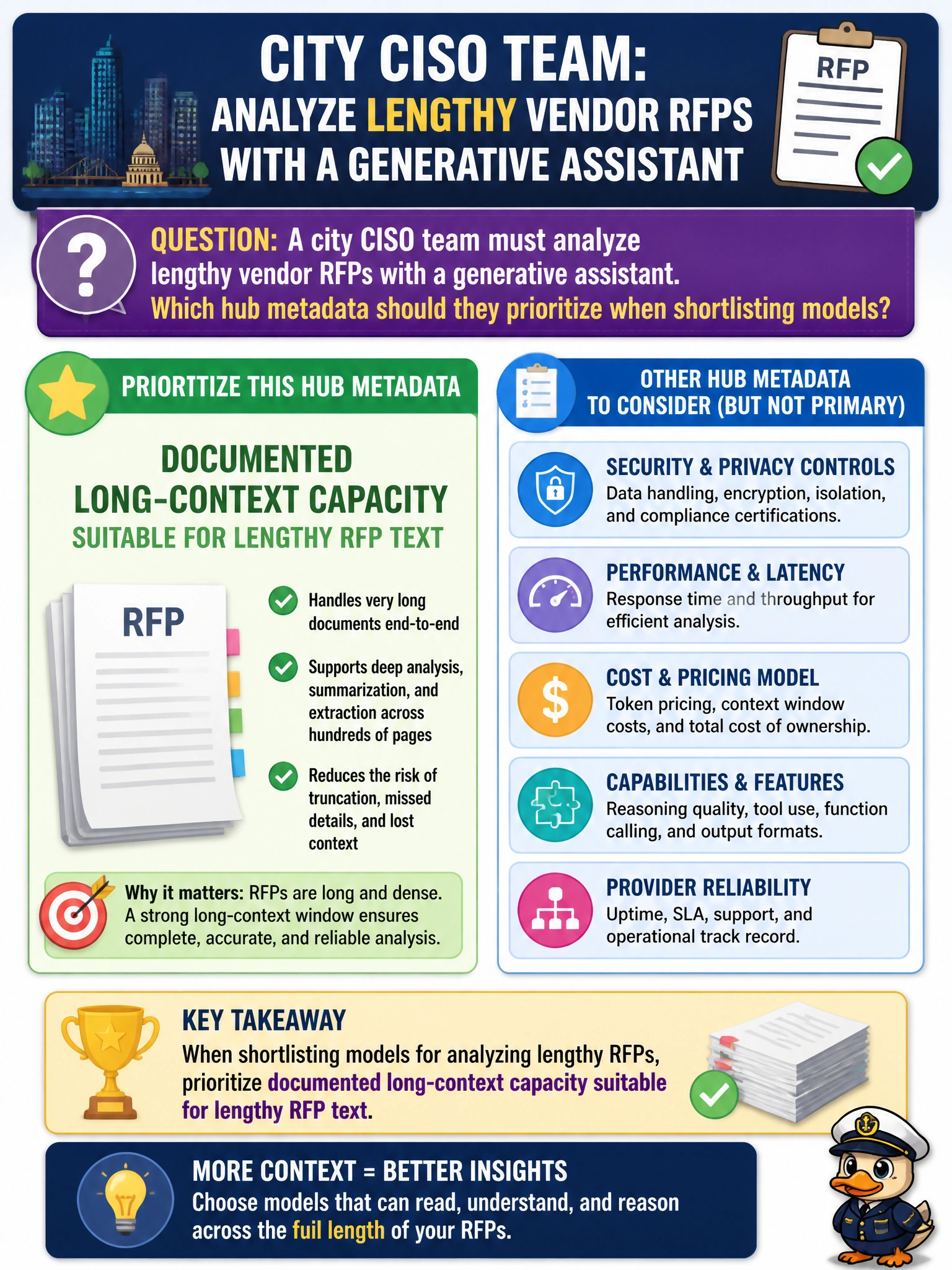
RFPs are phone-book thick. Hunt the hub card for long-context capacity first—pretty gradients and sticker packs won't fit those pages into the window.
Full Explanation
City CISO staff analyzing lengthy vendor RFPs with a generative assistant need models that can hold substantial document text in-context or with far fewer chunks. When shortlisting from a hub, prioritize documented long-context capacity suitable for lengthy RFP text—published context-window size and related long-document claims on the model card. That metadata predicts whether security, privacy, and SLA sections can be compared together without constant aggressive truncation that drops critical clauses.
Whether the card shows neon gradient marketing art is visual packaging aimed at browsers, not evidence of context capacity or security-analysis fitness. Whether the model is listed under cooking recipes (or any unrelated hub category) is taxonomy noise and does not indicate RFP analysis capability. Whether fans have posted unofficial stickers of the model is community merchandise signal with zero bearing on context length or the quality of CISO review support.
Exam caveat: long context reduces chunk count but does not remove careful prompting, citation of clause locations, or human review of security-sensitive RFP interpretations before award decisions. Operational check: compare stated context windows to typical RFP token counts in the city's procurement set, pilot one real vendor RFP end-to-end, and document which card's long-context metadata enabled acceptable section coverage.