
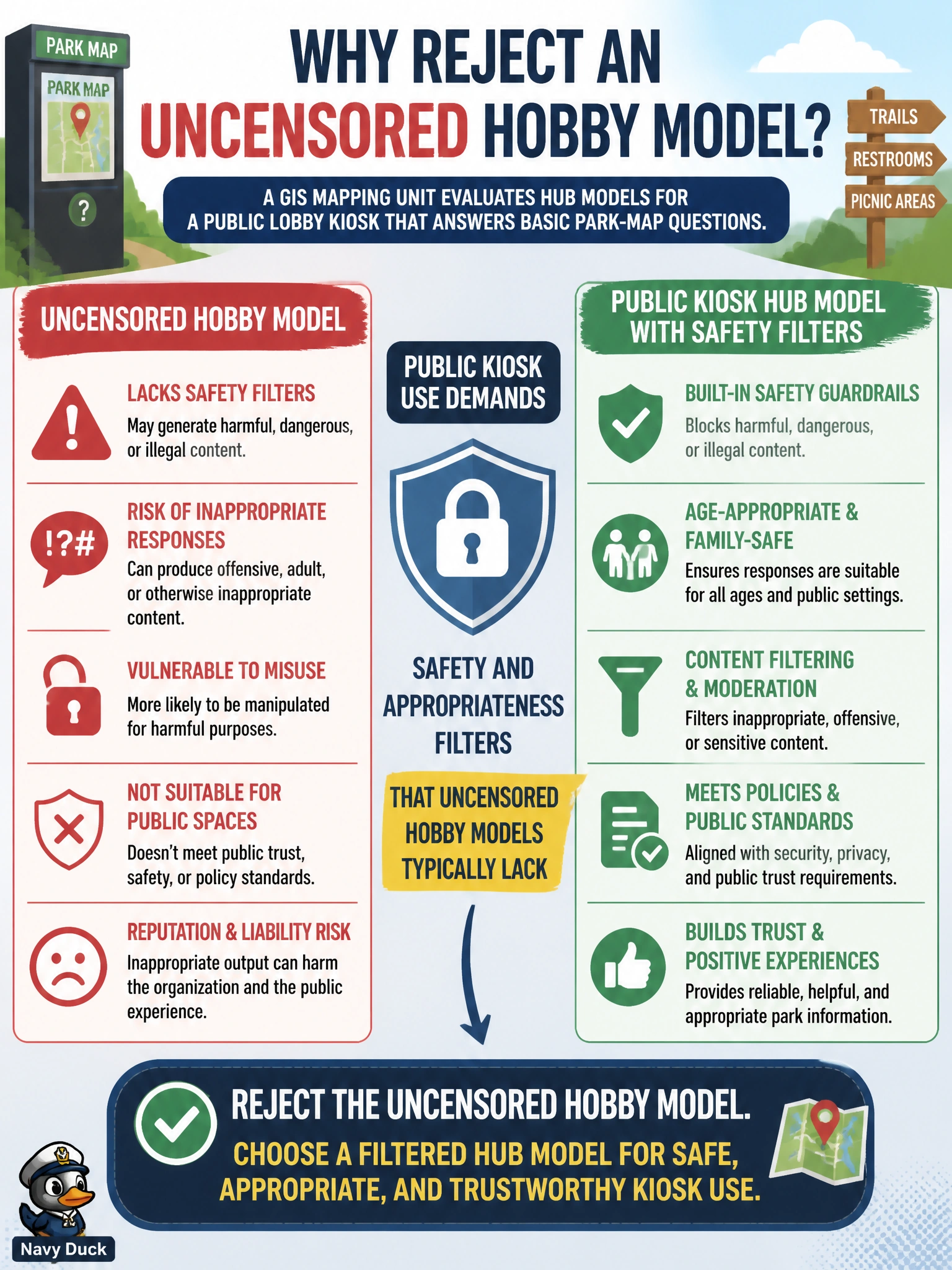
A GIS mapping unit evaluates hub models for a public lobby kiosk that answers basic park-map questions. Why reject an uncensored hobby model?
Select an answer to reveal the explanation.
Short Explanation
A lobby kiosk is not a private sandbox. Uncensored hobby builds skip the guardrails residents expect—pick something safer for the public floor.
Full Explanation
A GIS mapping unit placing a model on a public lobby kiosk that answers basic park-map questions is deploying to uncontrolled resident audiences. Public kiosk use demands safety and appropriateness filters; uncensored hobby models typically lack those guardrails and should be rejected for that venue even if raw capability scores look strong. Safety fit is a first-class selection criterion for citizen-facing municipal AI.
Hobby models do not always require InfiniBand between the kiosk and city hall—that fabric claim is an HPC myth unrelated to content safety. Whether uncensored models can draw vector basemaps in GIS software conflates generative chat safety with desktop GIS cartography; basemap drawing is not the selection issue here. A blanket city procurement ban on any model trained after 2020 is not the stated rationale and would be an odd, capability-harming policy unrelated to rejecting uncensored hobby builds.
Exam caveat: "censored" or aligned models still need content filters, logging, and escalation paths at the application layer for lobby deployments. Operational check: verify safety documentation on the hub card, red-team the kiosk with inappropriate prompts, and keep uncensored hobby weights off the public park-map assistant.