
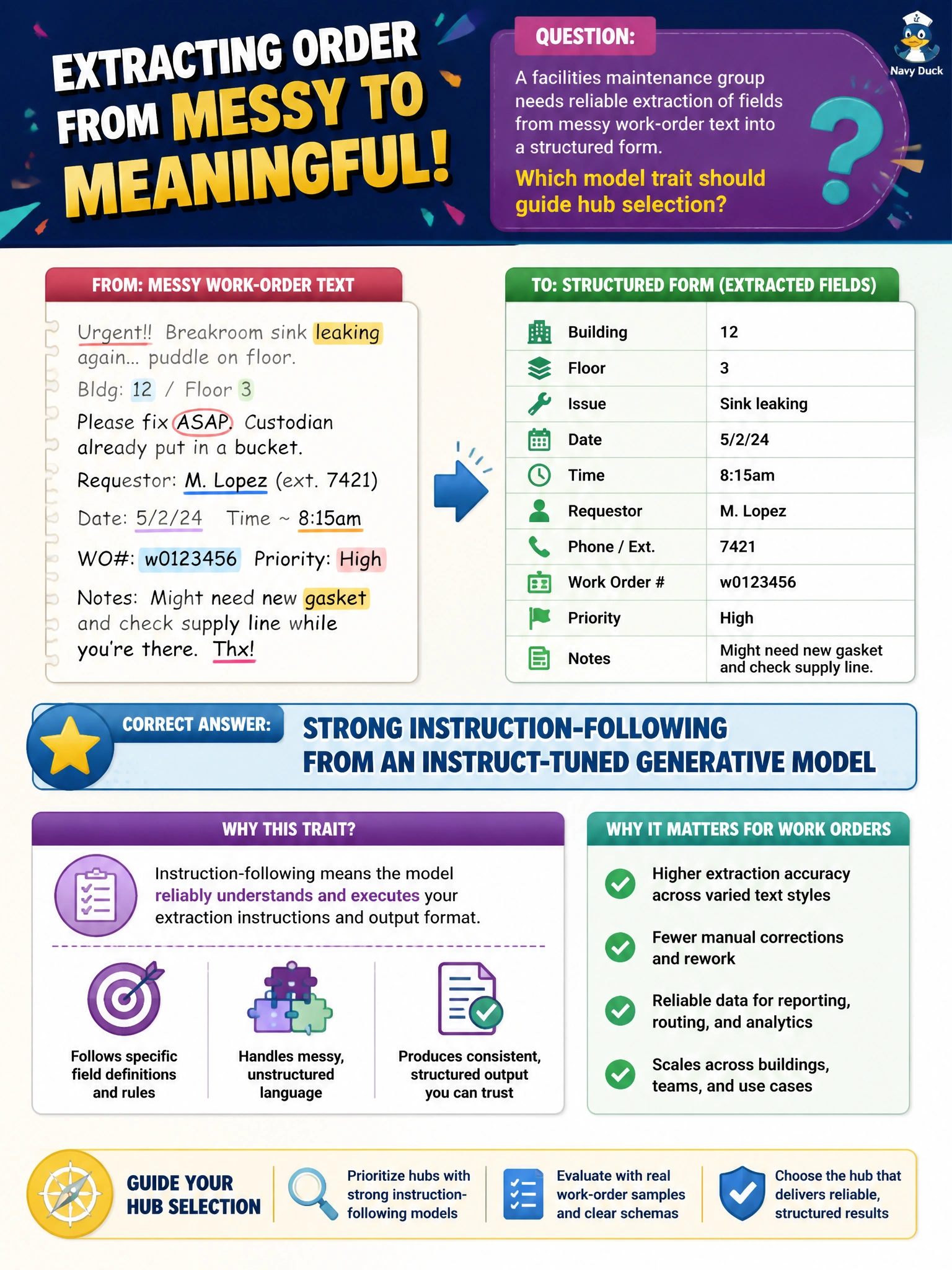
A facilities maintenance group needs reliable extraction of fields from messy work-order text into a structured form. Which model trait should guide hub selection?
Select an answer to reveal the explanation.
Short Explanation
You need the model to follow a recipe: identify the requested fields and return them in the required structure. An instruct-tuned generative model’s instruction-following is the trait to prioritize for turning messy work orders into clean fields.
Full Explanation
Extracting fields from messy work-order text into a structured form requires reliable instruction-following: the model must use fixed field names, respect allowed values, handle missing information as specified, and avoid inventing values. Strong instruction-following from an instruct-tuned generative model is therefore the relevant hub-selection trait; it supports compliance with formatting directions so downstream maintenance-management or ticketing systems can ingest results with less manual cleanup. Maximum image resolution supported by a diffusion card concerns image-generation fidelity, not extracting fields from work-order prose. Generating ambient hold music for callers is an audio capability unrelated to this text-extraction task. A preference for summarizing work orders instead of extracting structured fields does not meet the requirement: a fluent summary can omit, combine, or paraphrase details rather than populate the required fields. Exam caveat: instruction-following does not guarantee valid output, so provide an explicit schema, such as required JSON keys and allowed values, and validate results on the server. Practical check: test candidate models on messy real work orders against a frozen schema, measure field-level precision and recall, and reject a model that ignores format instructions even when its summaries sound fluent.