
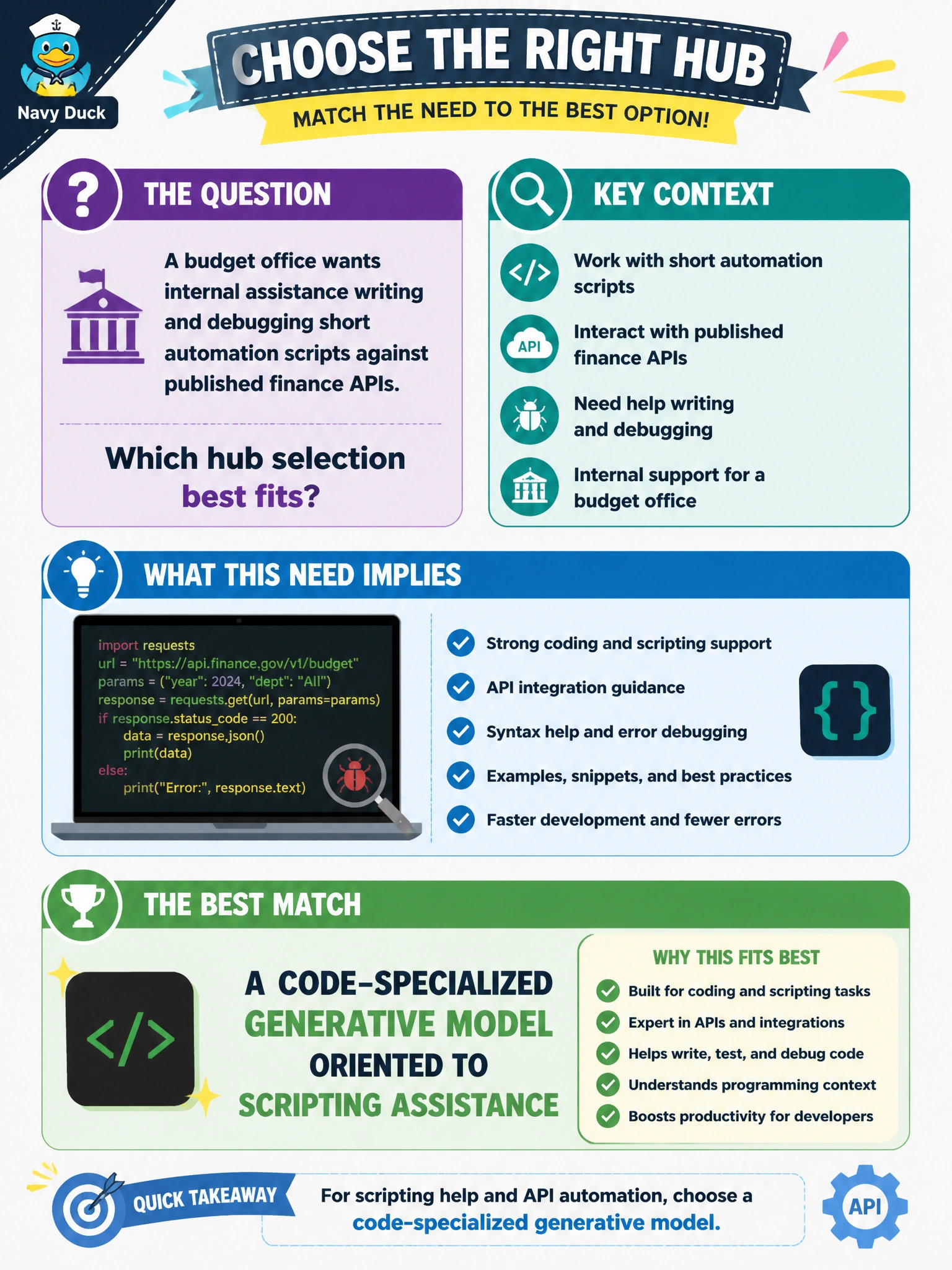
A budget office wants internal assistance writing and debugging short automation scripts against published finance APIs. Which hub selection best fits?
Select an answer to reveal the explanation.
Short Explanation
You’re tackling a scripting job, so choose the code-specialized generative model oriented to scripting assistance. The image-diffusion model decorates budget PDFs, the audio-only transcription model lacks code-token support, and the embedding model only vectorizes the city seal; none is suited to debugging finance API calls.
Full Explanation
Writing and debugging short automation scripts against published finance APIs is a code-generation and code-reasoning task, so the best fit is the code-specialized generative model oriented to scripting assistance. It is suited to producing and repairing code and can offer useful syntax, library choices, and debugging hints; test it on the office’s real API examples. The general image-diffusion model for decorating budget PDFs addresses graphics production, not script authoring or repair. The audio-only transcription model lacking code-token support can transcribe speech, but it cannot generate working finance API client code. The embedding model used only to vectorize the city seal supports similarity search on an emblem image, not interactive scripting assistance. Exam caveat: even a strong code model may invent endpoints, parameters, or authentication flows, so validate its output against the published API documentation and use sandboxed credentials before production. Practical check: run the candidate on a fixed internal suite covering authentication, pagination, retries, and error handling; score compile-and-run success to verify that it handles the office’s actual scripting needs.