
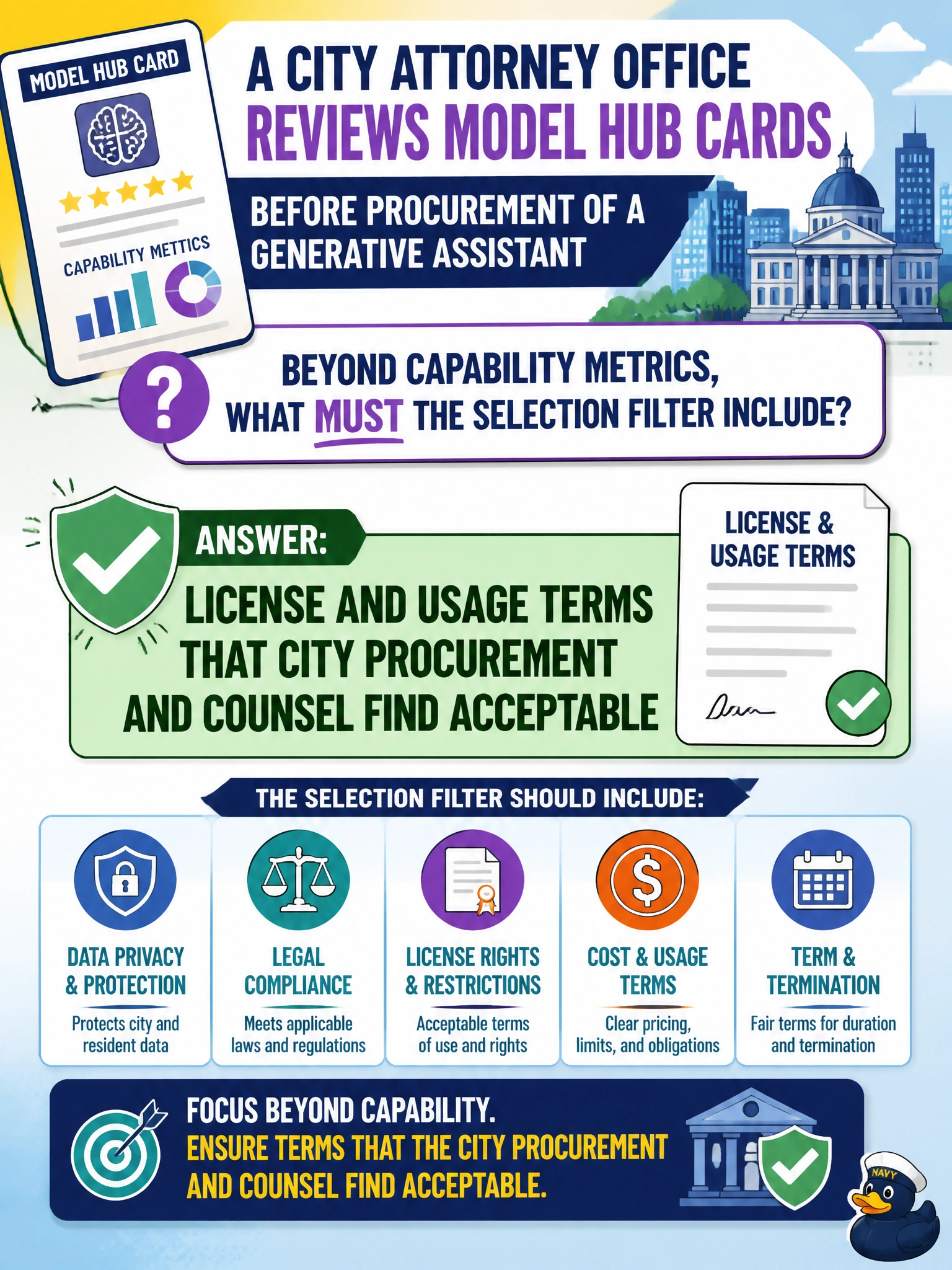
A city attorney office reviews model hub cards before procurement of a generative assistant. Beyond capability metrics, what must the selection filter include?
Select an answer to reveal the explanation.
Short Explanation
Capability demos are fun, but the city still has to sign the paperwork. Read the license like you would any vendor contract—procurement cares as much as the demos do.
Full Explanation
City attorney review of model hub cards for a generative assistant must include legal and procurement fit, not only capability demos or leaderboard scores. License and usage terms—redistribution rights, commercial use, output ownership, training-data use of city prompts, indemnification, and geographic restrictions—must be acceptable to procurement and counsel before any shortlist advances. A highly capable model wrapped in unacceptable terms remains a failed municipal selection because the city cannot lawfully or contractually deploy it.
Whether the hub uses a dark or light theme in the web UI is pure presentation chrome and tells counsel nothing about rights or risk. Whether the model name contains the word "municipal" is branding coincidence; naming does not create a public-sector license or waive restricted-use clauses. Whether fan art of the model mascot is trending on social media is popularity noise with no weight in a city attorney's procurement filter.
Exam caveat: hub license text can differ by model revision and by "open weights" versus hosted API offerings; pin the exact artifact and archive the terms reviewed with the purchase file. Operational check: attach counsel-reviewed license notes to the selection memo, flag unacceptable training-data or outbound-use clauses in the first pass, and refuse to advance cards that lack clear, counsel-readable terms.