
A convention-center IT group must summarize lengthy council packets and is comparing generative models on a hub. Beyond quality samples, which capacity factor should weigh heavily in selection?
Select an answer to reveal the explanation.
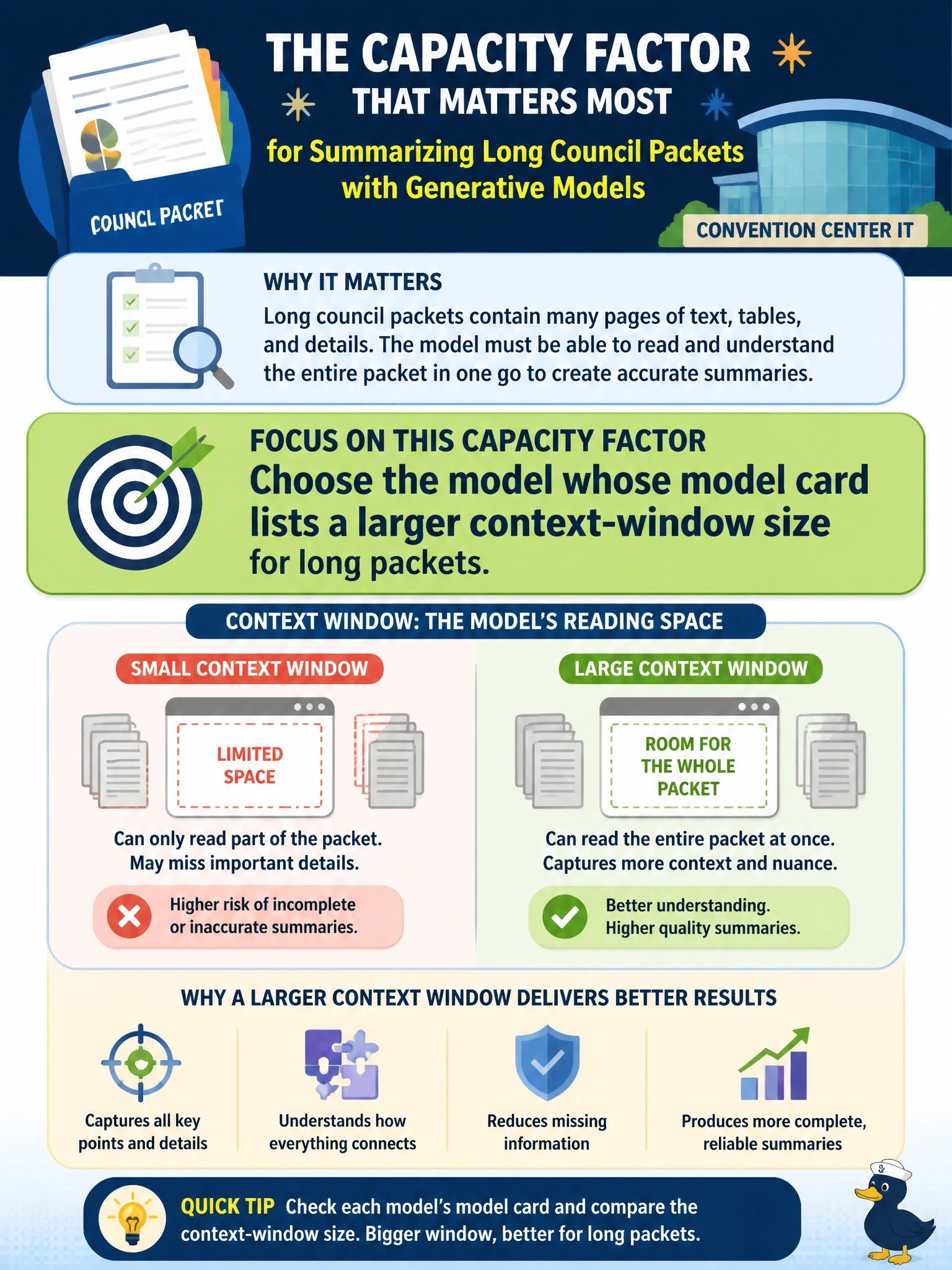
Short Explanation
When you’re working with lengthy council packets, you need room for more of the text at once. A larger context window gives the model a bigger desk, so fewer pages get left out of the summary.
Full Explanation
For lengthy council packets, the model card’s stated context-window size is a meaningful capacity measure: a larger window can fit more agenda text, attachments, and prior summary state together, allowing the model to process more of a packet in one pass or with fewer chunks. This reduces the risk of truncating municipal content and can help keep a summary coherent across sections. A default city seal watermark is a branding or output-styling feature; it does not increase how many tokens the model can attend to. A hub UI theme that matches the convention center brand guide is cosmetic and has no bearing on the model’s inference capacity. Requiring packets to arrive as Morse-code transcripts is a novelty and an unsuitable workflow requirement, not a useful capacity measure for summarizing council packets. Exam caveat: a large context window does not eliminate the need to chunk extremely large binders, and instruction clarity and evaluation on real packets still matter. Practical check: compare the context lengths stated on candidate model cards with median and p95 council-packet token counts, then run side-by-side summaries of the same packet to see whether the larger window reduces dropped sections.