
A parking authority notices that bilingual English–Spanish prompts and replies use more of the monthly inference allotment than English-only traffic. What should staff understand about the budget impact?
Select an answer to reveal the explanation.
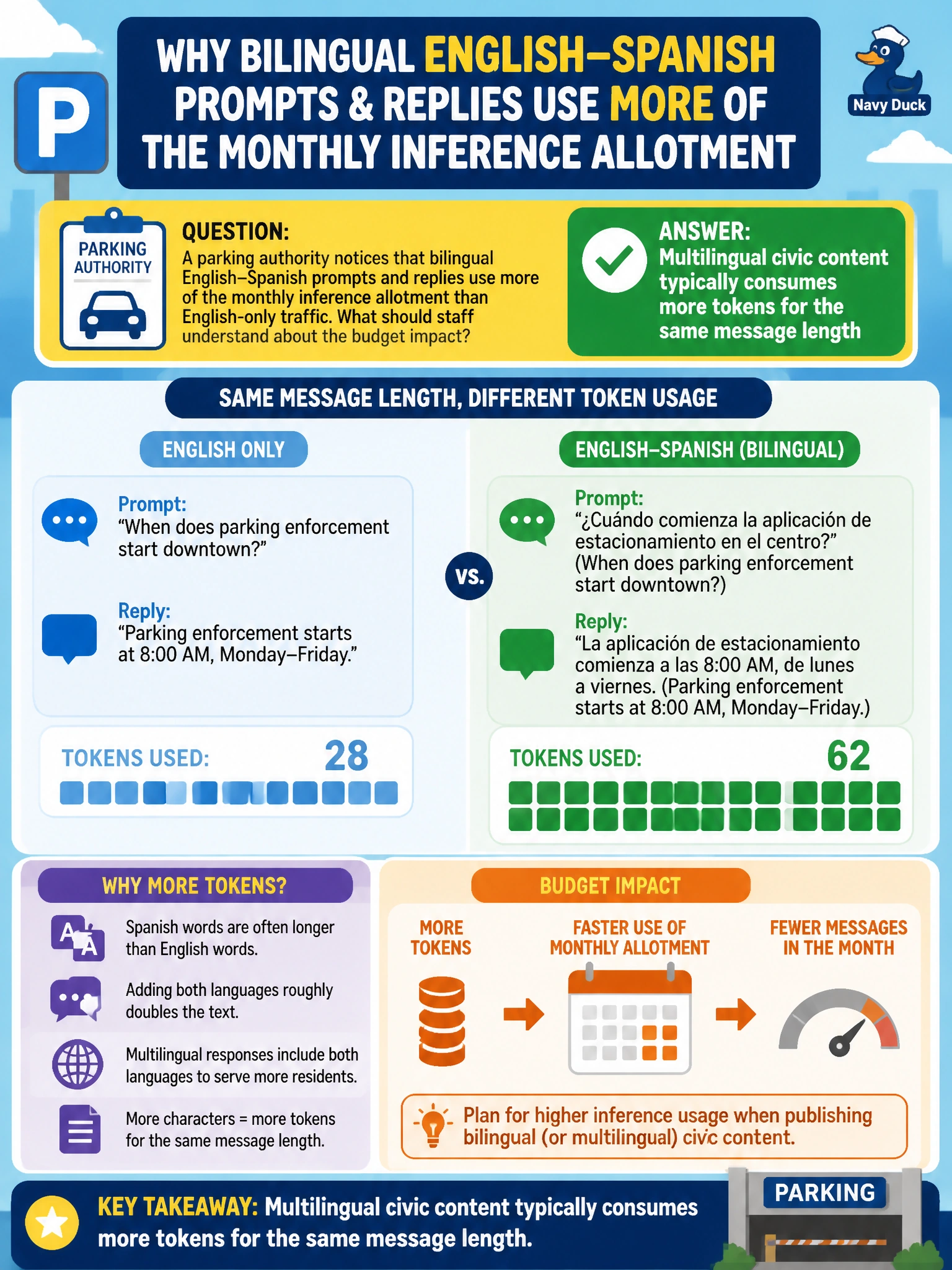
Short Explanation
Two languages means roughly two suitcases of packing material for the same trip story. Tokenizers often spend more pieces on multilingual wording, so the parking desk's bill climbs even when the meaning stays the same.
Full Explanation
Parking-authority bilingual English–Spanish prompts and replies typically consume more tokens than English-only traffic of similar human length because tokenizers often fragment multilingual or code-switched text into more pieces. Those extra tokens raise both context usage and billed inference for the same operational message, which explains the monthly allotment climb staff observe. Budget planning for language-access services must therefore assume higher token intensity for bilingual civic channels.
Spanish characters are not billed as GPU-hours rather than tokens in standard generative APIs; usage is still token-metered (or equivalent request metering), not a separate Spanish GPU tariff. Bilingual prompts are not free merely because the city licensed a GIS basemap—mapping licenses do not waive inference tokenization. Tokenizers do not ignore non-English text; non-English content is tokenized, often less efficiently per character than English, so a billing-error assumption is the wrong first diagnosis.
Exam caveat: exact token multipliers vary by model tokenizer and by how much Spanish versus English appears; measure on your production model rather than assuming a fixed 2× rule. Operational check: sample matched English-only and bilingual parking transcripts, compare token counts for equivalent intents, and resize monthly allotments or summarization policies for language-access load.