
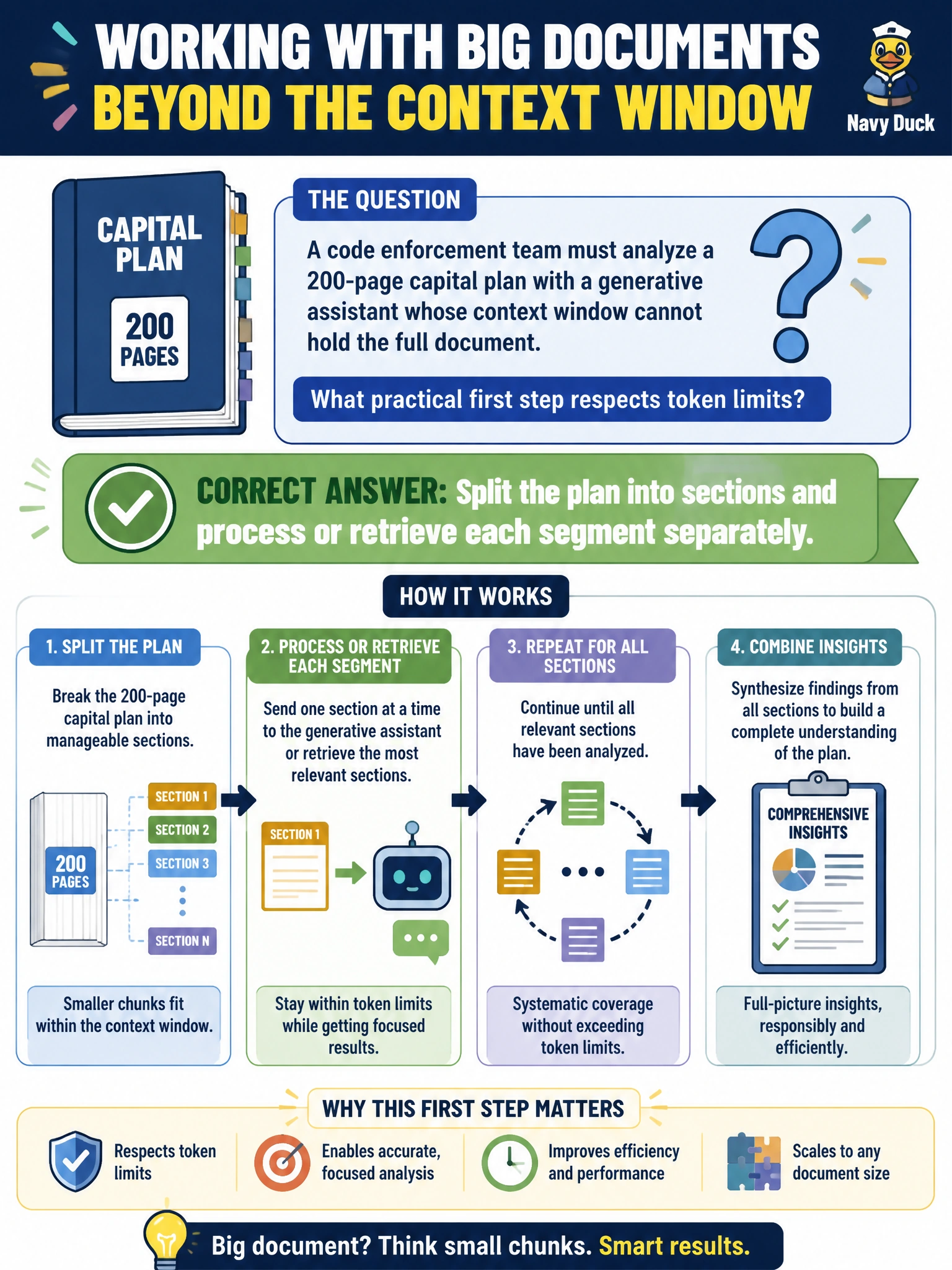
A code enforcement team must analyze a 200-page capital plan with a generative assistant whose context window cannot hold the full document. What practical first step respects token limits?
Select an answer to reveal the explanation.
Short Explanation
You wouldn’t try to swallow a whole sandwich in one bite, and you don’t need to ask the assistant to take in a 200-page plan all at once. Split the plan into sections, process or retrieve each piece, and then bring the findings together—token windows work the same way.
Full Explanation
A 200-page capital plan can exceed a generative assistant’s context window, so the practical first step is to split it into sections and process or retrieve each segment separately. You can use section-by-section prompting, map-reduce-style summarization, or chunked retrieval-augmented generation, then combine findings to cover the document systematically while respecting token limits. Pasting the entire plan repeatedly until the model “memorizes” it wastes tokens, can hit the same truncation repeatedly, and does not create durable memory of the PDF in the model’s weights. Converting every page to a diffusion image and discarding the text loses the analyzable ordinance and budget language needed for the task. Uploading the entire plan at once and relying on the assistant to prioritize relevant pages does not solve the context-window limit; the document may not fit, and relevant material may be omitted. Exam caveat: segmentation can miss cross-references, so use a second pass to reconcile findings across chapters rather than treating one chunk as the whole plan. Practical check: chunk by logical sections, record which sections were analyzed, verify high-stakes figures against source pages, and retain retrieval metadata so auditors can see what the assistant actually saw.