
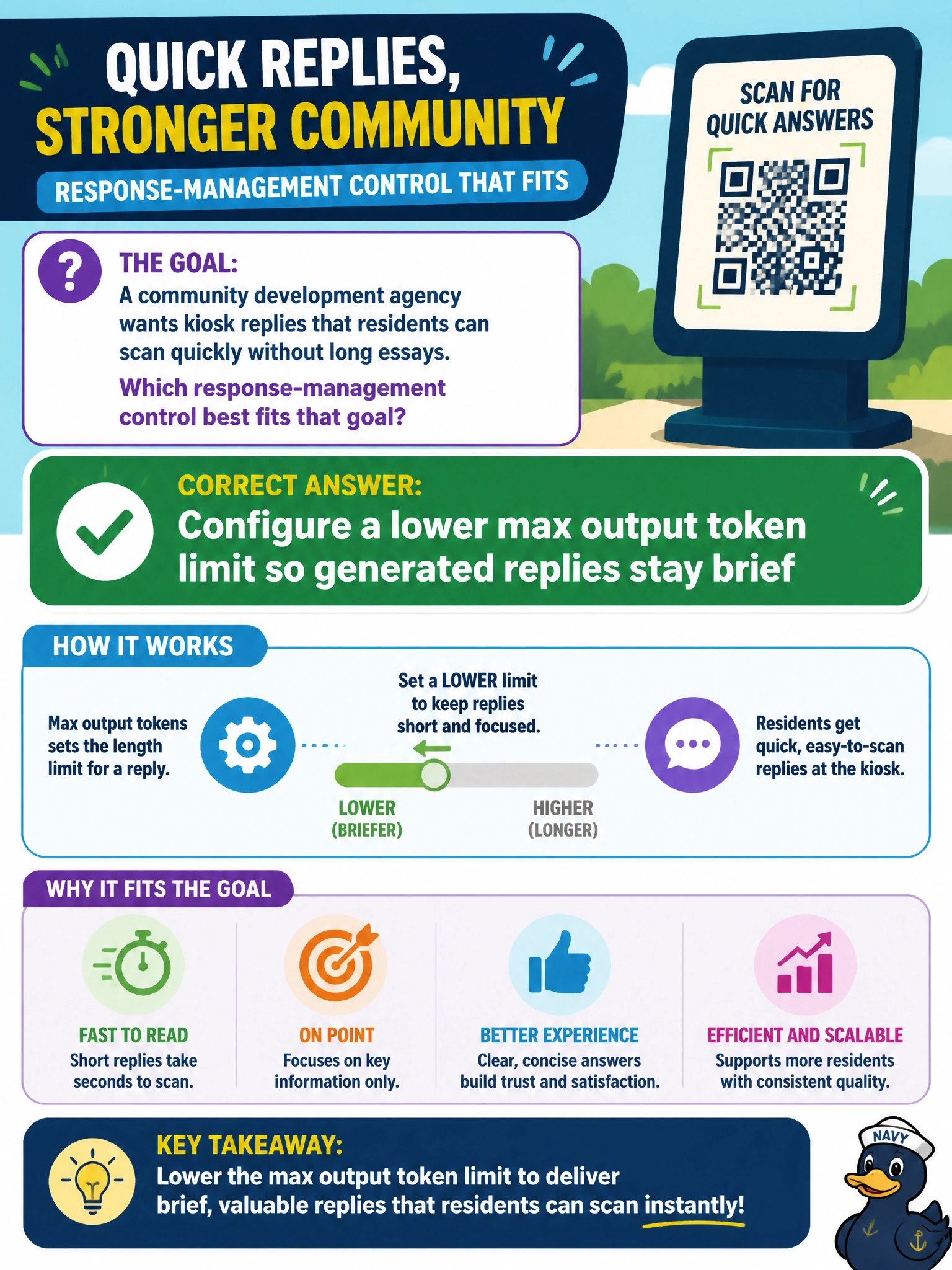
A community development agency wants kiosk replies that residents can scan quickly without long essays. Which response-management control best fits that goal?
Select an answer to reveal the explanation.
Short Explanation
Max output tokens are the leash on how long the kiosk is allowed to talk. Tighten the leash and residents get a scannable blurb instead of a novella.
Full Explanation
Community-development kiosks serve residents who need scannable answers, not essays. Configuring a lower maximum output token limit (often with related decoding settings) directly caps how long the model may generate, which is the standard response-management control for brief public replies. Shorter completions improve readability on small screens and reduce abandonment when residents only need a quick direction or eligibility blurb.
Increasing embedding dimension does not make answers visually shorter; embedding size affects vector representation for retrieval or similarity, not rendered reply length. Disabling the context window so the model answers in a single word is not a real control and would break grounded civic answers that need some input context. Switching exclusively to an uncensored hobby model addresses safety posture, not length management, and is usually inappropriate for public kiosks anyway.
Exam caveat: max output tokens limit length but do not by themselves guarantee factual correctness; pair length caps with retrieval of published community-development content and clear prompts for bullet-style answers. Operational check: A/B test kiosk transcripts at several max_tokens settings, measure average visible length and completion rate, and choose the lowest setting that still answers the common resident intents completely.