
A veterans services office asks why mid-conversation answers suddenly ignore constraints that were stated clearly at the start of the chat. What explanation should the practitioner give?
Select an answer to reveal the explanation.
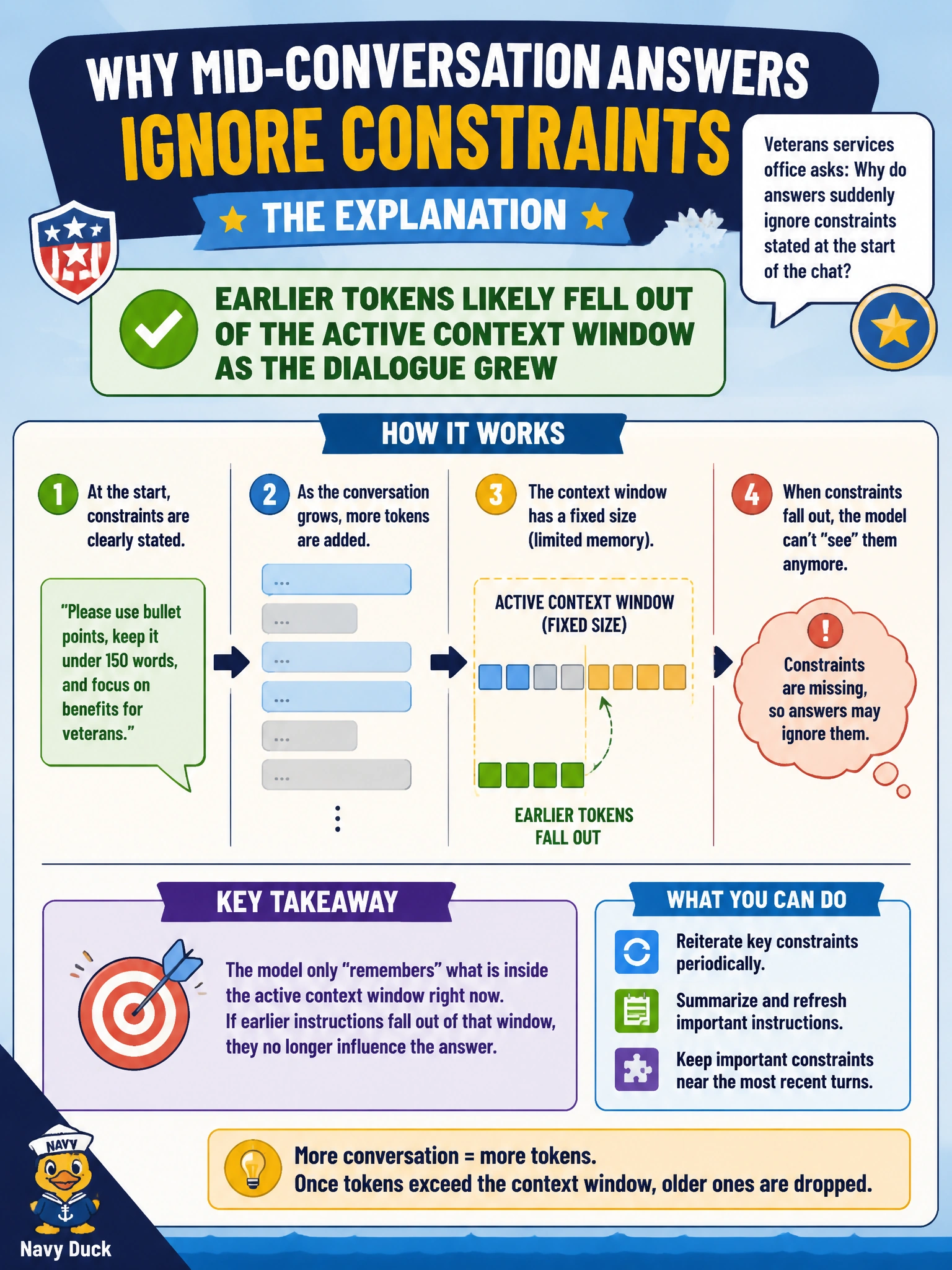
Short Explanation
It's like a tape recorder with a short loop: keep talking and the opening instructions get overwritten. The model isn't being rebellious—those early tokens simply slid out of the window.
Full Explanation
Veterans-services chats that open with clear constraints still degrade mid-conversation when the dialogue outgrows the active context window. Finite windows preferentially retain recent turns; earlier tokens—including opening eligibility rules, privacy limits, and tone requirements—fall out or are compressed so later replies no longer reflect them. The practitioner should explain that mechanical window overflow, not willful policy abandonment, is the usual cause, and recommend restating critical rules, summarizing history, or retrieving standing constraints.
Claiming the model permanently forgets all municipal policies after the first reply overstates the failure mode: parametric knowledge remains, but absent tokens cannot constrain the current generation. Asserting that only vision models retain opening constraints across a long shift is false; retention is about context management and architecture features such as memory or retrieval, not vision modality. Hub license terms that "expire after ten turns and strip system instructions" are not a standard product behavior and do not explain sudden mid-chat constraint loss.
Exam caveat: some platforms offer long-context or memory features, but practitioners must still verify whether early system content remains inside the window or was summarized away. Operational check: reproduce a long veterans-services transcript, confirm when the opening constraint tokens disappear from the prompt sent to the API, and add periodic rule re-injection before those turns.