
A public hospital IT team needs a fixed-context assistant that can still include key ordinance excerpts when answering staff policy questions. What prompt-budget move best supports that goal?
Select an answer to reveal the explanation.
Short Explanation
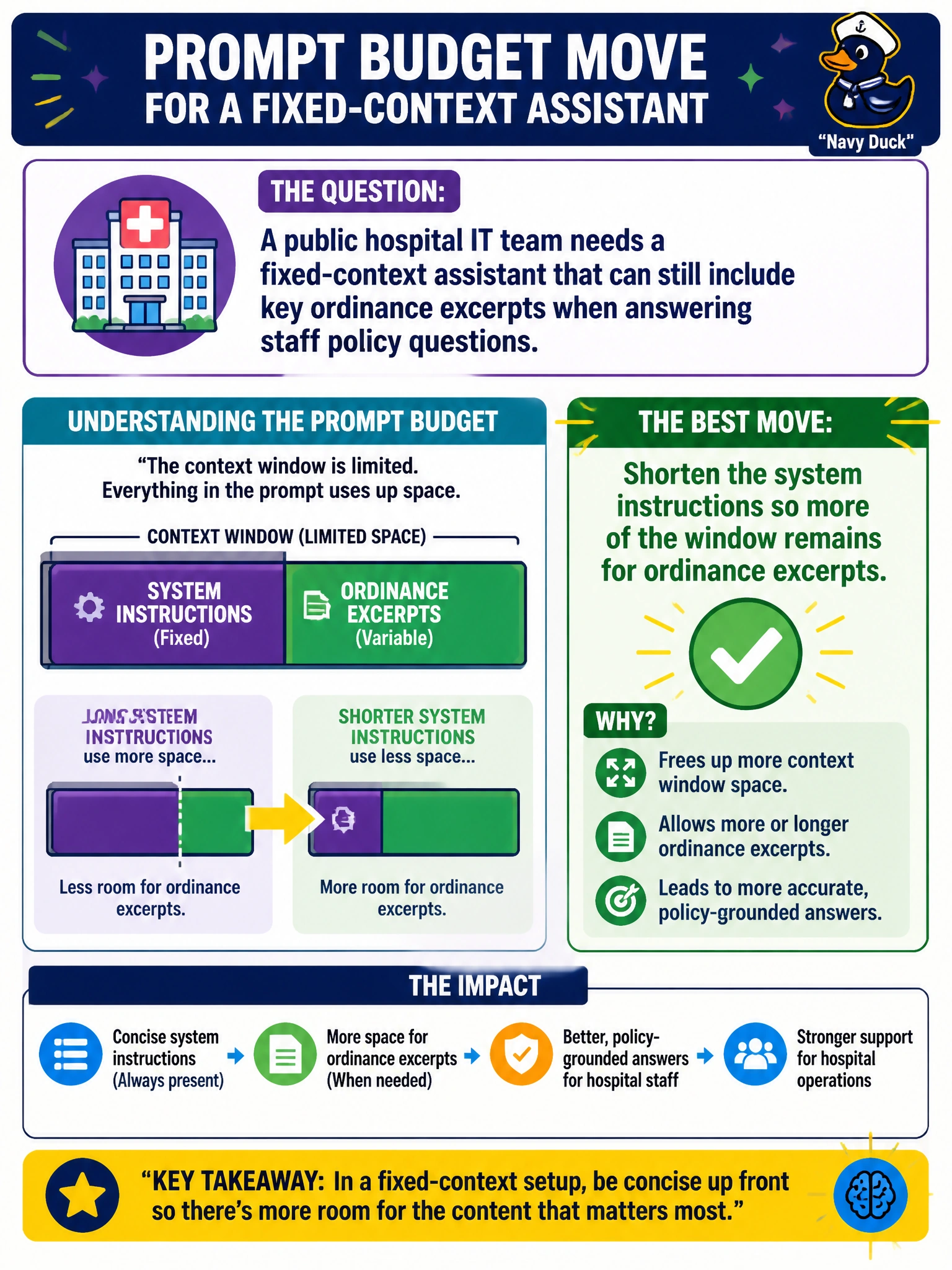
Think of the context window as a lunchbox with limited slots. If the system-prompt sandwich is huge, there's no room for the ordinance apple. Trim the standing instructions so the important excerpts still fit.
Full Explanation
A fixed-context public-hospital assistant must allocate a scarce token budget among standing system instructions, staff questions, and authoritative ordinance excerpts that should ground policy answers. Shortening system instructions is the practical prompt-budget move that frees window capacity for those excerpts without changing the model or inventing impossible bypasses. When ordinances actually appear in-context, staff answers stay tied to adopted text rather than vague parametric recollection.
Replacing the text model with a diffusion model so ordinances "render as posters" switches modality to image generation; posters do not supply grounded text reasoning for policy Q&A. Disabling tokenization so ordinance text bypasses the context window is not an available control—tokenization is how discrete models consume text, and there is no municipal override that skips the window. Moving the entire electronic health record into every prompt crowds the window further, raises privacy and minimum-necessary concerns, and still competes with ordinances rather than reserving room for them.
Exam caveat: shortening instructions must not delete non-negotiable safety, privacy, or role constraints; trim verbosity and redundancy, then retrieve or paste only the ordinance passages needed for the question. Operational check: track tokens spent on system prompt versus retrieved ordinance text, set a reserved budget for citations, and verify sample policy answers quote or paraphrase the excerpts actually present in the prompt.