
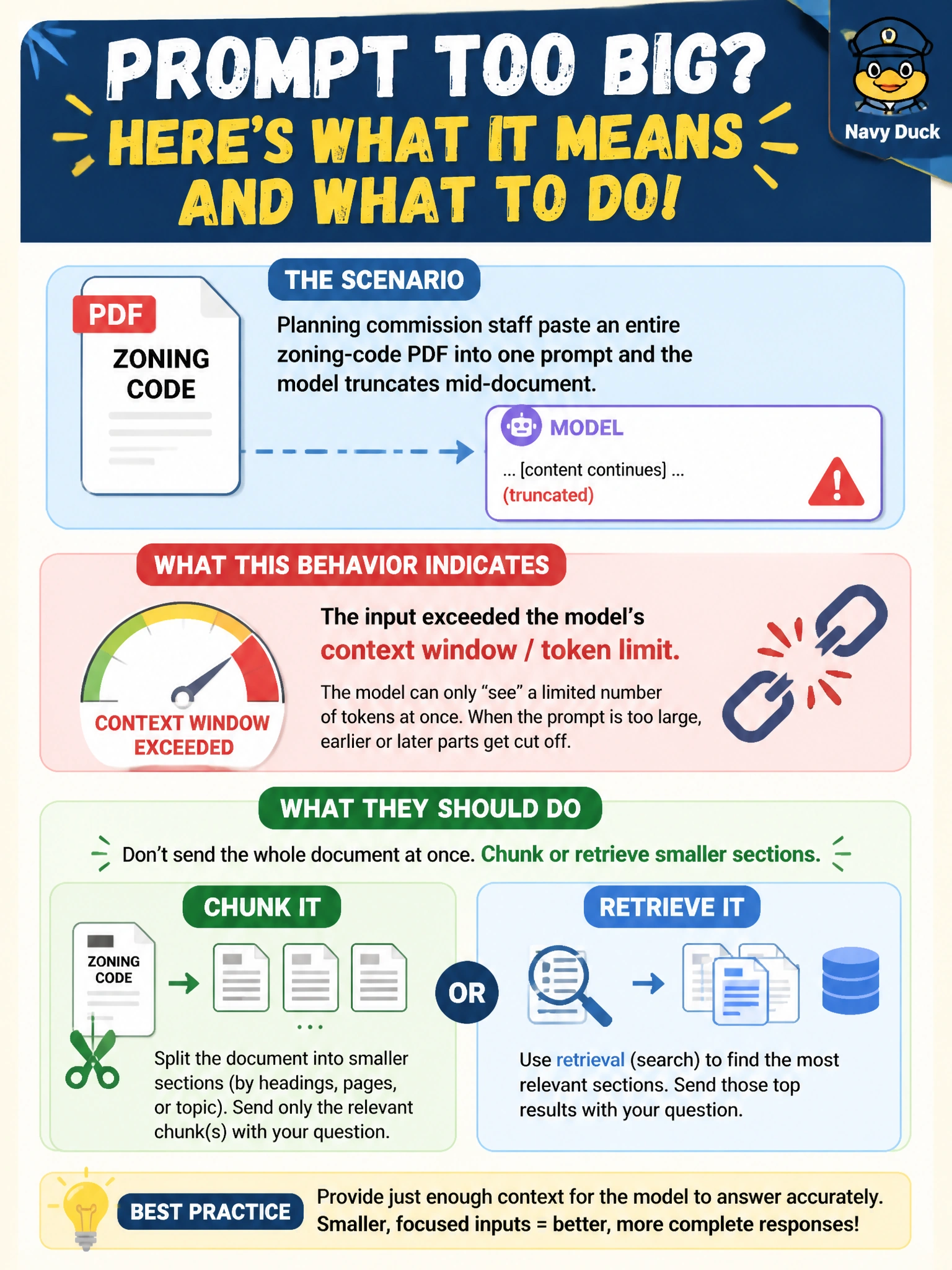
Planning commission staff paste an entire zoning-code PDF into one prompt and the model truncates mid-document. What does that behavior indicate, and what should they do?
Select an answer to reveal the explanation.
Short Explanation
Your model has room for only so many tokens, so pasting the whole zoning code can make the input exceed its context window. Chunk the PDF or retrieve the smaller sections you need instead of sending one giant paste.
Full Explanation
Truncation midway through an entire zoning-code PDF indicates that the input exceeded the model’s context window, or token limit. Staff should split the code into chunks or retrieve smaller relevant sections rather than paste the whole document at once. A context window bounds how much text a generative model can consider in a single request. Oversized municipal codes are common, and useful patterns include section chunking, hierarchical summarization, and retrieval-augmented generation over the adopted ordinance corpus. Treating truncation as a policy filter on zoning content and switching to a general-purpose model with fewer restrictions misdiagnoses a technical limit as a content ban; the symptom does not show that the material is prohibited. Assuming the PDF was encrypted and must be emailed to the vendor confuses a context limit with encryption and creates a data-handling risk. Believing context windows are infinite and that buying more monitors will fix truncation is technically false and operationally useless. Exam caveat: recognize mid-input drop-off as a generative-model constraint, not evidence of a policy refusal. Practical check: measure tokens before sending, split the code by article, retrieve the cited sections, verify answers against the official PDF, and remind planning staff that pasting the entire code is an unreliable pattern for civic Q&A.