
A city CIO office notices that a clerk chat assistant gives weaker, less relevant answers late in a long shift as the conversation history piles up. What is the most likely cause to address first?
Select an answer to reveal the explanation.
Short Explanation
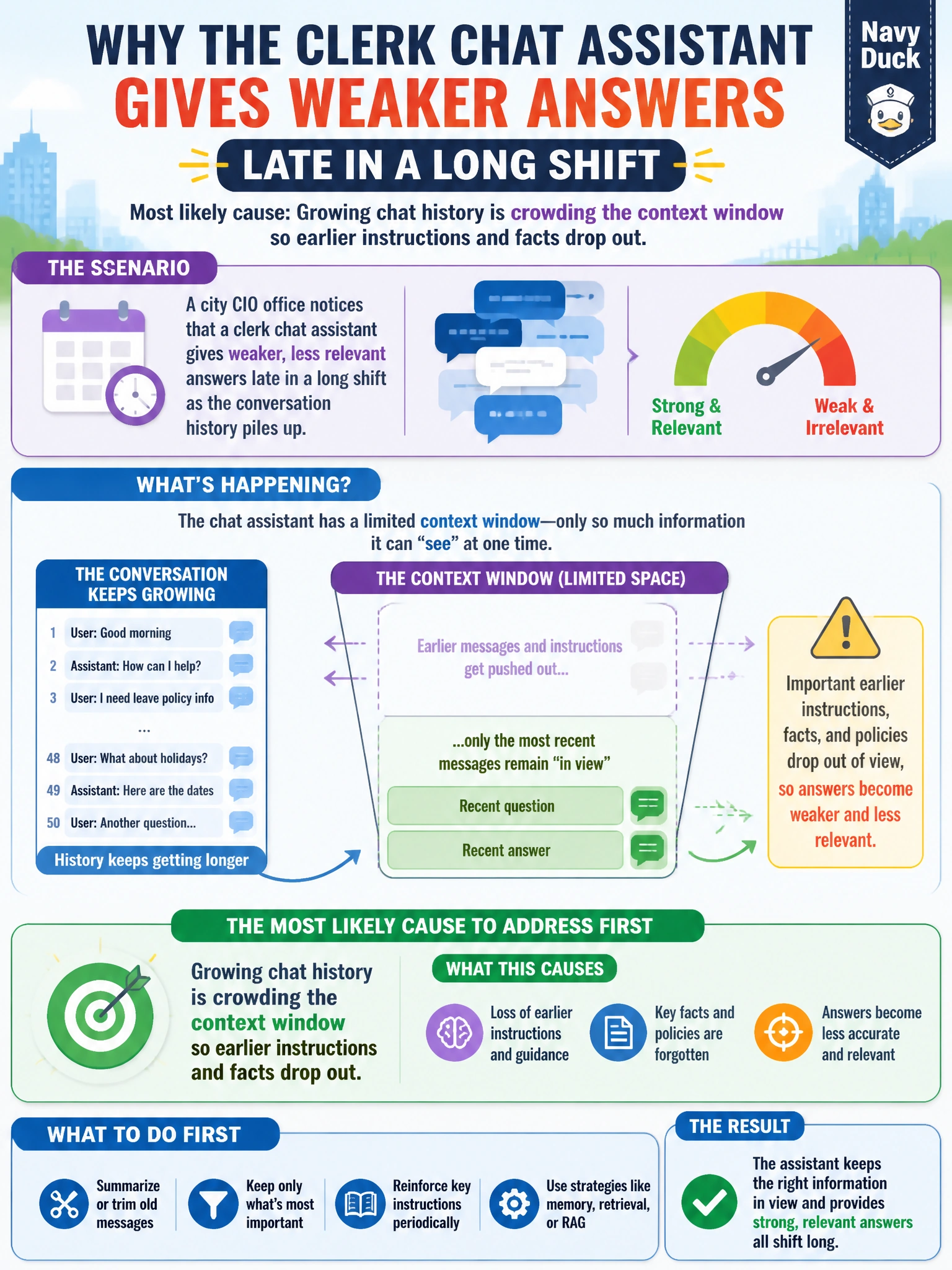
Picture a whiteboard that only holds so many sticky notes. As the shift chat keeps adding notes, the early ones fall off the board—and those early notes were often the rules. Shrink or summarize history so the window still holds what matters.
Full Explanation
In a municipal clerk chat session, every system instruction, retrieved fact, user turn, and prior assistant reply competes for space inside one finite context window. As the shift conversation grows without trimming, older tokens are truncated or diluted—often the very opening rules, ordinance citations, and case facts that kept early answers on policy. That crowding is the first-order cause of weaker, less relevant replies late in a long CIO-office shift, so history management (summarize, slide-window, or reset) is the remediation to try before chasing infrastructure myths.
Blaming a diffusion model used for flyer art for competing on the same GPU queue misattributes a text-session quality drop to an unrelated image workload; even if GPUs are shared, the symptom described is progressive loss of earlier conversational content, not inference queue contention. Municipal Wi-Fi throttling TLS handshakes to a model hub would typically cause timeouts, stalls, or connectivity errors—not a gradual slide from relevant to weaker answers as history piles up. Requiring a separate InfiniBand fabric between clerk desktops and the model confuses high-performance cluster interconnect design with conversational context limits; desktop-to-API latency fabric is not what drops early instructions from the prompt.
Exam caveat: context-window pressure is not the same as the model "forgetting" municipal policy permanently after one reply; the weights still hold parametric knowledge, but tokens no longer present in the active window cannot steer the next generation. Operational check: instrument prompt token counts over a shift, sample late-shift failures for missing early constraints, and enforce summarization or periodic re-injection of standing rules so the clerk assistant stays usable through peak volume.