
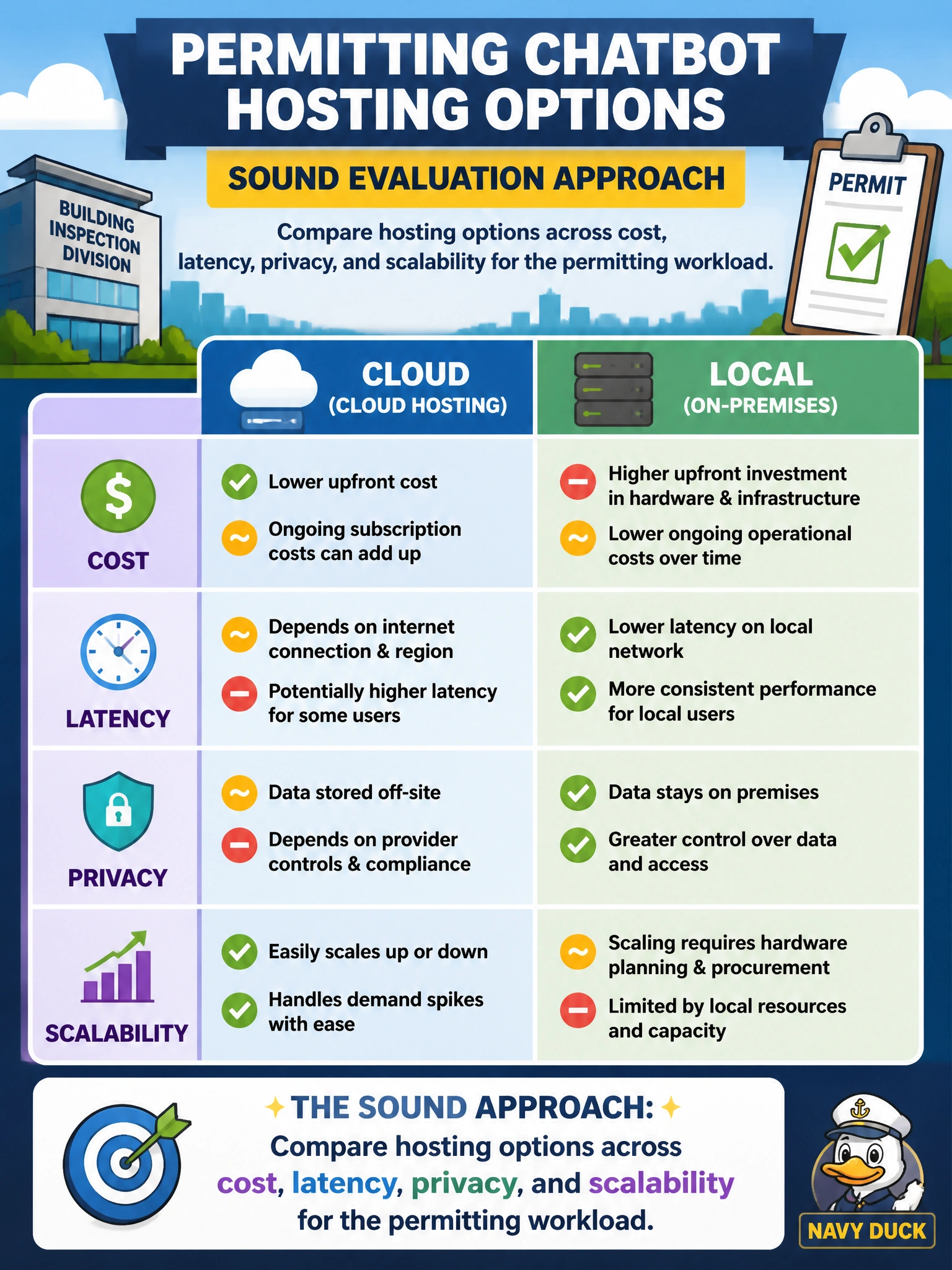
A building inspection division scores cloud versus local options for a permitting chatbot on cost, latency, privacy, and scalability. What is the sound evaluation approach?
Select an answer to reveal the explanation.
Short Explanation
Don’t crown a winner on one scoreboard. Price, speed at the counter, privacy, and room to grow all matter—score the permitting bot on the whole card, not just the cheapest tokens.
Full Explanation
The sound evaluation approach is to compare cloud versus local options across cost, latency, privacy, and scalability for the concrete permitting chatbot workload—not to optimize a single metric in isolation. Building-inspection chatbots face counter latency expectations, sensitive applicant data, budget limits, and seasonal permit volume; multi-factor scoring mirrors how practitioners should choose hosting for civic assistants. Optimizing only for the cheapest token price and ignoring privacy can place applicant data in unacceptable processing environments and create compliance findings. Optimizing only for peak theoretical FLOPS while ignoring latency at the counter favors bench-marketing over resident experience during busy permit hours. Picking randomly because hosting trade-offs never matter in government is false—trade-offs are central to civic AI operations and auditability. Exam caveat: expect questions that punish single-metric thinking; name the factors explicitly and tie each to the municipal workload described in the stem. Operational check: build a weighted scorecard with privacy and legal input, measure counter-latency pilots on real permit FAQs, model cost at expected queries-per-second, test scale for permit-season peaks, and record the decision rationale in IT governance artifacts so future changes can be re-scored.