
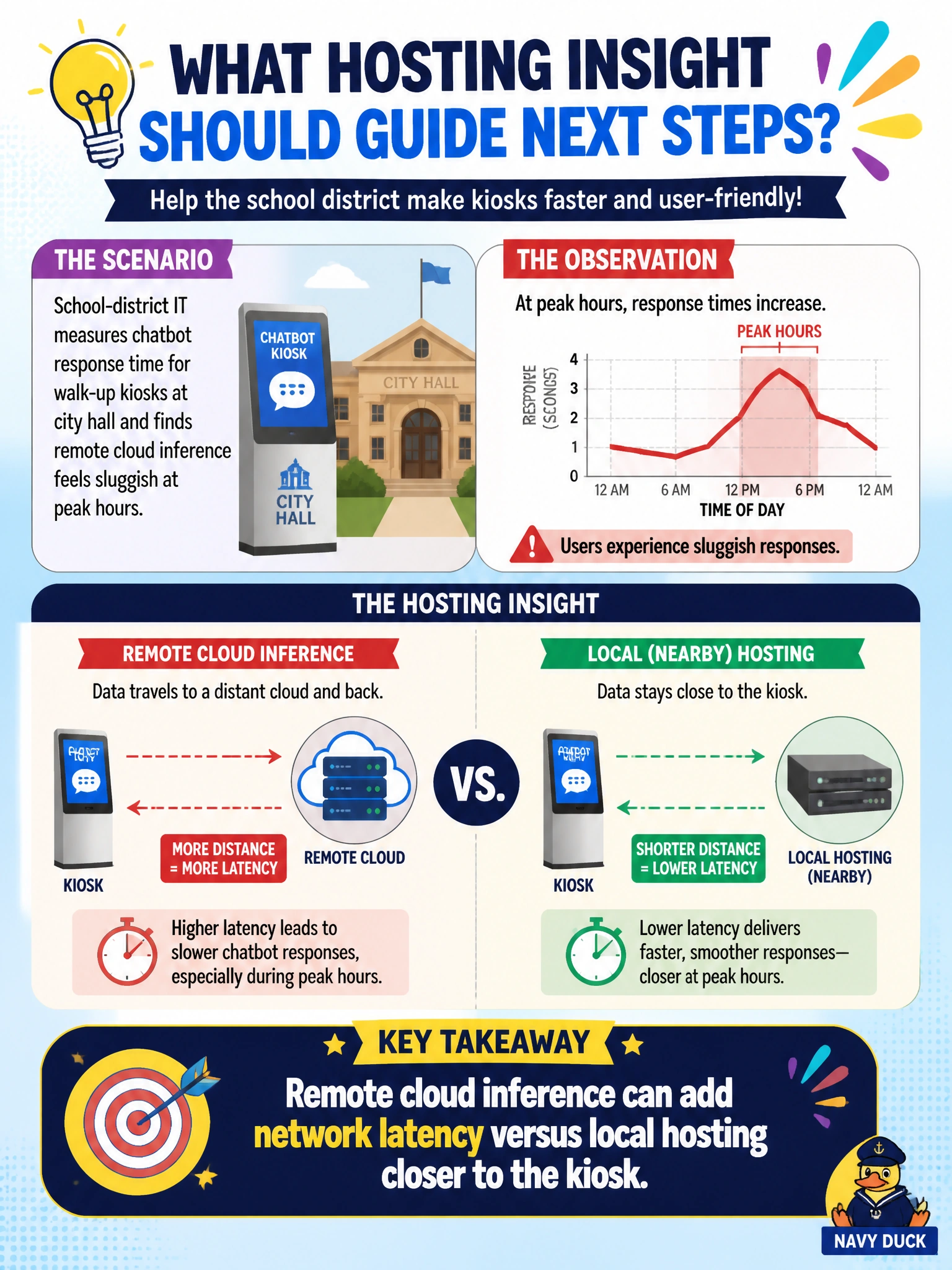
School-district IT measures chatbot response time for walk-up kiosks at city hall and finds remote cloud inference feels sluggish at peak hours. What hosting insight should guide next steps?
Select an answer to reveal the explanation.
Short Explanation
Every hop across the internet is another pause before the kiosk answers. If peak-hour cloud feels laggy, remember: local inference sits next door; remote sits across town on the network.
Full Explanation
Remote cloud inference can add network latency versus local hosting closer to the kiosk: each round trip across the WAN or Internet delays chat turns and can degrade interactive library or lobby experiences at peak hour. Hosting location is an explicit latency trade-off. Local inference shortens the path from kiosk to model; remote cloud adds hops, TLS handshakes, and shared congestion that users feel as sluggish replies when lines form. Saying latency is irrelevant for interactive kiosk users ignores observed usability—residents abandon slow counters and self-service stations when answers lag. Claiming only InfiniBand between racks can ever improve chat latency overstates one datacenter fabric choice and ignores the simpler remedy of placing inference nearer the user. Asserting that cloud always has lower latency than any local deployment is false; geographic and network proximity often win for chatty civic UIs. Exam caveat: cloud may still win on scale or operational simplicity, but latency must be measured against a kiosk SLO—not assumed away because the vendor is ‘fast in the brochure.’ Operational check: instrument p95 and p99 response time at the kiosk during peak hours, compare a local small-model pilot to the cloud endpoint on identical prompts, consider hybrid routing (local for interactive FAQ, cloud for heavy batch), and set UX thresholds before citywide rollout.