
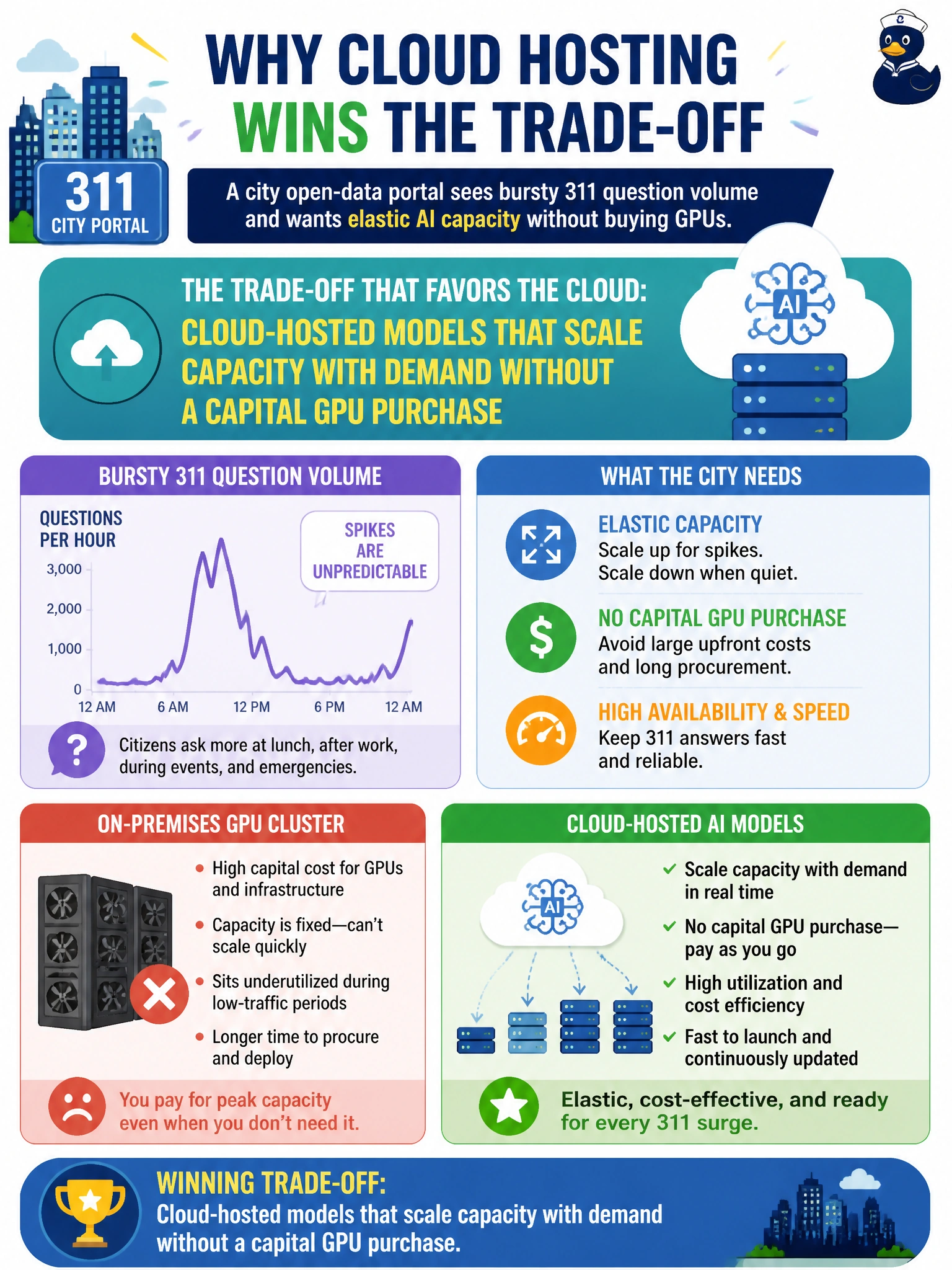
A city open-data portal sees bursty 311 question volume and wants elastic AI capacity without buying GPUs. Which hosting trade-off favors the cloud?
Select an answer to reveal the explanation.
Short Explanation
Bursty 311 traffic is like a parade day for servers—you need more lanes for an hour, not a permanent parking garage of GPUs. Cloud hosting flexes with the crowd; fixed local boxes don’t.
Full Explanation
Bursty 311 question volume on an open-data portal favors cloud-hosted models that scale capacity with demand without a capital GPU purchase: elasticity is the hosting trade-off that matches flash crowds after outages, storms, or viral local news. Cloud inference lets the city expand tokens and queries-per-second for the spike and contract afterward, avoiding hardware sized permanently for rare peaks while still serving residents when interest surges. Fixed on-prem GPUs that sit idle between bursts impose capital and operations cost for capacity unused most days, which poorly matches bursty civic traffic. A single workstation model that cannot scale horizontally becomes a bottleneck precisely when residents need answers most and ticket queues grow. Air-gapped local inference that cannot add capacity during spikes protects isolation but fails the scalability requirement stated in the stem for open-data FAQ load. Exam caveat: choosing cloud for scale assumes policy allows the data class involved; elasticity does not override privacy rules for sensitive case content that must stay local. Operational check: configure autoscaling with hard budget caps, cache frequent 311 FAQ answers, monitor latency and error rates during drills that simulate portal spikes, and document which question classes may go to cloud versus must remain on city-controlled hosts.