
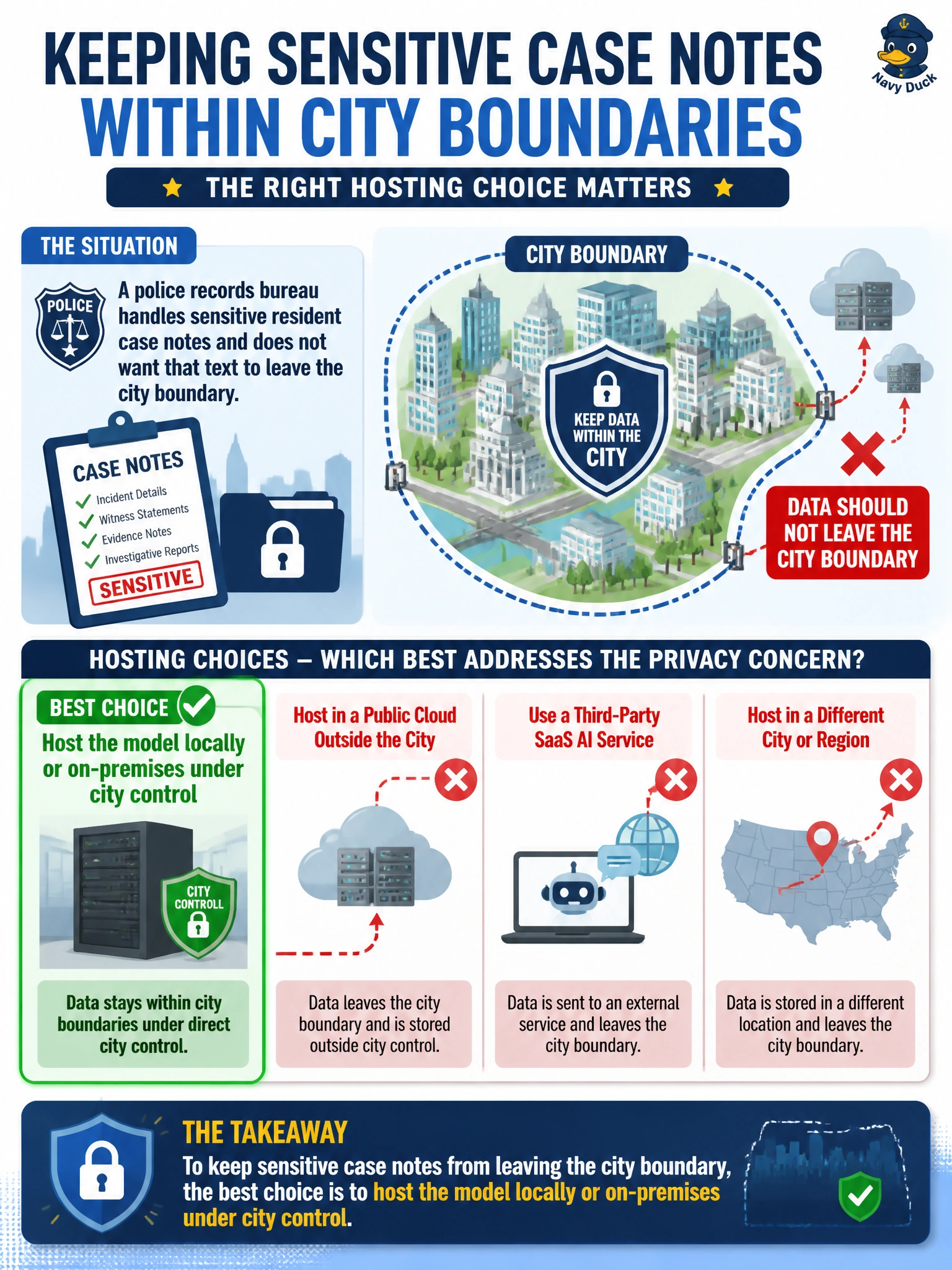
A police records bureau handles sensitive resident case notes and does not want that text to leave the city boundary. Which hosting choice best addresses that privacy concern?
Select an answer to reveal the explanation.
Short Explanation
If the notes can’t leave town, the model has to live in town. Local or on-prem hosting keeps sensitive case text under city control—public chatbots and random overseas endpoints do the opposite.
Full Explanation
When a police records bureau must keep sensitive resident case notes from leaving the city boundary, hosting the model locally or on-premises under city control best addresses that privacy constraint. Local/on-prem inference keeps prompts and outputs within municipal custody, aligning with records sensitivity, discovery risk, and residency expectations for law-enforcement-adjacent text. Sending all notes to a consumer public chatbot with no contract exports sensitive content to an uncontrolled third party with opaque retention. Posting redacted samples to an unmoderated model hub for ‘testing’ still risks residual identifiers and uncontrolled redistribution. Emailing full case files to a free overseas inference endpoint violates custody, residency, and often criminal-justice information policies. Exam caveat: privacy-driven hosting is a first-class generative design choice—not an afterthought once a public chatbot is already in use. Operational check: confirm network egress controls, document data classification for case notes, prefer models that run without mandatory telemetry offsite, involve legal/privacy and CJIS-aware staff where applicable, and test that prompts never traverse unsanctioned SaaS paths.