
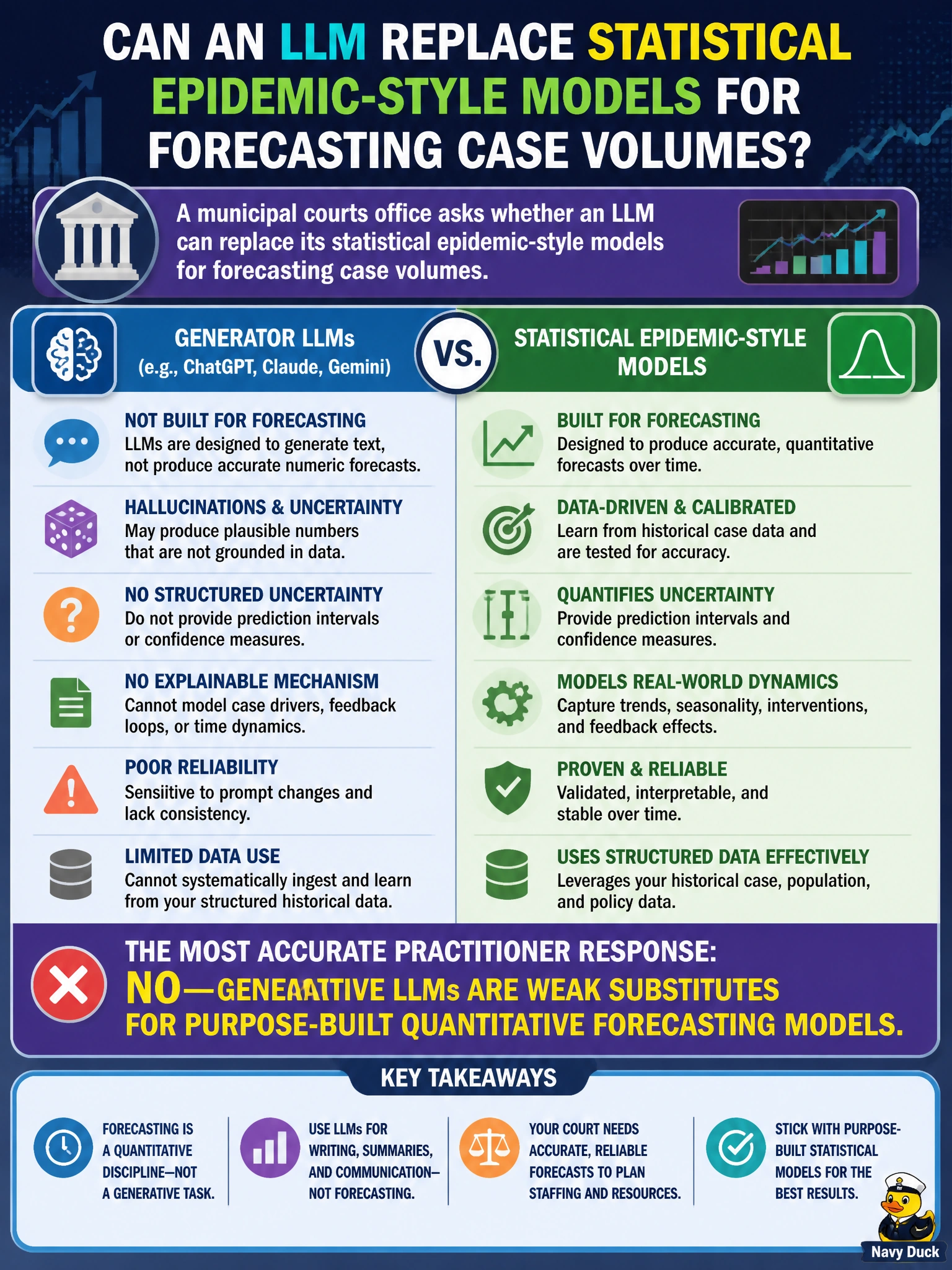
A municipal courts office asks whether an LLM can replace its statistical epidemic-style models for forecasting case volumes. What is the most accurate practitioner response?
Select an answer to reveal the explanation.
Short Explanation
Chat models are wordsmiths, not crystal balls with error bars. For case-volume forecasts you still want real statistical or time-series tools. An LLM can explain a chart—it shouldn’t be the chart’s engine.
Full Explanation
The accurate practitioner response is no: generative LLMs are weak substitutes for purpose-built quantitative forecasting models when municipal courts need calibrated case-volume projections. Forecasting for staffing and docket planning requires statistical rigor, uncertainty intervals, and methods tuned to time-series structure. LLMs generate fluent text; they do not reliably replace calibrated epidemic-style or classical forecasting systems for numeric planning. Claiming any generative chat model is a drop-in replacement for calibrated forecasts overstates LLM capability and risks bad resource decisions. Asserting LLMs always outperform time-series models on numeric projections is unsupported and exam-wrong. Believing polite prompting eliminates forecast error confuses conversational UX with statistical validity. Exam caveat: generative models may narrate or explain forecast outputs, but narration is not the forecasting engine. Operational check: keep official volume forecasts on validated time-series or statistical pipelines with backtesting; if staff use an LLM, limit it to drafting explanations of already-computed figures, require numeric citation from the forecasting system, and never let chat output alone drive overtime or courtroom scheduling.