
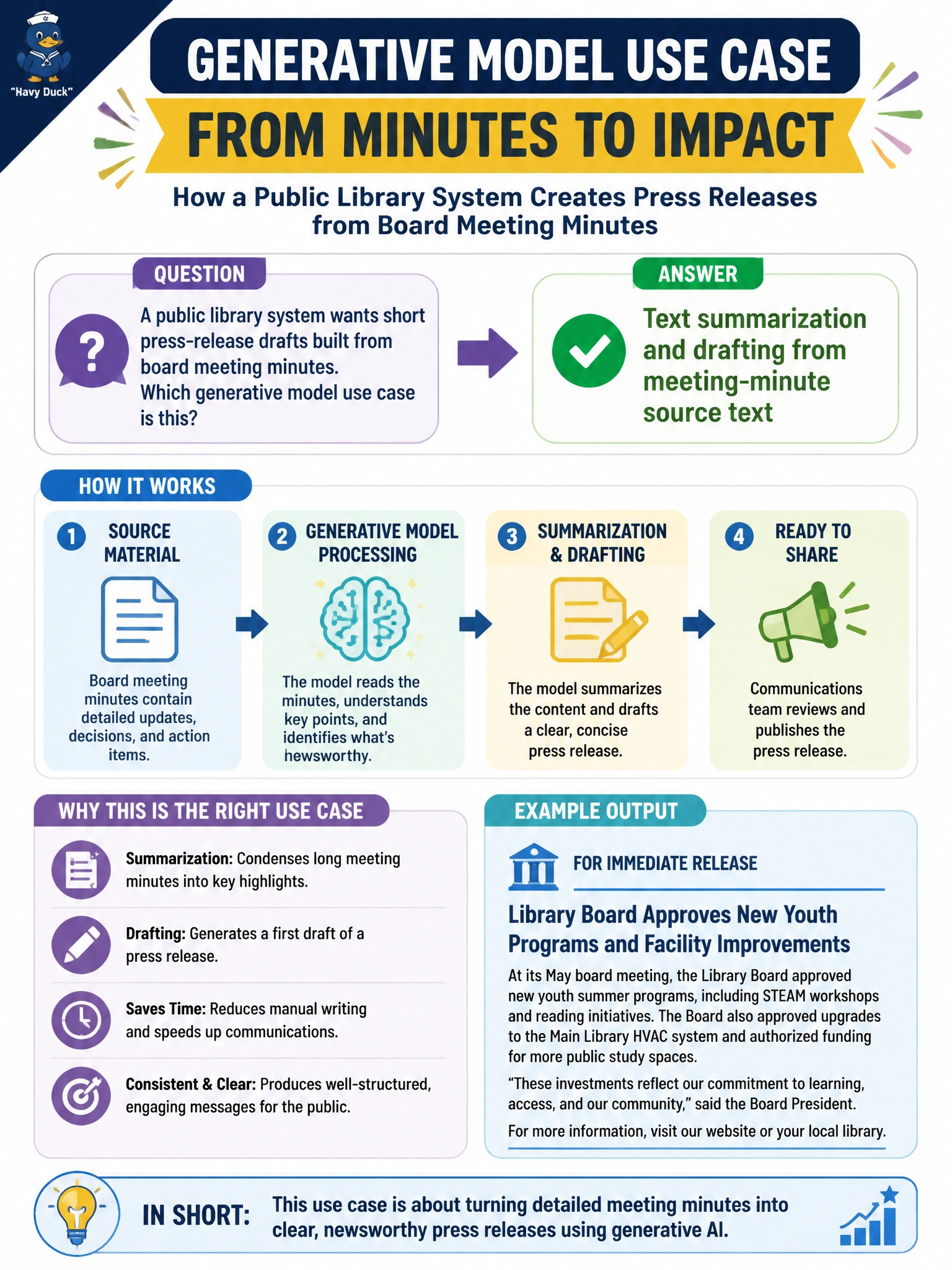
A public library system wants short press-release drafts built from board meeting minutes. Which generative model use case is this?
Select an answer to reveal the explanation.
Short Explanation
Minutes in, tidy press release out—classic “read this pile and write something shorter.” That’s LLM summarization and drafting, not camera vision or thermostat learning.
Full Explanation
Building short press-release drafts from board meeting minutes is text summarization and drafting: a generative language model condenses source minutes into public-facing narrative the library system can edit and approve. Minutes are long and procedural; press releases need clarity, quotes, and resident-relevant outcomes. LLMs accelerate that transformation while communications staff remain accountable for accuracy and tone. Anomaly detection on HVAC sensor streams is facilities analytics, not communications drafting. Object detection on bookshelf camera feeds is computer vision for inventory or security, unrelated to writing press releases. Reinforcement learning for HVAC setpoints optimizes building controls and has no bearing on generative text from minutes. Exam caveat: correctly naming the generative use case (summarization/drafting) prevents tool sprawl into unrelated ML families when the stem is about writing from text. Operational check: require communications review before publication, check quotes and vote outcomes against the official minutes, avoid inventing attributions, retain the source minute IDs with each draft, and watch for context-window truncation on lengthy meetings by summarizing section-by-section.