
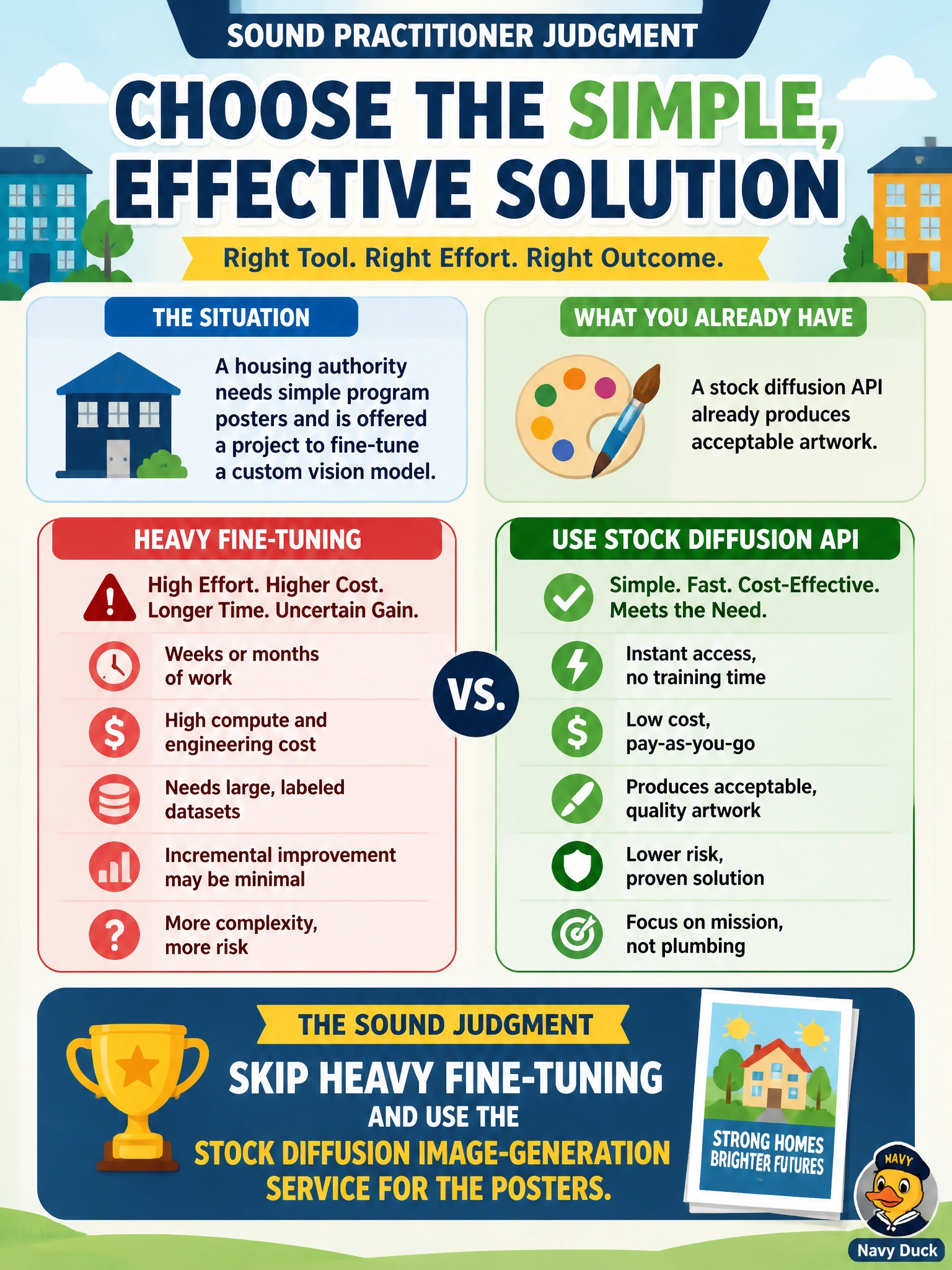
A housing authority needs simple program posters and is offered a project to fine-tune a custom vision model. A stock diffusion API already produces acceptable artwork. What is the sound practitioner judgment?
Select an answer to reveal the explanation.
Short Explanation
Don’t build a custom race car to drive to the corner store. If a ready-made image API already makes decent posters, use it. Fine-tuning a vision model (or inventing data-center fabric work) is overkill for simple creative art.
Full Explanation
Sound practitioner judgment prefers skipping heavy custom vision fine-tuning when a stock diffusion API already produces acceptable program posters for the housing authority. Match effort to outcome: simple creative artwork for resident program marketing rarely justifies months of fine-tuning, labeled datasets, and MLOps when an off-the-shelf image-generation service meets quality bars. Mandating a multi-month vision fine-tune before any poster ships delays public communication without clear benefit when stock quality is already good enough. Replacing posters with a tabular credit-scoring model confuses an unrelated predictive task with a creative generative need. Requiring on-prem InfiniBand fabric before generating any artwork invents data-center prerequisites that are irrelevant to producing simple marketing graphics. Exam caveat: generative practice includes knowing when not to build—use-case fit and cost of customization matter as much as model capability. Operational check: define an acceptance rubric (brand colors, readability, no harmful imagery), compare a short stock-API pilot to a custom-train estimate in dollars and weeks, keep human brand review, and revisit fine-tuning only if stock outputs systematically fail accessibility or brand constraints.